Most people who ask this question share one constraint: they can spend a week or two in Vietnam, not eighteen months in an orthodontist’s chair. Veneers look like the obvious shortcut, and sometimes they are. Other times they cover a problem that braces or aligners should have solved first.
The two routes do different jobs. Braces and clear aligners move teeth into new positions, which takes months because bone has to remodel around each root. Veneers are thin ceramic shells bonded to the front surface of teeth, so they change how teeth look without changing where the roots sit. A crooked smile can be corrected visually within one short trip, but only when the problem is cosmetic enough for that to be an honest description.
This guide explains which kinds of crooked teeth suit veneers, which need braces or aligners first, how long each route takes, what veneers cost at Delia Dental Clinic, and what to send before you book a flight.
Quick Answer
Veneers can visually correct mildly crooked, rotated or unevenly spaced front teeth within one trip, while braces and aligners physically move teeth over many months. Veneers suit minor to moderate cosmetic crowding when gums and bite are healthy. Heavy crowding, a faulty bite or badly rotated teeth usually need orthodontic assessment first.
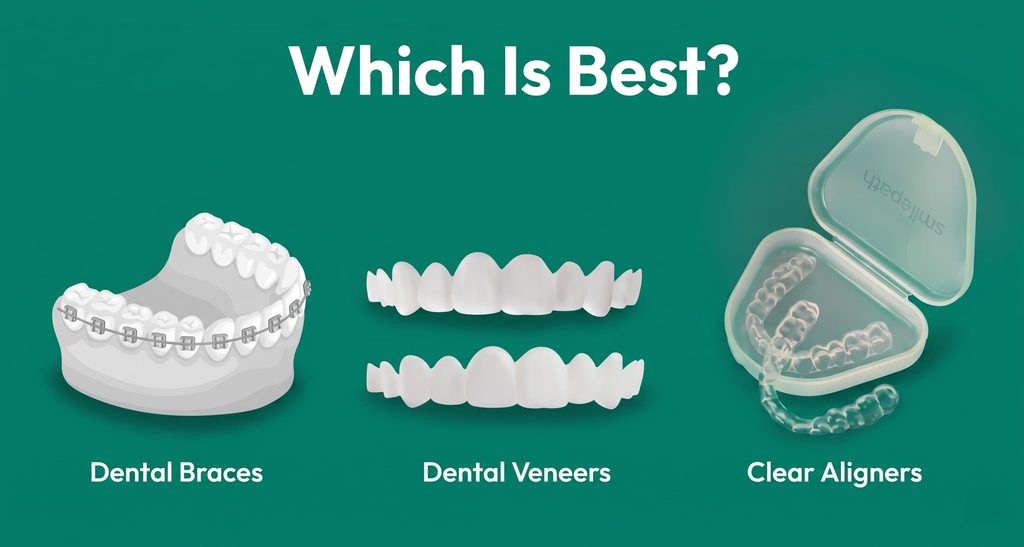
What Veneers, Aligners and Braces Each Change
Orthodontic treatment asks where the teeth should sit. Veneers ask how the visible surface of the teeth should look. Mixing the two up is how patients end up with a smile that looks straight in photos but feels wrong when they bite.
| Factor | Veneers | Clear aligners | Braces |
|---|---|---|---|
| What changes | Shape, size, colour and apparent alignment of the front surface | Actual tooth position | Actual tooth position and often the bite |
| Root position | Unchanged | Moved gradually | Moved gradually |
| Typical time | Commonly 5 to 10 days of clinic work in one trip | Often several months to over a year | Commonly 12 to 24 months |
| Enamel | A thin layer is usually shaped | Not removed | Not removed |
| Reversibility | Not fully reversible once enamel is shaped | Teeth can relapse without retainers | Teeth can relapse without retainers |
| Fixes bite problems | No | In selected cases | Often yes |
| Visits needed | One trip for most cases | Regular check ins with a provider | Regular adjustments with an orthodontist |
The first two rows decide most short trip cases. A veneer can only disguise misalignment within the limits of what a thin shell can reshape. It cannot pull a tooth forward or push it back, and a plan that pretends otherwise ends in a bulky result.
Which Crooked Teeth Can Veneers Cover?
The deciding factor is how far a tooth sits from where it should be. Small offsets can be hidden by reshaping the visible surface. Large offsets force the dentist either to remove a lot of tooth or to build the veneer out until it looks heavy.
Cases That Usually Suit Veneers
Veneers tend to work well when the problem is cosmetic and the foundation is healthy:
- Mild crowding where front teeth overlap slightly
- A tooth turned a few degrees that catches the light differently from its neighbours
- Small uneven gaps between front teeth
- Teeth of different lengths or worn edges alongside mild crookedness
- Patients who also want a colour or shape change, since one set of veneers can fix several complaints
In these cases a plan covering six to eight upper teeth can often be completed in a single trip, and the patient leaves with a visibly straighter, more even smile.
Cases That Usually Need Braces or Aligners First
Some situations call for orthodontic treatment, either before veneers or in place of them:
- Moderate to severe crowding, where teeth overlap by more than a sliver
- A bite that does not meet properly, including crossbites and open bites
- A tooth sitting well outside the arch, which would need heavy reduction to line up
- Gum disease or loose teeth, which need stabilising before any restoration
- Patients who want to keep their natural tooth structure untouched
None of this rules veneers out forever. Many patients straighten with aligners at home, then come to Vietnam for veneers that refine shape and colour on teeth that already sit close to where they belong. Each treatment then does what it does best.
How Much Tooth Is Removed to Straighten a Smile With Veneers?
Minimal preparation veneers usually stay within the outer enamel, often removing around 0.2 to 0.5 millimetres. Enamel does not regrow, so even this small amount makes the tooth a veneer tooth for life, but it leaves most of the natural structure and the nerve untouched.
Crooked teeth complicate that picture. A tooth that sticks out may need more reduction than its neighbours, and a tooth set back may need a thicker veneer to bring it level. Placing veneers over crowded or rotated teeth without any contouring tends to produce a bulky look that traps food and irritates the gums. Some selective shaping is therefore normal in a crooked case. The question to ask is how much, and why, for each tooth.
Patients who have seen overprepared teeth from work done elsewhere are often alert to this, and the guide to minimal prep veneers in Vietnam covers what to ask a clinic about tooth reduction. A good clinic explains the planned depth tooth by tooth and shows a mock up before any enamel is touched. If the plan calls for heavy reduction to hide significant crowding, that is a strong signal to consider straightening first.

How Long Does Each Option Take, and Does It Fit a Short Trip?
For most overseas patients, time decides the question, so it helps to line the routes up against a realistic trip.
| Route | Time commitment | Fits one short trip? |
|---|---|---|
| Veneers, 1 to 2 teeth | Around 5 to 7 days | Yes, for suitable cases |
| Veneers, 6 to 10 teeth | Around 7 to 10 days | Yes, for suitable cases |
| Veneers, 10 or more teeth or upper and lower | Around 10 to 14 days | Usually, with a longer stay |
| Clear aligners | Several months to over a year, with check ins | No, treatment happens at home |
| Braces | Commonly 12 to 24 months with regular adjustments | No, treatment happens at home |
| Aligners or braces at home, then veneers | Orthodontic stage at home, then one veneer trip | Yes, for the veneer stage |
These veneer ranges assume healthy teeth and gums. Active decay, gum inflammation, old fillings or crowns that need replacing, or whitening that has to settle before shade selection can all lengthen the trip. A detailed breakdown of how many days veneers take in Vietnam covers the stages and sample schedules.
Clinic time is concentrated around the consultation, preparation, try in and final bonding. The days in the middle are lab days, so patients usually have free time as long as they stay reachable for appointments. Veneers normally do not need a second trip months later, which is a real difference from implants. Leave at least one or two buffer days after the expected final bonding, especially for six or more veneers, instead of booking a flight home for the same day.
Aligners are harder to fit around a holiday. They need regular check ins with whoever is supervising the treatment, and starting in one country and continuing in another depends on a clean handover of records. Most short trip patients are better served by choosing one place to run the alignment stage, usually at home, and treating the Vietnam trip as the veneer stage.
What Veneers Cost in Vietnam for a Crooked Smile
Veneer pricing is per tooth, so the total depends on how many teeth show when you smile. Delia Dental Clinic’s standard prices are USD 300 per tooth for E.max Press veneers and USD 550 per tooth for LiSi veneers. These prices include consultation, a scan or impression, a mock up, a temporary restoration and a try in. Root canal treatment, core buildup or gum treatment are case dependent and billed separately if needed.
An illustrative calculation shows how the numbers scale:
| Teeth treated | E.max Press at USD 300 | LiSi at USD 550 |
|---|---|---|
| 4 teeth | USD 1,200 | USD 2,200 |
| 6 teeth | USD 1,800 | USD 3,300 |
| 8 teeth | USD 2,400 | USD 4,400 |
These figures are component calculations, not a final quote. Whitening, gum contouring, bite adjustments and any preliminary treatment change the total, which is why a written itemised quote after examination is the number to plan around. More on how the pieces add up is in the veneer cost guide for Vietnam.
Orthodontic prices vary widely by country, provider and case complexity, so a fair comparison needs a written quote from your local orthodontist for the same teeth. Keep in mind that veneers and braces do not buy the same result. If your teeth need to move, the cheaper option is the one that actually solves the problem.
Judging the Result at Mock Up and Try In
For a crooked smile, two appointments matter most, and they allow different changes.
The mock up comes first, before any enamel is shaped. A temporary version of the planned shapes sits over your teeth so you can judge how straight the smile looks, how thick the teeth appear and whether the proportions suit your face. At Delia Dental Clinic, Digital Smile Design, a mock up and a try in are part of the planning workflow for cosmetic cases. This is the stage to decide on length, width and overall shape, because those are built into the ceramic once fabrication starts.
The try in comes later, with the finished veneers. Shade can often still be adjusted through the resin cement, and minor margin, polish and bite contact issues are usually corrected chairside. Changes to length, shape or proportion generally mean sending the veneer back to the lab, which adds days to the trip. What can still change at veneer try in sets out which concerns fall on which side.
When you view the mock up, check whether the front teeth look wider or bulkier than your natural ones, since crooked teeth can push a plan toward extra thickness. Check how your lips close over the new shapes and whether speech feels normal. A bulky preview on a tooth that sits far out of line is useful information. It may mean that tooth should be moved first.
How Delia Dental Clinic Reviews Crooked Teeth Before You Book a Flight
For crooked teeth, the first thing the international patient team at Delia Dental Clinic looks at is whether the problem is mostly cosmetic or mostly positional. That single judgement decides whether a one trip veneer plan is realistic or whether teeth should be moved first.
Before booking, patients can send clear photographs to WhatsApp or Messenger so the team can form a preliminary view:
- A front smile photo with teeth together, and another with a wide smile
- Side photos of the left and right bite
- Close ups of the teeth that concern you most
- Any recent dental X-rays you already have
- Notes on past braces, aligners or retainers
- An existing quote or treatment plan from another clinic, if you have one
From those, the team can suggest whether veneers look suitable, roughly how many teeth might be involved and what stay to plan for at the Hanoi or Ho Chi Minh City clinic. Where the photos suggest teeth should be moved first, the team can advise on the alignment options and how they would fit around a later veneer trip, and the specific alignment services available are confirmed during consultation. English speaking coordinators handle the planning conversation before you travel.
Photos cannot confirm gum health, bite behaviour or how much enamel each tooth can spare. Those are settled at an in person examination with imaging where needed, covering decay, gum condition and bite before the final plan and itemised quote are confirmed. If whitening is part of the plan, it is usually completed before the final shade is chosen, since natural teeth whiten and veneers do not.
Frequently Asked Questions
Can Veneers Fix Crooked Teeth Permanently?
Veneers correct the appearance of crooked teeth for as long as the veneers last, but they do not move the teeth underneath. The shells can chip, wear or discolour at the edges over time and may eventually need replacing. Good home care and regular check ups extend their life, and patients who grind their teeth should raise that before treatment because it affects how the plan is built.
Will Veneers Make My Teeth Look Bulky if They Are Crooked?
They can, if the plan tries to hide too much misalignment. A tooth that sits forward gets thicker when a veneer goes on without reducing it first, and a tooth set back needs extra thickness to line up. The mock up shows this before anything is final, so a bulky preview on a particular tooth is a sign to discuss moving that tooth first.
Can I Get Veneers After Braces or Aligners?
Yes, and it is a common sequence. Straightening first moves the teeth close to their ideal positions, so veneers can focus on shape, colour and proportion with less enamel reduction. You will normally wear a retainer afterwards, and your dentist will advise on timing so the teeth are stable before veneers are made.
Can Veneers Replace Braces Entirely?
Only for mild cosmetic cases. Veneers do not change the bite or fix teeth that sit significantly out of line, so a case with a bite problem or heavy crowding is better served by orthodontic treatment first. A short review of photos is usually enough to show which group you fall into.
How Many Teeth Do I Need to Treat to Straighten My Smile?
It depends on how far the crookedness extends across the visible arch, but treatment usually covers the teeth that show when you smile. Treating a single crooked tooth can make its neighbours look different in shade or shape, so many plans include several teeth for a balanced result. The dentist decides this tooth by tooth after examination.
Should I Whiten My Teeth Before Starting Aligners and Veneers?
Whitening is normally planned before the final veneer shade is chosen, because natural teeth respond to whitening and ceramic does not. If you plan to straighten first, ask your dentist when whitening should happen so the shade can settle before you travel for veneers. Active decay and gum problems also need treatment before any cosmetic restoration.
Can Delia Dental Clinic Tell From Photos Whether Veneers Will Work?
Photos allow a preliminary direction, such as whether the crookedness looks mild enough for veneers or likely to need orthodontic treatment. They cannot show how healthy your gums are, how your teeth meet when you bite or how much enamel is available. The final decision comes after an in person examination and imaging at the clinic.
Planning the Rest of Your Veneer Decision
A few more guides cover the questions that usually follow once you know whether veneers fit your teeth.
- Dental Veneers vs Dental Crowns: Which is Right For You?
- Smile Makeover in Vietnam: Cost, Timeline and Treatment Options
- Porcelain Veneers in Vietnam: Patient Guide
- Replacing Old Veneers in Vietnam
Final Thoughts
The right choice comes down to one question: are your teeth in roughly the right place, or do they need to move? If they are close, veneers can deliver a straighter looking smile within one trip. If they are far out of line, a short trip is the wrong tool, and the time is better spent starting alignment first.
Send your smile photos, side bite photos and any existing X-rays or quotes to Delia Dental Clinic via WhatsApp or Messenger before booking your flight. The international patient team can review them, suggest a preliminary direction and help estimate the likely cost and stay for Hanoi or Ho Chi Minh City. The final treatment plan and quote are confirmed after an in person examination.


