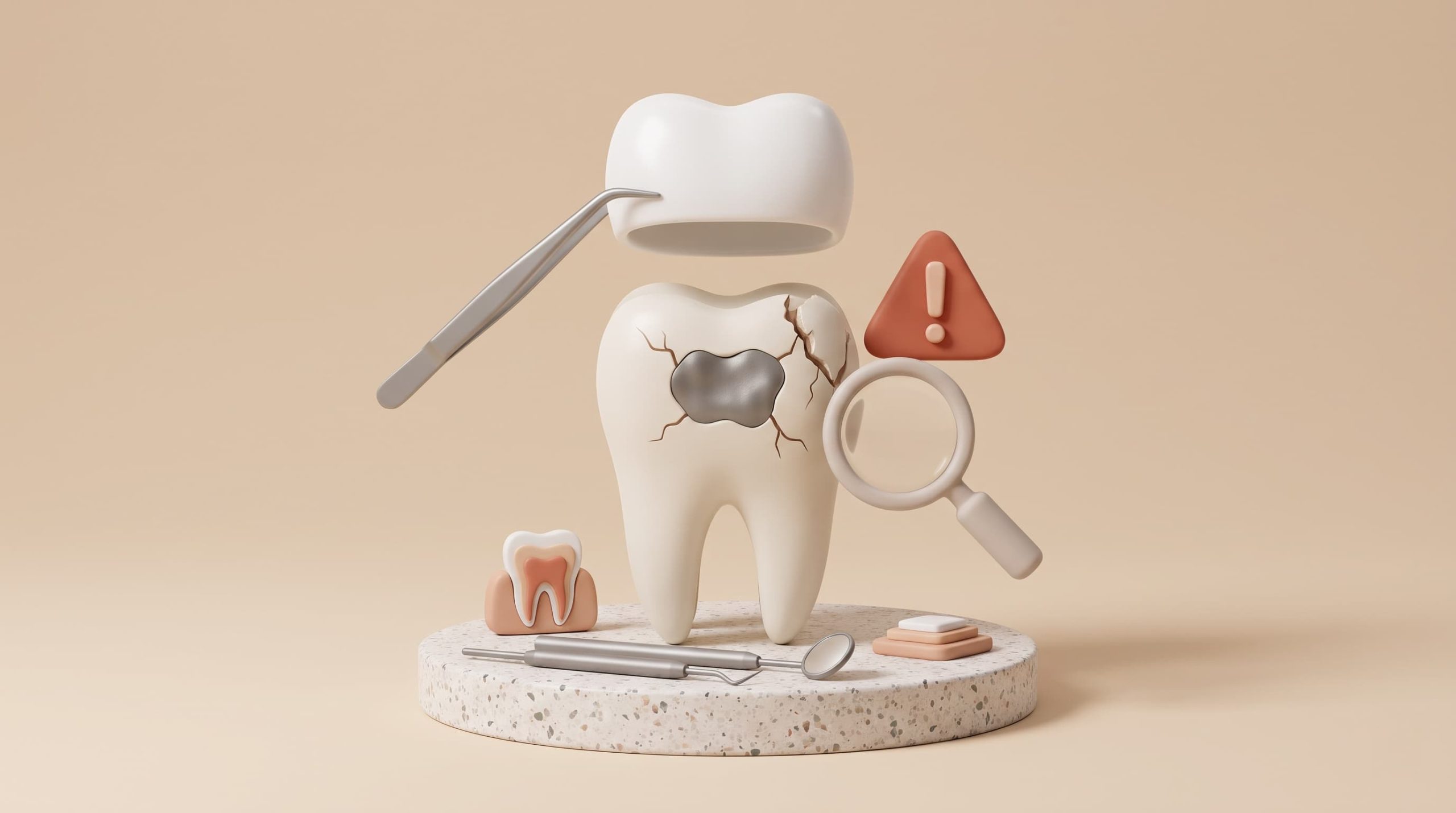
A filling replaces what decay took out of a tooth. It does not hold together what is left. When the cavity was small, that difference barely matters. When the filling spans most of the biting surface, the thin walls of natural tooth around it carry chewing force they were never built to carry alone. That is where cracked cusps, chipped fillings and sudden pain on biting tend to start.
So the filling or crown question is rarely about a fixed size. It depends on how much healthy tooth remains around the filling, whether a crack is present, and whether the tooth has already had root canal treatment. A crown covers the whole tooth above the gum and holds the remaining walls together, which a bigger filling cannot do. Sometimes a filling is still the right choice, and part of a good dentist’s job is saying so.
This guide covers the signs that point toward a crown, the signs that a filling can still do the job, and the red flags that should not wait for a flight. It also explains what international patients can send before travelling and what stays uncertain until the tooth is examined in person.
Quick Answer
A large filling may need a crown when little healthy tooth remains around it, when the tooth has a crack or a broken cusp, when a filling keeps failing, or when the tooth has had root canal treatment. A dentist confirms this by examination and X-rays, because photos alone cannot show a crack.
What a Filling Can and Cannot Do for a Weakened Tooth
A filling can seal a cavity, restore the shape of the tooth and stop decay from spreading. It cannot add strength to the tooth around it. A tooth with a large filling is often described as a tooth with a hollow middle: the outer walls, called cusps, stand on their own and flex slightly under every bite.
Over years, that flexing can create hairline cracks or break a cusp away. Back teeth are the most exposed, because they take the heaviest chewing load and often carry the biggest fillings. Grinding or clenching at night adds force that a thin wall of tooth may not tolerate.
A crown works differently. After the tooth is shaped, the crown wraps around it like a cap, spreading chewing force across the whole tooth instead of leaving each cusp to fend for itself. This is the main reason dentists move from a bigger filling to a crown once the tooth has lost too much of its own structure. If you want to compare crown materials for this purpose, the zirconia crown guide for Vietnam explains where each material tends to fit.
Signs a Large Filling May Need a Crown
No single sign settles the question. A dentist weighs several together, and the table below shows the patterns that most often lead to a crown recommendation.
| Sign | What it may indicate | Usual next step |
|---|---|---|
| Sharp pain when you release a bite | A crack in the tooth or a flexing cusp | Examination, bite testing, X-ray |
| Pain on biting that comes and goes | Possible crack or failing filling | Examination before it worsens |
| A chunk of filling or tooth has broken off | Weakened walls | Crown assessment |
| The same filling replaced more than once | The tooth cannot hold a filling reliably | Discuss full coverage |
| Dark shadow or decay at the filling edge | New decay under or beside the filling | X-ray, then filling replacement or crown |
| Cold or sweet sensitivity that lingers | Decay under the filling or irritated nerve | Examination, possibly root canal assessment |
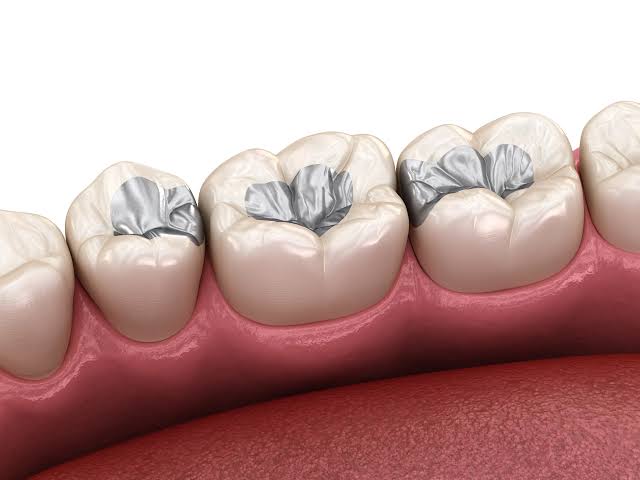
| Filling covers most of the biting surface | Thin remaining walls | Crown or onlay discussion |
Symptoms You Can Notice Yourself
The most useful symptom is pain that appears when you stop biting down rather than while you press. This pattern is commonly linked to a cracked tooth, because the two sides of the crack press together under load and spring apart as the bite releases, which irritates the nerve. It tends to be hard to reproduce on demand, which is why patients often say the pain is unpredictable.
Other everyday clues include a corner of the filling that feels rough against your tongue, food that now packs into a gap that was not there before, and sensitivity to cold that lasts longer than a few seconds. None of these proves a crown is needed. Together with an old, large filling, they are a reason to have the tooth looked at rather than waiting.
What a Dentist Can See That You Cannot
An examination can show cracks under magnification or with a light, worn or chipped filling margins, and cusps that move under pressure. A bite test, where you bite on a small stick or pad placed on one cusp at a time, can pinpoint which part of the tooth reproduces the pain. X-rays can show decay beneath an old filling and how close that decay sits to the nerve.
Cracks, however, often do not appear on standard X-rays, so a clear X-ray does not rule one out. This is one reason remote photo review can only suggest a direction and never settle the decision.
Teeth That Have Already Had Root Canal Treatment
A tooth that has had root canal treatment has usually lost a good deal of structure through decay and through the access opening made to clean the canals. If it is a back tooth, it also takes the heaviest chewing load. For that combination, dentists commonly recommend full coverage rather than relying on a filling alone. If this is your situation, the Delia guide on whether you need a root canal before a crown covers how that decision is made.
Signs a Filling May Still Be Enough
A crown is not an automatic upgrade. Removing tooth structure to fit a crown is a permanent step, so a conservative option is worth choosing when the tooth allows it.
A filling may still be reasonable when the cavity is small to moderate, the cusps are intact and thick, there is no crack, and there are no symptoms on biting. A worn filling with a localised problem, such as a chipped edge or a small area of new decay at the margin, can sometimes be repaired or replaced with a new filling. In these cases the tooth still has enough of its own structure to share the load.
There is also a middle option. Partial coverage restorations, usually called onlays, cover one or more cusps while leaving more natural tooth in place than a full crown does. They suit teeth that need more support than a filling can give but still have sound walls. Whether an onlay suits your tooth, and whether it can be offered for your case, is something the Delia Dental Clinic team confirms during consultation. Whichever clinic you choose, ask whether this option is available before agreeing to a full crown.

Red Flags That Should Not Wait for Your Trip
Some symptoms point to infection or a serious fracture and need prompt care where you are, not a dental trip planned weeks ahead.
- Facial or gum swelling
- Fever alongside tooth pain
- Pus, a bad taste or a pimple on the gum near the tooth
- Severe pain that starts without any trigger or keeps you awake
- A tooth that has split or a large piece that has broken away
If any of these appear, see a local dentist or urgent care first. Sending photos to a clinic abroad can help you understand your options afterwards, but it is not a substitute for being treated while a problem is active. In the meantime, avoid chewing on that side and keep the area clean.
How Dentists Decide Between a Filling, an Onlay and a Crown
The decision rests on a handful of questions rather than a single measurement. The table shows what each question tells the dentist.
| Question | Why it matters |
|---|---|
| How much healthy tooth remains? | Thin walls cannot share load with a filling |
| Is there a crack, and how deep does it run? | Deeper cracks usually need full coverage and sometimes more treatment |
| Is it a front or back tooth? | Back teeth take far more force |
| Has the tooth had root canal treatment? | Treated teeth have less structure and often need protection |
| Do you grind or clench? | Extra force increases the chance a filling fails |
| Is there decay under the old filling? | The old filling may need to be removed and rebuilt first |
If the old filling is removed and decay has taken more of the tooth than expected, the dentist may place a core buildup before shaping the tooth for a crown. This is why a final decision is made with the tooth in front of the dentist, not from a photo.
What a Crown Costs in Vietnam and How Many Days to Plan
At Delia Dental Clinic, crown prices are per tooth and depend on the material. The figures below are list prices in USD.
| Crown type | List price per tooth | Warranty period |
|---|---|---|
| Ceramill crown | $190 | 10 years |
| E.max crown | $300 | 10 years |
| Lava Plus crown | $380 | 15 years |
| Lava Esthetic crown | $600 | 15 years |
| Orodent Bleach crown | $950 | 19 years |
| Orodent Innovation crown | $1,150 | 19 years |
Prices are shown before VAT, which is added to the final quote.
These prices include the consultation, a scan or impression, a mock up, a temporary restoration and a try in. Root canal treatment, core buildup and gum treatment depend on the case and are billed separately when needed. Because a heavily filled tooth often needs at least a buildup, it is sensible to ask for an itemised quote that shows whether one is likely. If you want to compare the wider range of options and prices, see the guide to dental crown cost in Vietnam.
A crown on a tooth that needs no extra treatment is commonly planned within several days to about a week. Infection, root canal treatment or gum problems can extend that, so it is wise to leave spare days rather than booking a flight home on the last scheduled appointment.
How Delia Dental Clinic Reviews a Failing Filling Before You Fly
Delia Dental Clinic has branches in Hanoi and Ho Chi Minh City, and the international patient team works in English. Before you book a flight, you can send your records so the team can tell you whether a crown, a repair or an in person assessment is the likely direction.
The most useful records are a recent X-ray of the tooth, close photos of the filling from the top and from the side, and a short note about when the filling was placed and what the tooth feels like. If you already have a quote from your own dentist, send that as well, so the team can compare the proposed treatment and see whether it matches what the X-ray suggests.
What the team can do remotely is give a preliminary direction and an estimated cost. What it cannot do is confirm a crack, measure how much sound tooth is left, or decide between a crown and an onlay. Those decisions are made after an in person examination, with the imaging the dentist considers necessary on the day. If a crown is chosen, the plan includes a scan or impression, a mock up and a try in before the final crown is completed.
Frequently Asked Questions
Can a dentist just replace a large filling with a bigger one instead of a crown?
Sometimes, yes. If the cusps are intact, there is no crack and the tooth is not sore on biting, a new filling may be reasonable. The risk is that repeated replacement removes more tooth each time, which can leave the tooth weaker than a planned crown would have. A dentist should be able to explain why they recommend one over the other for your specific tooth.
Is it normal for a large filling to hurt when I bite?
It is common but it is not something to ignore. Pain on biting can come from a high filling that needs a small adjustment, from decay beneath it, or from a cracked tooth. Pain that appears when you release the bite, or that comes and goes, is more often linked to a crack. Any of these deserves an examination rather than waiting to see if it settles.
Can a crown be placed over a tooth that already has a big filling?
Yes, and this is common. The dentist checks the old filling and the tooth beneath it, removes any decay, and often rebuilds the tooth with a core buildup before shaping it for the crown. The old filling may be part of that rebuilt core or may be replaced entirely, depending on its condition.
How long does a large filling usually last before it needs attention?
There is no reliable number, because it depends on the size of the filling, the position of the tooth, your bite and how well the tooth is cleaned. Large fillings in back teeth tend to need replacement sooner than small ones. Regular check ups and X-rays are the practical way to catch a failing filling before it turns into a cracked tooth.
What if my dentist at home says a filling is fine but I am unsure?
A second opinion is a reasonable step, especially when you have symptoms that your current dentist has not explained. Bring your X-rays and a note of when the symptoms started. If you are weighing a trip abroad, you can send the same records to a clinic overseas for a preliminary view, and then compare it against your local dentist’s advice.
Does a cracked filling mean the tooth itself is cracked?
Not necessarily. A filling can chip or fracture without any crack in the tooth, and a tooth can crack with the filling still intact. Telling the two apart usually needs a clinical examination, sometimes with magnification or a bite test. This is one of the main reasons a remote review cannot give a final answer.
Getting the Crown Side of Your Trip Right
A few more guides cover the timing, comparison and aftercare questions that usually follow once a tooth is heading toward a crown.
- Can Decay Form Under a Crown? Warning Signs and Prevention
- Crown or Implant for a Badly Damaged Tooth?
- Can You Combine Veneers and Crowns in One Treatment Plan?
- Dental Veneers vs Dental Crowns: Which is Right For You?
Final Thoughts
A filling that has grown large is not automatically a problem, and a crown is not automatically the answer. The deciding factors are the amount of sound tooth left, the presence of a crack and how the tooth behaves when you bite. Symptoms that point to infection should be treated where you are, before any travel is planned.
If you are weighing a crown for a heavily filled tooth, send your recent X-rays, close photos of the tooth and any existing quote to Delia Dental Clinic via WhatsApp or Messenger before booking your flight. The international patient team can review what you send, suggest a preliminary treatment direction and help estimate the likely cost and travel timeline for Hanoi or Ho Chi Minh City. The final treatment plan and quote are confirmed after an in person examination.


