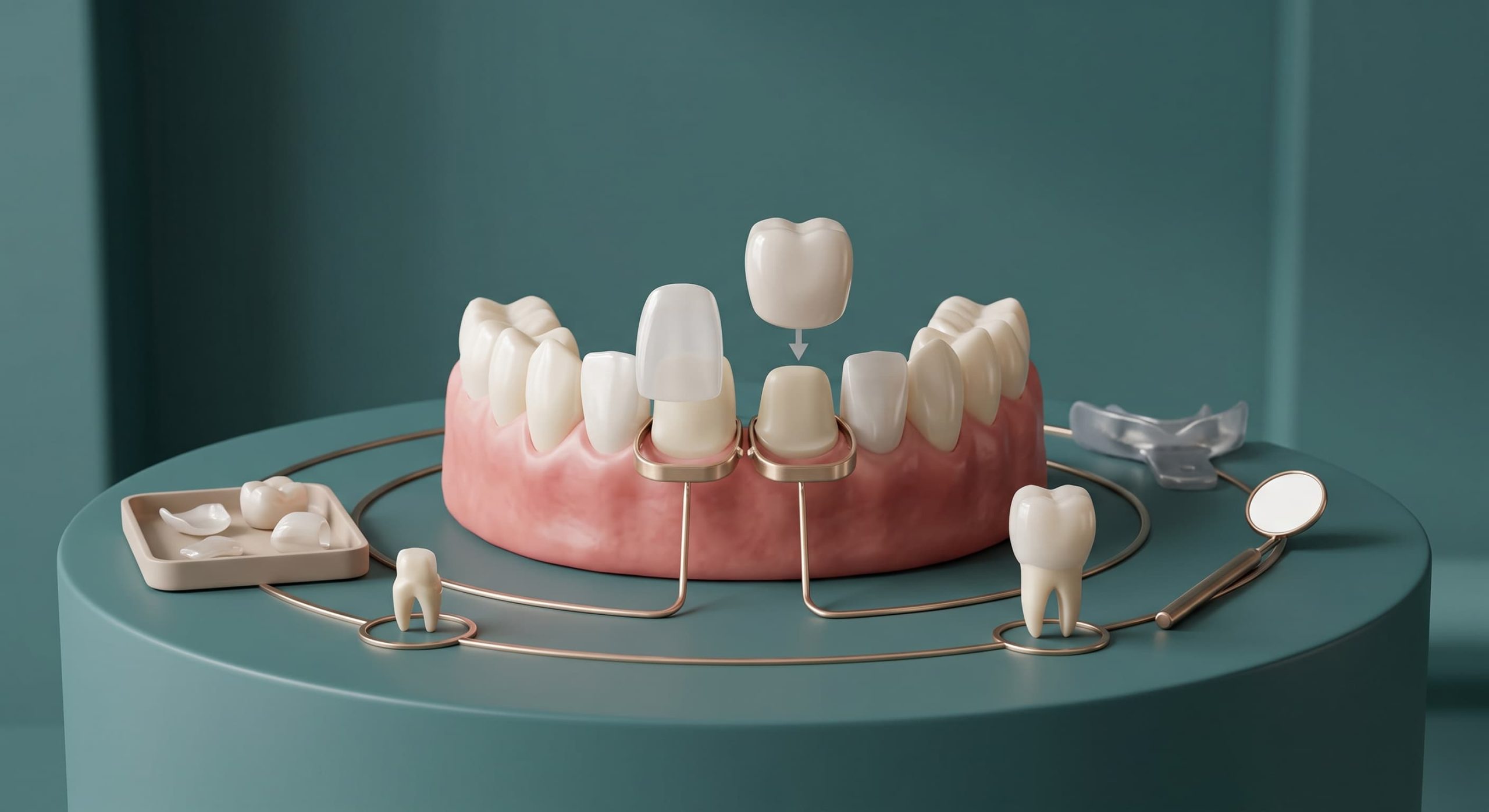
Yes, veneers and crowns can be used together in the same treatment plan. A mixed approach may be suitable when some teeth mainly need an aesthetic change, while others have lost enough structure to require greater coverage and support.
This means a smile makeover does not automatically require veneers on every tooth or crowns across the entire mouth. Each tooth can be assessed separately, then brought into one design that coordinates colour, proportion, surface texture and bite.
The challenge is not simply deciding how many veneers and crowns to use. The materials must be planned as one smile, the cost must be calculated tooth by tooth, and any uncertainty identified before an international patient books a flight to Vietnam.
Quick Answer
Veneers and crowns can be combined in one smile makeover. Veneers may be considered for suitable teeth whose main concern is appearance, while crowns may be used where greater structural coverage is needed. The materials, colour and bite must be coordinated as one treatment plan, with final decisions confirmed after an in-person examination.
Can Veneers and Crowns Be Used Together in the Same Smile?
Crowns and veneers can sit next to each other in the same smile when they are designed as part of one coordinated treatment plan. They do not need to be made from exactly the same material, but they should be selected and adjusted with the overall appearance and function in mind.
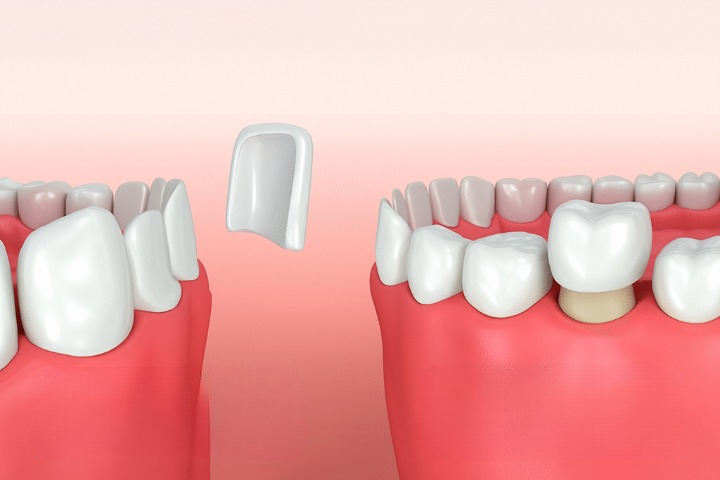
A veneer covers the visible front surface of a suitable natural tooth. A crown covers the tooth more extensively and may be considered when the remaining structure needs more protection or restorative support. In a mixed plan, each restoration is placed on a different tooth according to that tooth’s condition.
This is different from placing a veneer over an existing crown. A veneer is designed to bond to suitable tooth structure, not to act as a new cosmetic layer over an old crown. If an existing crown does not fit the new smile design, the dentist must decide whether it can remain or whether replacing it would produce a more predictable result.
The purpose of combining veneers and crowns together is therefore not to force two treatments into the same case. It is to avoid giving every tooth the same restoration when the teeth do not all have the same needs.
Which Teeth May Receive Veneers and Which May Need Crowns?
The decision should begin with the condition of each tooth, not with a target number of veneers or crowns. Two teeth that look similar in a photograph may have very different amounts of enamel, previous dental work or structural damage underneath.
Veneers may be considered when a tooth has suitable remaining structure and the main goal is to change its colour, contour, apparent length or surface appearance. Crowns may be considered when a tooth requires broader coverage because it has lost more structure or needs a more extensive restoration.
The following table shows the treatment direction that may be discussed. It is not a diagnosis or a fixed rule for every patient.
| Tooth condition | Possible treatment direction | What still needs assessment |
| Suitable tooth structure with a mainly cosmetic concern | Veneer may be considered | Enamel, bite, gum health and bonding conditions |
| Small gaps, minor shape differences or persistent discolouration | Veneer may be considered | Alignment, shade change required and tooth position |
| Large filling or substantial loss of tooth structure | Crown may be considered | Remaining structure and long-term restorability |
| Cracked, heavily worn or weakened tooth | Crown or another restorative option may be considered | Crack depth, bite forces and tooth prognosis |
| Root-canal-treated tooth | Crown may be considered in some cases | Tooth position, remaining structure and fracture risk |
| Existing crown within the planned smile | Retain or replace the crown | Fit, condition, shade and compatibility with the new design |
| Condition cannot be established from photos or an X-ray | Further assessment required | Clinical examination, suitable imaging and diagnostic tests |
This tooth-by-tooth approach also helps avoid unnecessary preparation. If a tooth remains suitable for a veneer, it should not automatically receive a crown simply because the tooth next to it needs one. Conversely, choosing a veneer only because it appears less extensive or less expensive may be inappropriate if the tooth requires more structural support.
For a direct comparison of the two restorations, see Delia Dental Clinic’s guide to dental veneers vs dental crowns in Vietnam.
Will Crowns and Veneers Look Like One Natural Smile?
Crowns and veneers can be designed to look coordinated, but choosing the same shade code does not automatically make different restorations appear identical.
Shade is only one part of the final appearance. A restoration is also affected by translucency, fluorescence, surface texture, thickness and the colour of the tooth or restoration underneath it. Light may pass through a glass-ceramic veneer differently from the way it interacts with a more opaque zirconia crown.
This matters most in the visible front zone. If one restoration reflects more light, appears flatter or has a different level of translucency, the difference may become noticeable even when both restorations are labelled with the same shade.
Depending on the case, stronger zirconia restorations may be considered in posterior areas or where greater masking and support are required. More translucent glass-ceramic restorations may be considered in the anterior zone when the aesthetic conditions are suitable. This is not a universal material formula: tooth condition, restoration thickness, bite and the underlying shade can all change the decision.
At Delia Dental Clinic, a mixed case is planned as one smile rather than as a collection of separate crowns and veneers. Shade, translucency, surface texture and fluorescence are coordinated across the proposed restorations. The patient can then review the overall design during the planning and try-in stages before the final restorations are approved.
How Do Digital Smile Design, a Mock-Up and Try-In Reduce Aesthetic Risk?
A patient should not have to wait until every final restoration is permanently fitted to understand the proposed appearance. Digital Smile Design, a mock-up and a try-in provide different opportunities to review the plan before final completion.
Digital Smile Design helps establish the direction of the smile, including proportions, tooth length, symmetry and the relationship between the teeth, lips and face. A mock-up gives the patient a more tangible preview of the proposed shapes. The try-in stage allows the restorations and their relationship with the surrounding teeth to be assessed before final approval.
At these stages, the patient and dental team can review more than whether the smile is “white enough.” Relevant details include:
| Detail to review | Why it matters |
| Shade and brightness | The restorations should coordinate with each other and any visible natural teeth |
| Tooth length and edge shape | These affect smile character, age and facial proportion |
| Translucency | Different materials should not create an obvious visual break |
| Surface texture | Texture changes how light reflects from each restoration |
| Symmetry and proportion | The result should suit the smile rather than reproduce identical-looking teeth |
| Thickness and profile | Restorations should not look unnecessarily bulky or flat |
| Bite comfort | The teeth must function together, not only look aligned |
| Speech and lip support | Changes in tooth position and length can affect how the smile feels |
Delia has also published an international veneer patient’s account describing how the dentist explained the treatment and showed a 3D preview of the future smile before treatment began. The review supports the role of pre-treatment visual planning, although every patient’s treatment and result remain individual. See the porcelain veneer patient review.
A preview does not guarantee that the final restorations will reproduce every digital detail exactly. Clinical findings, preparation, bite and material behaviour still need to be considered. Its value lies in identifying preferences and possible concerns before the treatment reaches its final stage.
Does Combining Veneers and Crowns Reduce the Total Cost?
A mixed treatment plan may cost less than placing premium crowns across every tooth, but it is not automatically the cheapest option. The total depends on how many teeth receive each treatment and which materials are selected.
The financial advantage is not simply that one restoration costs less than another. A tooth-by-tooth plan may prevent a patient from paying for extensive coverage on suitable teeth that mainly need an aesthetic change. At the same time, it avoids selecting a veneer for a tooth that requires a more substantial restoration.
Delia Dental Clinic’s standard international prices for the relevant restorations are:
| Restoration | Standard price |
| Ceramill crown | $190 per tooth |
| E.max crown | $290 per tooth |
| Lava Plus crown | $350 per tooth |
| Lava Esthetic crown | $600 per tooth |
| E.max Press veneer | $300 per tooth |
| LiSi veneer | $550 per tooth |
These standard prices include consultation, scan or impression, mock-up, temporary restorations and try-in. Treatment identified during the assessment, such as root canal treatment, a core buildup or gum treatment, may affect the final quote.
The separate dental crown cost in Vietnam and veneers in Vietnam cost guides explain the individual material options in more detail.
Sample Mixed Crown-and-Veneer Cost Calculations
The following examples show how the standard cost can be calculated when veneers and crowns are combined. They are mathematical illustrations, not recommended treatment packages.
| Illustrative combination | Calculation | Standard cost |
| 6 E.max Press veneers + 2 Ceramill crowns | $1,800 + $380 | $2,180 |
| 8 E.max Press veneers + 4 E.max crowns | $2,400 + $1,160 | $3,560 |
| 10 E.max Press veneers + 10 Ceramill crowns | $3,000 + $1,900 | $4,900 |
| 8 LiSi veneers + 4 Lava Plus crowns | $4,400 + $1,400 | $5,800 |
A real quote should identify the proposed restoration and material for each tooth. A single total without a tooth-by-tooth breakdown makes it difficult to understand whether the plan is based on clinical need, aesthetic preference or a uniform package.
The final plan may also change after the dentist examines the teeth, gums and bite in person. A remote estimate should therefore identify which parts appear likely and which remain subject to clinical confirmation.
How Many Days Does a Mixed Crown-and-Veneer Plan Take in Vietnam?
Many multi-tooth crown and veneer cases are planned within approximately 7–10 days. This allows time for consultation, smile planning, preparation where required, temporary restorations, laboratory work, try-in and final adjustments.
The required stay is case-specific. A patient having a smaller number of restorations may not follow the same schedule as someone receiving work across both arches. Root canal treatment, gum treatment, substantial bite changes or revisions requested after the try-in may also extend the timeline.
For this reason, international patients should confirm whether an estimate refers to clinic days or total calendar days. Flights should not be scheduled too tightly around the final fitting. Leaving time for a final bite and comfort check reduces the pressure to accept a restoration immediately before departure.
The remote review can help estimate the likely stay, but the confirmed appointment sequence depends on the findings after arrival.
What Should You Confirm Before Booking a Full-Mouth Smile Makeover?
Before paying for flights, the patient should understand what has already been estimated and what cannot be confirmed remotely.
| Information to confirm | Why it matters |
| Preliminary tooth-by-tooth direction | Shows which teeth may receive veneers, crowns or further assessment |
| Proposed material by area | Explains how strength, masking and aesthetics are being balanced |
| Standard cost calculation | Makes the quote easier to compare with another treatment plan |
| Included planning stages | Confirms consultation, scan or impression, mock-up, temporaries and try-in |
| Possible additional treatment | Reduces surprise if further dental problems are found |
| Likely number of clinic days | Helps plan accommodation and return flights |
| Aesthetic approval stage | Shows when shape, shade and proportion can be reviewed |
| Final examination requirement | Makes clear that the remote plan remains preliminary |
| Records and warranty information | Supports maintenance and follow-up after returning home |
Patients who already have a treatment plan from another clinic can send it for comparison. The useful question is not simply whether Delia’s total is lower. It is whether both quotes propose the same number of restorations, the same materials, the same included stages and an appropriate treatment for each tooth.
How Delia Dental Clinic Plans Crowns and Veneers as One Case
Delia Dental Clinic approaches a mixed crown-and-veneer case as one restorative and aesthetic plan. Each tooth is reviewed individually, while the proposed restorations are coordinated across the complete smile.
Depending on tooth position, remaining structure and function, the plan may combine zirconia restorations in areas requiring greater strength or masking with glass-ceramic restorations in visible areas where suitable translucency is important. This allocation remains case-specific and is confirmed after the required examination.
Digital Smile Design, a mock-up and a try-in allow the patient to review the proposed direction before the final restorations are completed. The team also considers how shade, translucency, fluorescence and surface texture will work together rather than selecting each crown or veneer independently.
Delia has published a smile makeover case that combined a zirconia-based bridge with porcelain veneers, demonstrating how different restoration types may be integrated within one aesthetic plan. The case should not be interpreted as the correct combination for every patient, but it provides an example of mixed-restoration planning in practice.
International patients can begin with a remote review before travelling to Delia Dental Clinic’s Hanoi or Ho Chi Minh City branch. Dental photos, smile photos, recent X-rays and an existing quote can help the team estimate which teeth may need further assessment, the likely standard cost and the time that should be reserved in Vietnam.
The remote review is preliminary. The final allocation of veneers and crowns, treatment price and appointment schedule are confirmed after an in-person examination and any required diagnostic imaging or tests.
Frequently Asked Questions
Can crowns and veneers be placed next to each other?
Yes. A crown and veneer can be placed on neighbouring teeth when each restoration is suitable for the tooth underneath and both are designed as part of the same smile. Their colour, translucency, surface texture and proportions need to be coordinated.
Will crowns and veneers be exactly the same colour?
They can be designed to coordinate closely, but no clinic should promise that two different materials will automatically appear identical because they use the same shade code. Material opacity, restoration thickness, lighting and the colour underneath can affect the result. Mock-up and try-in stages allow the overall appearance to be reviewed before final approval.
Can a veneer be placed over an existing crown?
A veneer is not normally placed over an existing crown as a cosmetic cover. The dentist must assess whether the crown can remain within the new smile or whether it needs replacement because of its condition, fit, shape or colour.
Is it cheaper to combine veneers and crowns?
It may be, depending on the number of teeth and materials selected. However, a mixed plan should not be based only on choosing the lowest price for each tooth. The restoration must first be appropriate for the condition and function of that tooth.
Can zirconia crowns be combined with glass-ceramic veneers?
Yes, they may be combined in one treatment plan. Zirconia may be considered where strength or masking is important, while glass ceramic may be considered in visible areas where suitable translucency is desirable. The correct allocation depends on the individual case.
Can I approve the smile before the final restorations are fitted?
Delia Dental Clinic uses Digital Smile Design, a mock-up and a try-in to help patients review the proposed appearance. The available changes depend on the treatment stage, so concerns about shape, length or shade should be discussed before final completion.
Can Delia confirm exactly which teeth need crowns before I fly?
Photos, X-rays and dental records can support a preliminary assessment, but they cannot always confirm the condition of every tooth, the gums or the bite. The final decision requires an in-person examination and any necessary diagnostic tests.
Final Thoughts
Combining veneers and crowns is not simply a way to reduce the number of expensive restorations. Its main purpose is to treat each tooth according to its condition while bringing different materials together in one functional and aesthetic design.
A useful plan should show which restoration is proposed for each tooth, how the materials will be coordinated, what the standard price includes and which decisions remain preliminary.
Send your smile photos, close-up dental photos, recent X-rays and any existing dental quote to Delia Dental Clinic via WhatsApp or Messenger before booking your flight. The international patient team can review your case, suggest a preliminary tooth-by-tooth treatment direction and help estimate the standard cost and likely stay for treatment in Hanoi or Ho Chi Minh City. The final treatment plan and quote will be confirmed after an in-person examination.


