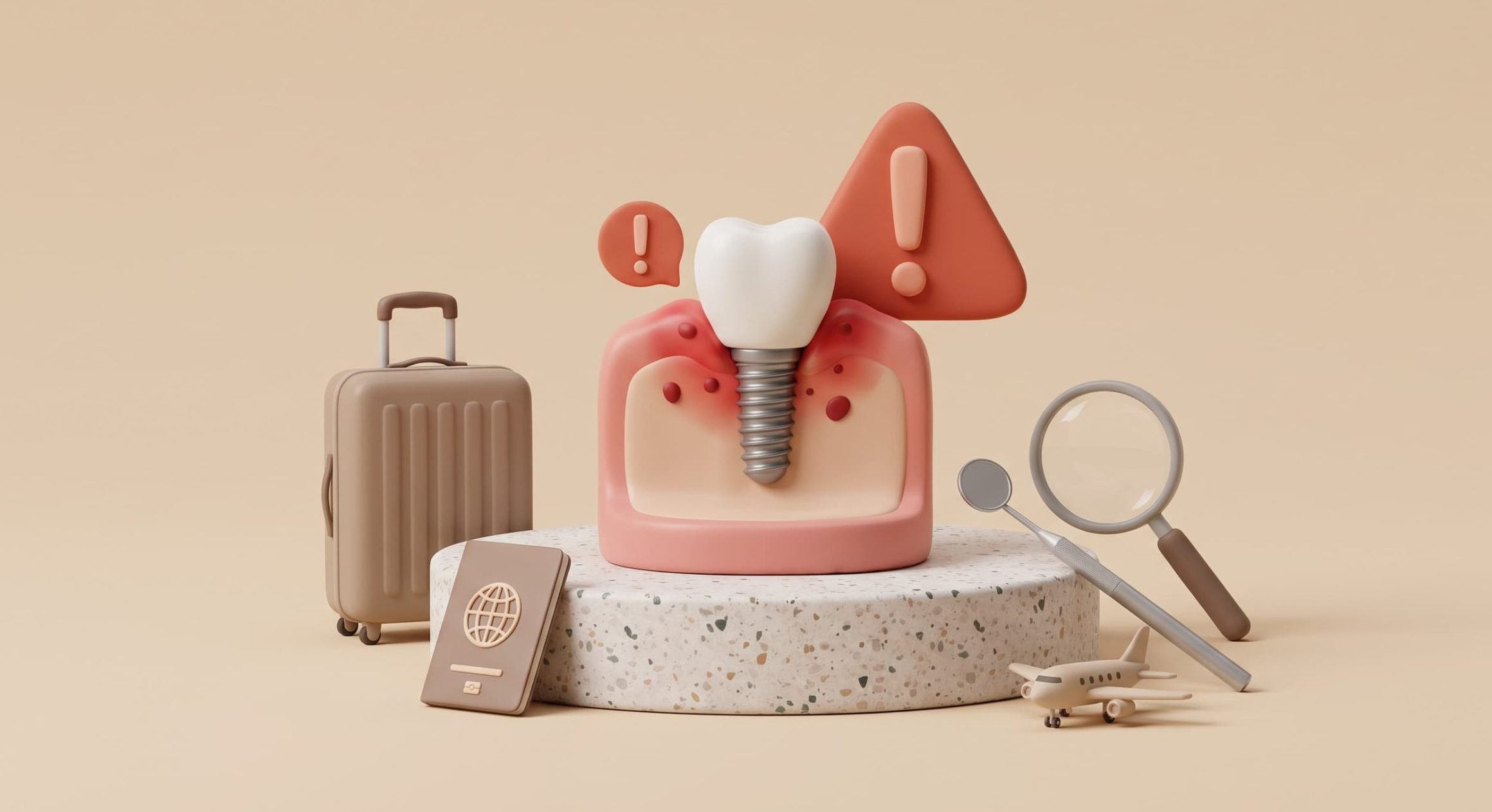
A few months after flying home, you notice a spot of blood on your toothbrush near the implant. There is no pain, the crown feels solid, and the gum looks a little redder than usual. It is easy to put off, especially when the dentist who placed the implant is thousands of kilometres away, yet these quiet changes are often the first signs of peri-implantitis.
That small change is worth taking seriously. Inflammation around an implant often develops without pain, and the stage that can still be reversed is the stage most patients miss.
Peri-implantitis is an infection and inflammation of the gum and bone around an implant. It usually starts as a gum problem and, if left alone, can lead to bone loss. For patients treated abroad, the practical difficulty is knowing which signs matter and who should examine them.
This article explains the warning signs, how to tell early gum inflammation from bone loss, what to do when your implant dentist is overseas, and what a remote review can and cannot tell you.
Quick Answer
Bleeding, redness, swelling, pus, a bad taste or a receding gum around an implant are the main warning signs of peri-implantitis. Pain is often absent, and a firm implant does not rule it out. See a dentist soon for an examination and X-ray, and keep your implant brand and placement date on hand.
What Is Peri-Implantitis and How Does It Start?
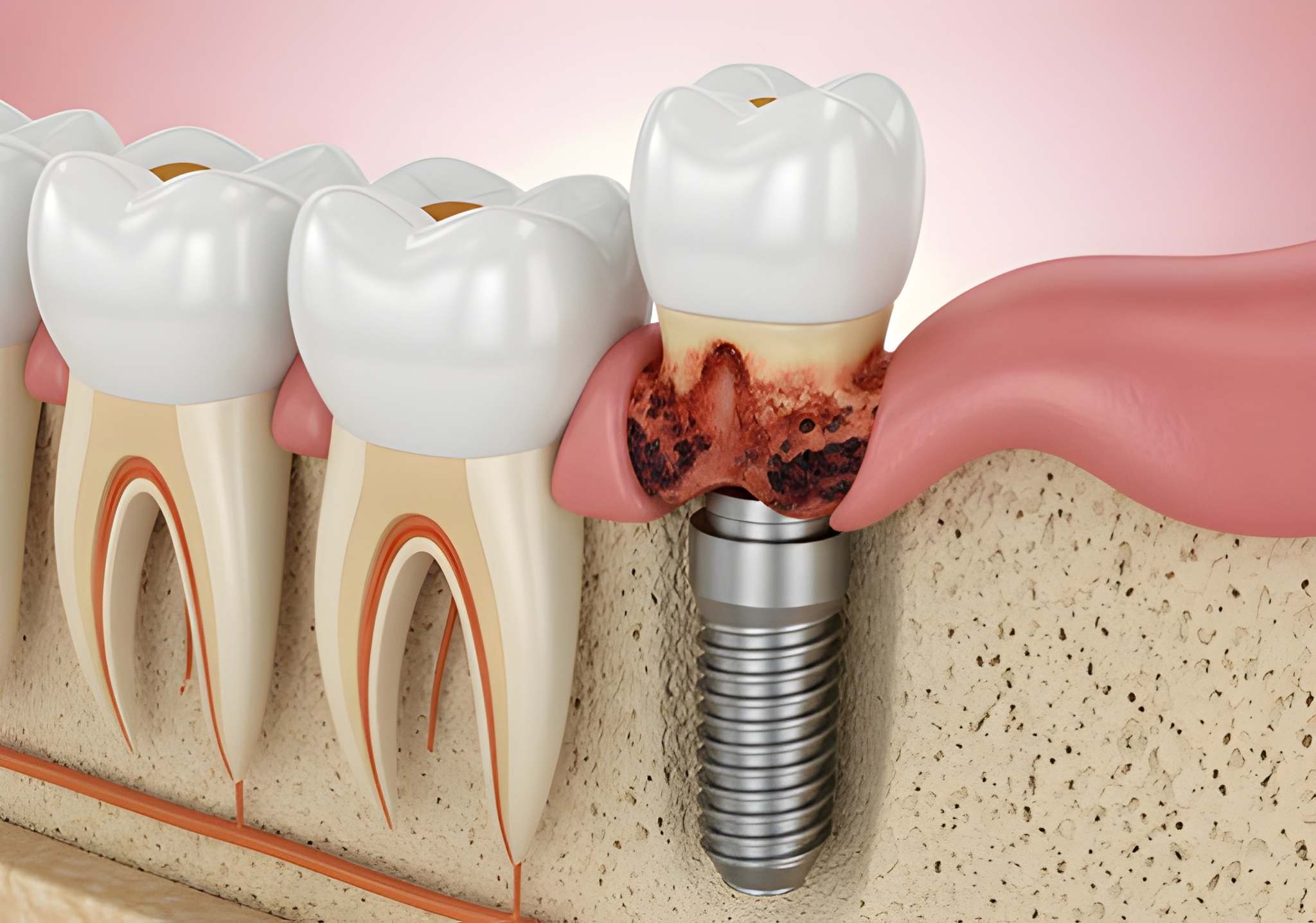
Peri-implantitis is inflammation of the tissue around an implant together with progressive loss of the supporting bone. It usually begins as peri-implant mucositis, which is inflammation of the gum alone, with bleeding or swelling but no bone loss. Mucositis is generally reversible with professional cleaning and better home care, which is why catching it early matters.
The condition is common enough to plan for. Education material from Straumann cites recent reviews suggesting that around 43% of patients develop mucositis and about 22% develop peri-implantitis, with wide ranges because studies define the disease differently. These are worldwide figures, not figures for any one clinic or country.
The main trigger is plaque building up around the implant. Smoking, a history of gum disease, poorly controlled diabetes and difficulty cleaning around the crown or bridge all raise the risk. A bridge that is hard to reach with a brush is a common reason, and the guide on cleaning under an All-on-4 or All-on-6 bridge when you live overseas covers daily care for that situation.
What Are the Warning Signs of Peri-Implantitis?
The warning signs are bleeding, redness and swelling of the gum around the implant, pus, a persistent bad taste or smell, and a gum line that recedes to show the metal threads. Each one reflects infection or tissue breakdown, and several together make the case stronger. Signs that persist even though you are cleaning well carry the most weight.
- Bleeding when you brush or floss around the implant, which healthy gum should not do
- Red, puffy or shiny gum that looks different from the tissue around natural teeth
- Pus, or a bad taste or smell that does not clear with brushing
- A gum line that is shrinking, so the implant surface or the edge of the crown looks longer
- A deeper gap where food keeps collecting around the implant
- Tenderness when biting or brushing, although many patients feel nothing at all
- A change in your bite, or any movement of the crown or implant, which needs prompt assessment
Two points catch patients out. Pain is not a reliable guide, because the disease can progress with little discomfort. And a stable, firm implant does not mean everything is fine. Looseness usually appears late, when a large amount of bone has already been lost.
How Can You Tell Normal Healing From a Problem?
Gum bleeding, swelling and tenderness in the first days and weeks after surgery are expected. Concern starts when signs appear after healing, return after they had settled, or get worse over time instead of better.
A useful comparison is direction and timing. Soreness that eases each week is healing. Bleeding that begins months or years after the implant felt comfortable, or a taste that keeps coming back, is a change. The table below sets out how the pattern differs.
| Pattern | What it may mean | What to do |
|---|---|---|
| Soreness and light bleeding in the first weeks, easing steadily | Normal healing | Follow the aftercare instructions you were given |
| Bleeding or puffiness at brushing that comes and goes | Possible gum inflammation, sometimes mucositis | Improve cleaning and book a check within a few weeks |
| Bleeding with pus, bad taste, or a gum line that is shrinking | Possible peri-implantitis | See a dentist soon for probing and an X-ray |
| Swelling spreading, fever, severe pain or a loose implant | Advanced or acute infection | Seek dental or medical care promptly |
Bone is the dividing line between the second and third rows, and bone can only be judged on an X-ray. A small amount of bone adjustment in the first year after the crown is fitted is considered a normal part of remodelling. Continued loss beyond that point is what dentists look for.
What Should You Do if Your Implant Dentist Is Overseas?
Start with a dentist near home instead of waiting for a trip back. A local dentist can measure the gap around the implant, check for bleeding and take an X-ray, which are the things a photo cannot do. Early inflammation is often handled with a professional cleaning and a plan for home care.
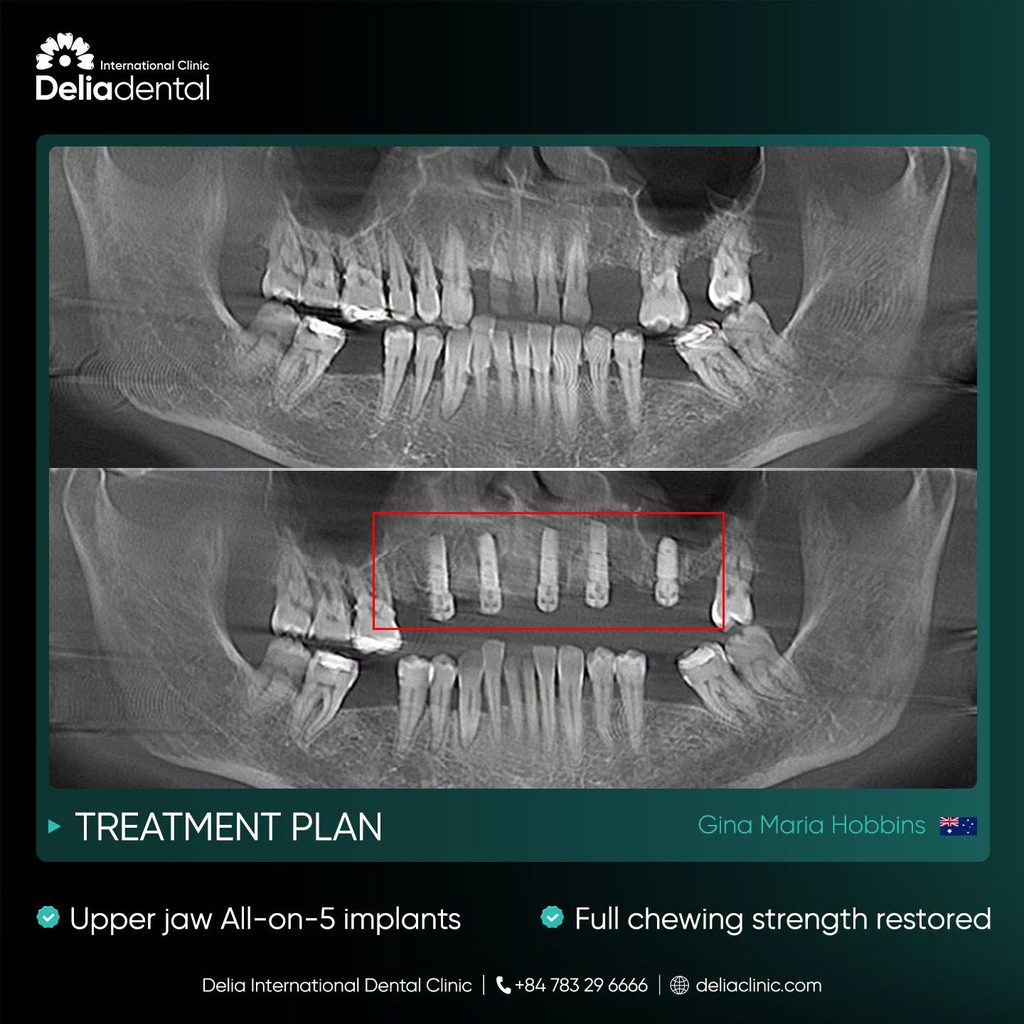
A few records make that visit more useful. Bring the implant brand and size if you have them, the dates of placement and crown fitting, and any X-rays taken after the crown was placed. A baseline X-ray is the reference point for judging whether bone has changed. If you cannot find these, ask the clinic that treated you to send them.
Avoid trying to fix it yourself. Do not scrape around the implant with sharp tools, and do not start leftover antibiotics. Both can mask the problem or damage the implant surface. Gentle brushing with a soft brush, an interdental brush suited to the implant and the rinse your dentist suggests are the sensible steps while you wait for an appointment.
Do not mistake a loose crown or screw for infection, since they are different problems with different fixes. Delia Dental Clinic’s article on what to do when an implant crown or screw loosens after you return home explains the difference.
How Is Peri-Implantitis Treated, and Can It Be Reversed?
Treatment depends on how much bone has been lost. Mucositis is generally reversible with professional cleaning and consistent home care. Early peri-implantitis is often treated with deeper non-surgical cleaning, sometimes with antimicrobial rinses or gels, and a review a few weeks later.
More advanced cases may need surgery to clean the infected area and, in selected cases, to reshape or rebuild lost bone. Bone that has already been lost does not always return, and an implant with severe loss may be removed. This is why the line between reversible inflammation and permanent bone loss is the one worth acting on. The dentist chooses the approach after examining the implant, and no article can replace that. For the wider picture of why implants fail, see Delia Dental Clinic’s article on causes of dental implant failure.
How Delia Dental Clinic Reviews Gum and Bone Concerns From Abroad
Delia Dental Clinic’s international patient team can look at clear photos of the area, any recent X-rays, the implant details and a description of your symptoms to give a preliminary view of whether the pattern looks like something to watch or something to have checked soon. The team can also tell you what a local dentist should examine, so that the visit is focused.
A remote review has clear limits. It cannot measure pocket depth, test for bleeding or confirm bone loss without an X-ray taken at the time, and it does not replace an examination. When a case needs a hands-on assessment, patients may be asked to see a dentist locally or, if they are returning to Vietnam, to be examined at Delia Dental Clinic in Hanoi or Ho Chi Minh City. The article on what an X-ray can confirm before an implant trip explains how remote records are used.
Frequently Asked Questions
Can Peri-Implantitis Be Prevented?
Largely, yes. Thorough daily cleaning around the implant and the crown or bridge, not smoking, controlling diabetes and keeping up professional check-ups all lower the risk. The design of the restoration matters too, because a prosthesis that you cannot reach with a brush makes cleaning harder. If you struggle to clean a particular area, tell your dentist so the technique or the tools can be adjusted.
Can Peri-Implantitis Develop Years After Treatment?
Yes. It can appear months or years after the implant has healed and the crown has been fitted, which is why it is a long-term concern rather than a recovery issue. Many cases are found at routine check-ups before the patient notices anything. Signs that appear after years of a comfortable implant deserve the same attention as signs in the first year.
Can I Treat It at Home With Mouthwash or Salt Water?
Rinses may soothe the area, but they do not remove the plaque and infection that drive the problem, and they cannot show whether bone has been lost. Antiseptic rinses such as chlorhexidine are best used on a dentist’s advice and for a limited period, since long use can stain teeth. Use home care to support a dental visit, not to replace it.
Does the Warranty Cover Peri-Implantitis?
It depends on the written terms. Implant warranties, prosthetic warranties and biological complications are commonly treated separately, and many carry maintenance conditions such as regular check-ups. Ask for your warranty documentation in writing and read what is listed for gum and bone problems before assuming cover.
How Often Should an Implant Be Checked After I Return Home?
Dentists commonly suggest checks every three to twelve months, depending on risk, with X-rays at intervals the dentist sets. Smokers, people with a history of gum disease and those with a bridge that is hard to clean usually need closer follow-up. Your dentist sets the schedule. Waiting for a symptom before booking is the pattern to avoid.
Do I Need to Fly Back to Vietnam if I Have Signs of Infection?
Usually not as the first step. Early signs can often be assessed by a dentist near home, with the original clinic advising on the implant details. A return visit becomes relevant if the problem involves the components or the prosthesis, or if the treating dentist recommends it. The decision depends on the examination findings.
Staying Ahead of Problems After You Return Home
These articles cover long-term care, what a warranty does and does not cover, and how aftercare is organised for patients abroad.
- How to Maintain Dental Implants Placed in Vietnam
- Implant Warranty vs Prosthetic Warranty
- From First Message to Final Smile: The Delia International Patient Journey
Final Thoughts
The warning signs of peri-implantitis are quiet, and the window to reverse the problem is the early one. A change in how the gum looks, bleeds or tastes is enough reason to have the implant examined and X-rayed, wherever it was placed.
If you have noticed a change, send clear photos of the area, your latest X-ray if you have one, the implant details and a short description of your symptoms via WhatsApp or Messenger so Delia Dental Clinic can suggest what to check first.


