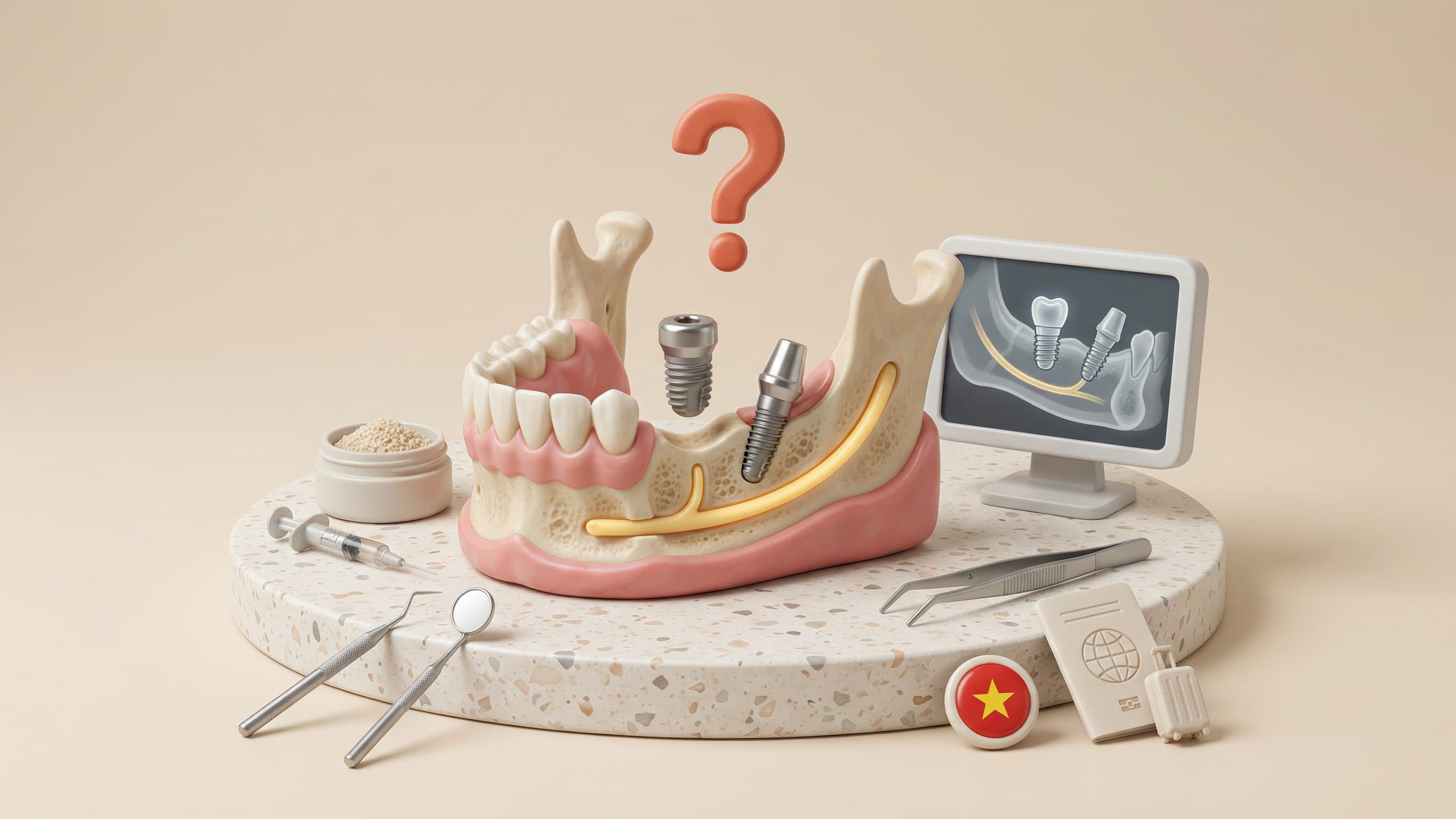
Limited bone height above the lower jaw nerve does not automatically rule out dental implants, but it changes which options are safe. The nerve canal sets a fixed vertical boundary in the back of the lower jaw, and the plan has to work around that boundary instead of pushing past it.
Most patients end up on one of four routes: a shorter implant, implants placed in front of the nerve exit, bone grafting to gain height, or a non implant alternative. Which route fits depends on measurements that only a 3D scan can give.
This guide explains what each option involves, what the CBCT needs to show before anyone can quote a lower jaw implant, and how limited bone height affects the number of trips to Vietnam.
Quick Answer
Limited bone above the lower jaw nerve can still allow implants, through short implants, placement in front of the mental foramen or bone grafting. A bridge is another valid option. Which route fits depends on bone height, bone width and nerve position measured on a CBCT scan, not on a 2D X-ray.
How Much Bone Do You Need Above The Lower Jaw Nerve?
The bone needed above the lower jaw nerve is the implant length plus a safety margin, and published studies commonly plan that margin at about 1.5 to 2 mm. The inferior alveolar nerve runs inside the lower jaw on each side and supplies feeling to the lower teeth, lip and chin. A British Dental Journal retrospective study of short implants in the premolar region, for example, prepared every site with a margin of at least 2 mm from the mandibular canal.
No single height works for every patient, because implant length is chosen against the measured bone on each side of the jaw. In the clinical literature, a residual height of about 7 to 8 mm above the nerve is the zone where short implants and vertical grafting are most often compared. A 12 month comparison of consecutive patients with 7 to 8 mm of bone above the nerve (PubMed PMID 24818205) reported implant survival of 97.1% for short implants in native bone and 95.6% for implants placed in grafted bone. Those figures describe a small group under study conditions and cannot predict the result for an individual jaw.
Bone height drops for identifiable reasons. Teeth that have been missing for many years let the ridge resorb. Gum disease can remove bone around a tooth before it is extracted. Long term denture wear can flatten the ridge as well. A lower molar area that measured well five years ago may now have noticeably less height, which is why old X-rays are a starting point and not a plan.
Why Does The Nerve Limit Lower Jaw Implants?
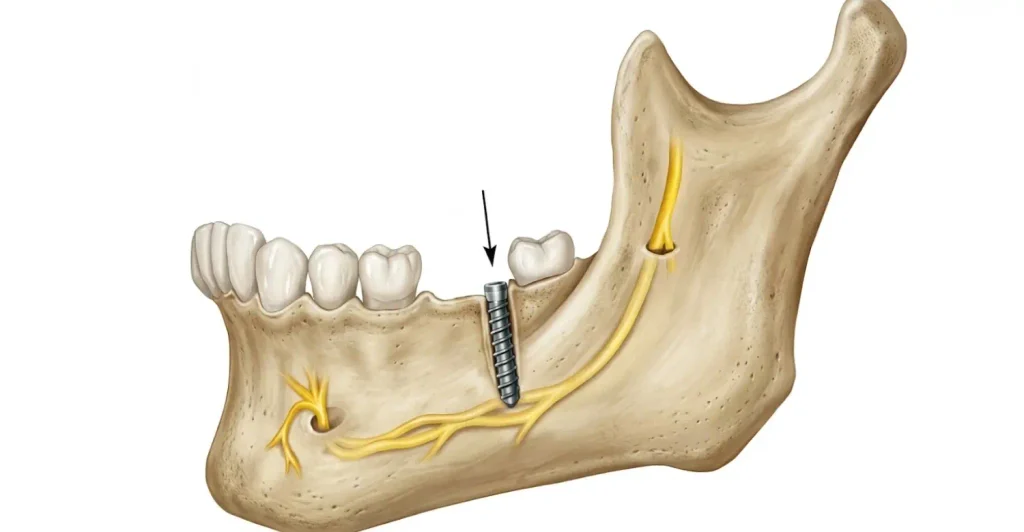
The inferior alveolar nerve limits implant length because an implant that contacts or compresses the nerve canal can cause altered sensation, numbness or pain in the lower lip, chin or teeth. These changes are sometimes temporary and sometimes long lasting, which is why clinicians treat the margin above the canal as a boundary and not a preference.
The risk is specific to the lower jaw. The upper jaw has the sinus to work around, but the lower jaw has a nerve that cannot be moved aside during routine surgery. Treatment planning for the lower back teeth therefore depends heavily on 3D imaging, and the clinical question is whether an implant can fit with enough clearance that the nerve is never touched, not simply whether it fits in the bone.
The nerve also does not follow the same path in everyone. Near the chin it exits through the mental foramen, and in some people it extends forward before looping back to the opening, a feature called the anterior loop. Because this varies between individuals, a review in the Journal of Applied Oral Science concluded that it is not prudent to rely on a general safe zone in front of the foramen. That variation matters for the second option below.
What Are Your Implant Options When Bone Height Is Limited?
Four implant based options exist when bone height above the nerve is limited, plus non implant alternatives. Each one solves the height problem differently and carries a different trade off in time, cost and surgical complexity.
| Option | What it does | Main trade off | Effect on trips |
|---|---|---|---|
| Short implant | Uses a shorter fixture that fits above the nerve with a safe margin | Needs enough bone width and bone quality | Usually the standard two trips |
| Placement in front of the mental foramen | Places implants where the bone is usually taller | Fewer implants in the back, so the prosthesis design carries more of the plan | Usually the standard two trips |
| Bone grafting for height | Rebuilds bone so a longer implant can be placed | Longer healing and more surgical steps | May add a third trip |
| Nerve repositioning | Moves the nerve away from the implant site | Higher risk of altered sensation, rarely a first choice | Case specific |
Short Implants
Short implants are fixtures shorter than conventional lengths, and the definition varies between studies. One systematic review in the Journal of Oral and Maxillofacial Research defines them as 8 mm or less, while other studies use 6 mm or less. A five year case series in the posterior lower jaw followed single crowns on 6 mm implants placed in patients with at least 8 mm of height above the nerve and at least 6 mm of width, and reported that these implants provided a solid basis for single tooth restoration (Clinical Implant Dentistry and Related Research, PMC6899810). That study was small and selected its patients, so it supports short implants as a reasonable option in suitable bone and not as a universal substitute.
Suitability depends on bone width, bone quality, bite forces on that tooth and how many implants share the load. A short implant is one of the tools used when the measurements support it, not a shortcut around a grafting recommendation.
Implants Placed In Front Of The Mental Foramen
When the back of the lower jaw lacks height, implants can sometimes be placed forward of the mental foramen, where bone is usually taller. This principle underlies how full arch treatments such as All-on-4 and All-on-6 are planned, with the replacement teeth supported by implants in the front and middle of the jaw. It does not apply to a single missing molar, because that implant has to go where the tooth was. Even in the front of the jaw, the anterior loop must be located on the scan before the implant position is fixed.
Bone Grafting To Gain Height
Bone grafting adds bone to the ridge so a longer implant can be placed with a safe margin above the nerve. Grafting can be done before implant placement or, in selected cases, at the same time as placement. It adds healing time before the implant can carry a tooth, and how much height can be gained depends on the technique and on the patient’s own healing. Grafting in the lower jaw is more involved than many patients expect, which is why it is discussed after the CBCT and not before it.
Nerve Repositioning
Nerve repositioning moves the inferior alveolar nerve out of the way so an implant can occupy the space it used. It carries a meaningful risk of altered sensation in the lip and chin and is generally reserved for situations where other options are unsuitable. A clinic that offers it as a first line option should be asked which alternatives were considered and why they were ruled out.
Bridge Or Partial Denture
A fixed bridge supported by neighbouring teeth, a removable partial denture, or leaving the space unrestored are all legitimate choices in some cases. A bridge only makes sense when the neighbouring teeth are healthy enough to carry it. For a patient with limited bone and a tight timeline, a non implant option can be the more practical decision, and a clinic that presents only one route is not giving the full picture.
What Does The CBCT Need To Show Before An Implant Plan Is Made?
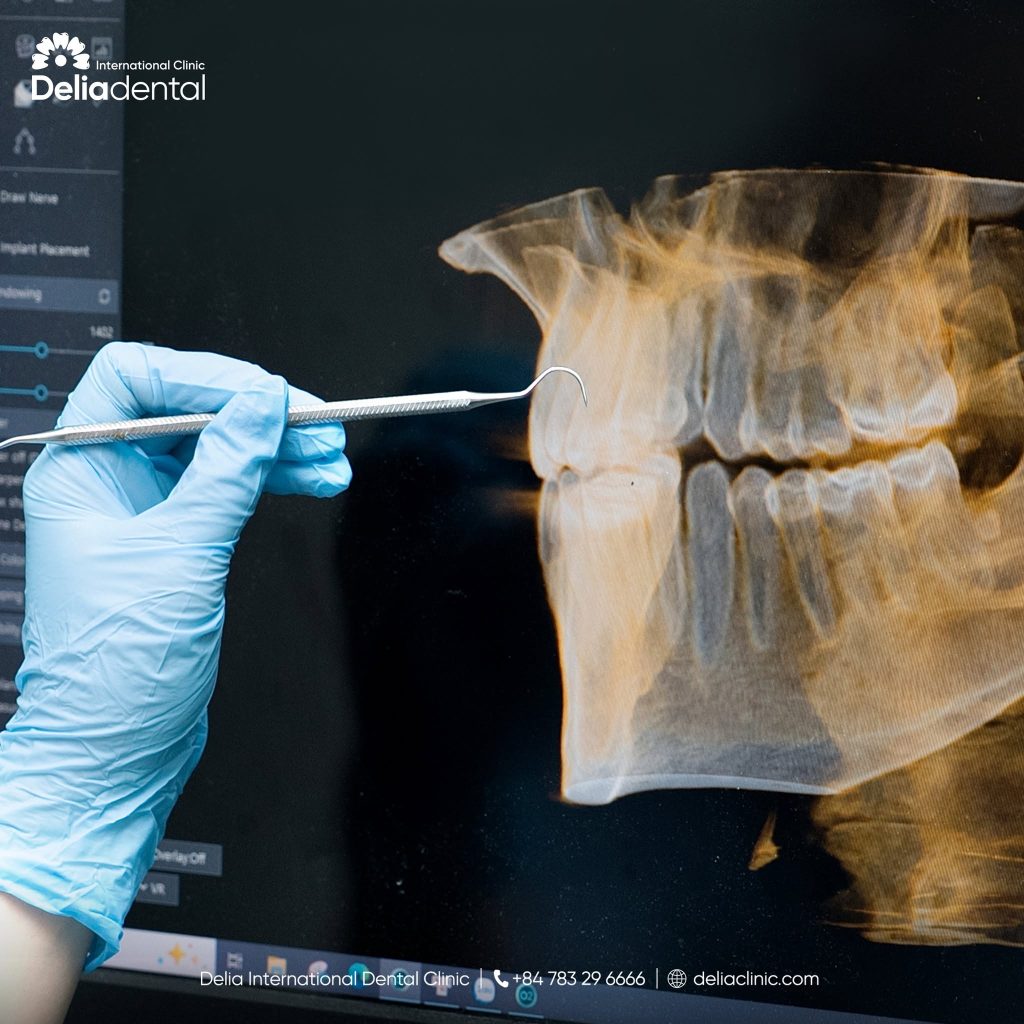
A CBCT scan has to show bone height, bone width and nerve position at the exact site of the planned implant. Without those measurements, any plan or price for a lower back implant is preliminary. A useful scan answers a specific set of questions:
- Vertical bone height from the ridge crest to the top of the nerve canal at the planned site
- Bone width, since a tall but thin ridge can still rule out a standard implant
- Path of the nerve canal, including whether it sits closer to the cheek side or the tongue side
- Position of the mental foramen and whether an anterior loop is present
- Bone density and quality, which affect implant choice and healing time
- Any infection, root remnants or lesions in the area that need treatment first
- Condition of the neighbouring teeth if a bridge is being considered
Bone height alone does not decide the plan. A site with 9 mm of height but only 4 mm of width presents a different problem from one with 6 mm of height and plenty of width, and the best option differs for each. Delia Dental Clinic explains why every implant case starts with this scan in its guide on why a CBCT scan comes before every dental implant.
Why Is A 2D Panoramic X-ray Not Enough?
A 2D panoramic X-ray cannot measure bone width or show the exact nerve path, so it cannot confirm that an implant is safe near the lower jaw nerve. Panoramic images flatten a three dimensional jaw into one plane and distort distances, so a canal that looks comfortably far from the ridge can sit closer in reality or lie on the tongue side where the image does not show it. A cross sectional study of the mental nerve loop in the Medicina Oral journal (PMC4393989) found that two dimensional imaging gives less accurate information about the anterior loop and recommended CBCT when planning implants in the front of the lower jaw.
A remote review of a panoramic X-ray can therefore suggest a direction but should not be treated as a plan. Patients who already hold a CBCT or DICOM file from a local clinic can send it for review, which often saves repeating the scan.
How Does Limited Bone Height Change The Number Of Trips?
Limited bone height can add a trip when bone grafting is needed, because the graft has to heal before the implant is placed or loaded. The standard implant model uses two trips: the first covers assessment, surgery and a temporary solution, and the second covers the final prosthetic after healing. A case that needs grafting first may need a third trip, and the CBCT is what indicates whether that is likely.
| Route | Typical trip pattern | What drives any change |
|---|---|---|
| Short implant | Standard two trips | Bone quality and the healing of that site |
| Placement in front of the mental foramen | Standard two trips | Prosthesis design and healing |
| Bone grafting before implant | Two trips, with a possible third | Graft size and healing time confirmed on CT |
| Bridge or partial denture | Often one trip, depending on the case | Condition of the supporting teeth |
The second trip can usually be rescheduled with advance notice to the coordinator, so patients can plan around work and leave. Patients weighing a grafting route can read how healing affects the flight home in the guide to bone grafting and the return flight from Vietnam before booking tickets.
How Delia Dental Clinic Reviews Lower Jaw Bone Height Before You Travel
Delia Dental Clinic starts every implant case with an in clinic CBCT scan at its Hanoi or Ho Chi Minh City branch, because a 2D panoramic X-ray sent in advance is enough only for a preliminary direction. Patients can send existing X-rays or CBCT files before travelling, and the team can then flag whether the case looks straightforward, likely to involve grafting, or better suited to a different plan.
The in person CBCT is what lets the clinical team measure the bone above the nerve, check bone width and nerve position, and discuss which option fits: a shorter implant, a different implant position, grafting or a non implant alternative. Teeth that have been missing for many years can still be treated with implants in many cases, though bone grafting is likely and the amount is decided case by case on the scan. The final plan and quote are confirmed after that scan, not before it.
Frequently Asked Questions
Can I Still Get A Dental Implant If The Bone Above My Nerve Is Thin?
In many cases yes, although the route changes. A shorter implant, a position in front of the mental foramen or bone grafting may make an implant possible, and some patients are better served by a bridge or partial denture. The deciding factors are measured height, width and nerve position, so nobody can confirm the answer from a description or a panoramic image. A clinic should be able to tell you which options it considered and why it chose one.
Are Short Implants As Reliable As Standard Length Implants?
Short implants can perform well in suitable bone, but their record depends on the conditions in the study. The five year case series cited above selected patients with at least 8 mm of height and 6 mm of width, which is a more favourable situation than a thin, soft ridge. Bite force, the number of implants sharing the load and how well the patient cleans the area all affect the outcome. Ask why a short implant suits your scan specifically, and what the plan is if the bone quality proves lower than expected during surgery.
Is Bone Grafting Always Needed When Bone Height Is Limited?
No. Grafting is one option, and it is not required when a short implant or an implant position in front of the mental foramen fits the measurements. It becomes more likely when the height deficit is large and a longer implant is the better clinical choice for the tooth being replaced. Because grafting adds healing time, the decision also weighs how many trips a patient can realistically make.
What Are The Signs Of Nerve Irritation After Lower Jaw Implant Surgery?
Numbness, tingling, a burning feeling or reduced sensation in the lower lip, chin or the teeth on that side that does not fade as the anaesthetic wears off should be reported to the treating dentist promptly. Mild swelling and tenderness are common after surgery, but altered sensation is a different pattern and is worth an early review instead of a wait and see approach. Photos cannot show nerve function, so a patient who has flown home should contact the treating clinic and a local dentist the same day. Difficulty breathing or swallowing, or fast spreading facial swelling, calls for urgent medical care.
Can A Clinic Confirm An Implant Length From An X-ray Or Photo Sent Online?
An online review can give a preliminary direction and identify missing records, but it cannot confirm that a specific implant length is safe near the nerve. Final suitability depends on a CBCT scan and a clinical examination. If a clinic quotes a firm price and a specific implant length from a flat X-ray alone, ask how that length was determined and what happens if the scan shows less bone than the X-ray suggested.
What Should I Send Before Booking Flights?
Recent X-rays and any existing CBCT or DICOM file are the most useful records, together with a note of which lower teeth are missing and for how long. A list of current medications and any previous grafting or extraction history help the team judge whether healing may be slower. Sending your intended travel window lets the team say whether a one trip, two trip or three trip pattern looks realistic for your case. Records that are older than a couple of years may be repeated on arrival, since bone can change over time.
Choosing Between Implants And Other Options
These guides cover the decisions that usually come next when a lower back tooth is missing.
- Missing Molar Tooth Options
- Bridge vs Implant Long Term Cost
- Bone Grafting and the Return Flight from Vietnam
- Smoking and Alcohol Around Dental Implant Surgery
Final Thoughts
Patients who want to verify the implant system before agreeing to treatment can ask to see the unopened implant box and check the brand code on the manufacturer’s website. To start, send recent X-rays or any existing CBCT file, plus a note of which lower tooth or teeth are missing, through WhatsApp or Messenger. Delia Dental Clinic can then suggest a preliminary direction and tell you what the in person scan still needs to confirm.


