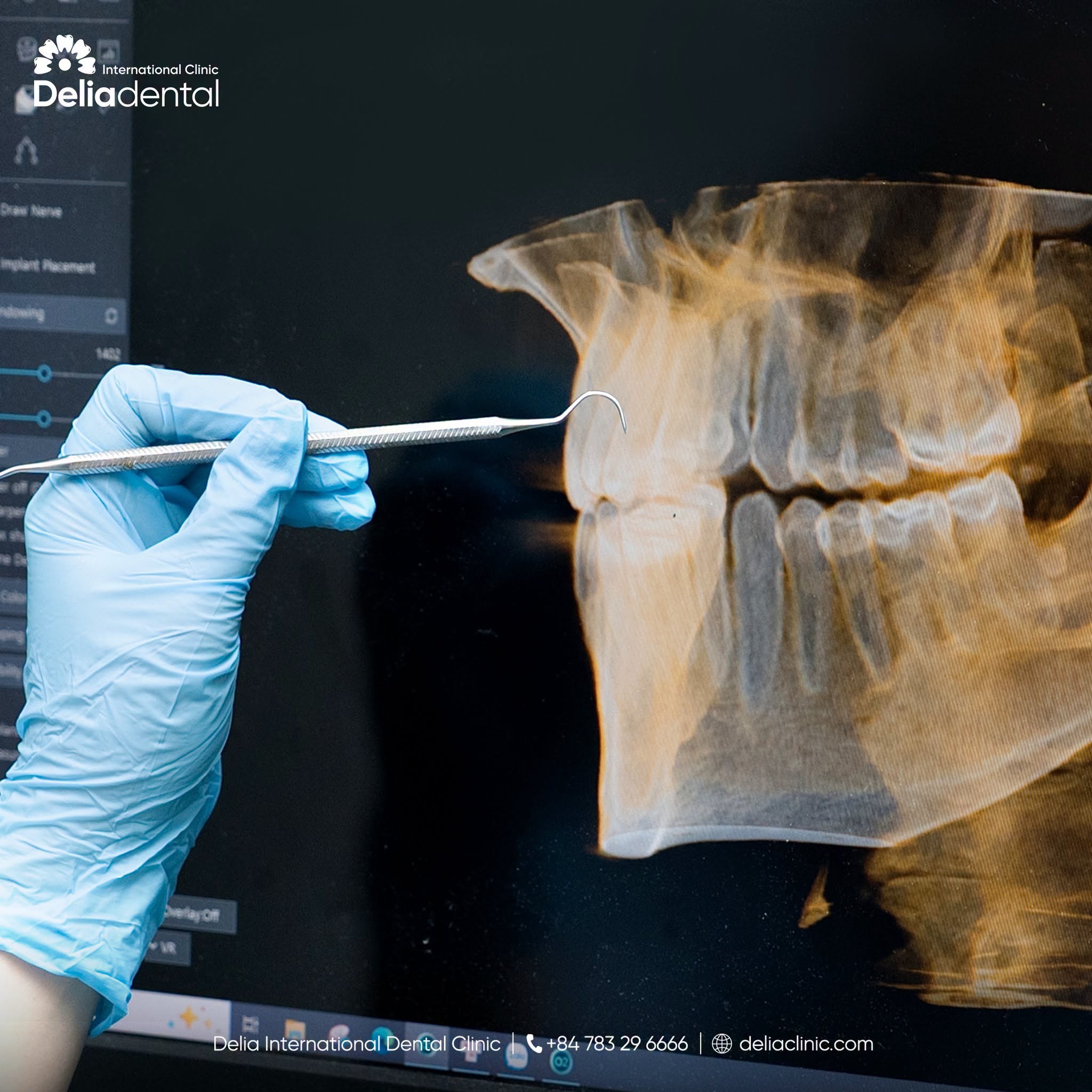
A CBCT scan is not always required before a dental implant. Published guidelines allow a panoramic X-ray alone for straightforward single tooth cases in accessible bone. Delia Dental Clinic requires a CBCT scan for every implant patient regardless of case complexity, which is stricter than the minimum research supports.
Patients researching implants in Vietnam run into this question early, usually after one clinic asks for a CBCT scan and a few hundred dollars before travel while another is willing to quote from a panoramic X-ray sent by email. Both positions can point to real evidence. The published guidance from radiology bodies does not treat CBCT as mandatory for every implant, and a 2D panoramic image has been shown to plan simple cases correctly a large share of the time.
That research gap does not mean a clinic requiring CBCT for every case is overcautious or padding the bill. It means the clinic has decided the cost of occasionally scanning a straightforward case is worth avoiding the failure mode where a 2D image looked adequate and was not. This guide separates what the literature actually recommends from what Delia Dental Clinic requires in practice, and explains the reasoning gap between the two.
Quick Answer
A CBCT scan is not universally required for dental implants. The American Academy of Oral and Maxillofacial Radiology recommends cross sectional imaging, preferably CBCT, be used to assess implant sites, while acknowledging panoramic radiography can be sufficient for planning simple posterior mandibular cases when a safety margin above the nerve canal is respected. Delia Dental Clinic requires an in clinic CBCT scan for every implant case before treatment, not just complex ones, because a panoramic image sent before travel is only accurate enough for a preliminary plan and cannot measure bone density or volume.
What Published Research Actually Says About CBCT Necessity
The imaging debate in implant dentistry is not settled the way some clinic marketing implies. A position paper from the American Academy of Oral and Maxillofacial Radiology states that cross sectional imaging should be used to assess all dental implant sites and identifies CBCT as the preferred method for gaining that information, without describing panoramic imaging as unacceptable on its own.
Several studies back the more permissive reading for simple cases. A prospective study of 1,527 consecutively treated patients found panoramic radiographs adequate for preoperative planning of posterior mandibular implants, and other researchers reported that panoramic imaging was sufficient for available bone height when a vertical safety margin of at least 1.7 to 2 millimeters above the mandibular canal was maintained. A retrospective comparison of 56 patients who received both imaging types found statistically significant differences between panoramic and CBCT measurements at every anatomical landmark checked, even though the average gap ranged from only 0.36 to 0.76 millimeters.
That small average difference is the crux of the disagreement. A joint 2026 practice guideline from the American Dental Association and AAOMR narrows CBCT’s mandatory role to specific triggers rather than every case: when clinical examination indicates bone grafting or reconstruction will be needed, when a surgical guide will be fabricated, and when the relationship between the implant site and nearby anatomic structures needs three dimensional confirmation. Outside those triggers, the guideline treats panoramic imaging plus clinical examination as an acceptable starting point, not a shortcut.

Where the Evidence Actually Supports Skipping CBCT
The permissive research findings share a narrow profile, and it is worth being specific about what that profile excludes. The favorable panoramic studies generally involved single implants in the posterior mandible, a region with more predictable bone anatomy than the posterior maxilla, adequate visible bone height on the panoramic image itself, and no indication from clinical examination that grafting would be needed.
A separate study designed specifically to test whether CBCT changes the plan found that CBCT more accurately predicted implant size and the need for bone grafting than panoramic imaging plus clinical exam alone, while still concluding that panoramic based planning was adequate for some cases. The same paper recommended reserving CBCT for cases involving guided surgery, elevated risk to vital structures, or a preoperative need to confirm whether grafting will be required, which lines up with the ADA and AAOMR triggers above rather than contradicting them.
None of this describes a full arch case, a case with visibly reduced bone height, a maxillary posterior site near the sinus floor, or a patient with a history of periodontal bone loss. Those situations sit inside the trigger list for mandatory cross sectional imaging in every guideline referenced here, which is one reason a clinic offering a panoramic only plan for a full arch case is a bigger flag than one doing so for a single lower molar.
Why Delia Dental Clinic Requires CBCT for Every Implant Case
Delia Dental Clinic’s protocol is stricter than the minimum the literature requires, and that gap is deliberate rather than an oversight. Every implant case at Delia Dental Clinic begins with an in clinic CBCT scan, including cases that would likely qualify as straightforward under the panoramic sufficient research above. A panoramic image or prior X-ray sent ahead of travel is used only to build a preliminary plan and estimate whether the case looks straightforward, staged, or unsuitable for a short trip, not as the basis for final implant size, position, or grafting decisions.
The reasoning connects directly to what a panoramic image cannot show. A 2D image compresses a three dimensional jaw into a flat picture, which is exactly why the research above measured consistent gaps against CBCT even in cases later confirmed to have gone well. Panoramic imaging does not measure bone density, cannot reliably confirm buccolingual width, and gives an approximate rather than exact reading of the distance to the inferior alveolar nerve or the sinus floor. For a domestic patient, an inaccurate panoramic based plan usually means a follow up scan scheduled for the following week. For an international patient who has already flown to Vietnam and is not staying for months, discovering mid case that the panoramic estimate was wrong is a materially worse outcome, since it can mean an unplanned second surgical visit or a revised timeline while still in the country.
Treating CBCT as standard rather than case dependent also removes a judgment call from the pre travel planning stage, when the clinic has not yet examined the patient in person and clinical examination, the trigger the guidelines rely on to flag complex cases, has not happened yet. A photo or a panoramic scan cannot substitute for that in person exam, so requiring CBCT for everyone closes the gap between what a guideline assumes is available at the planning stage and what is actually available before a patient boards a flight.
What a CBCT Scan Adds That a Panoramic X-ray Cannot
| What is being assessed | Panoramic X-ray | CBCT |
|---|---|---|
| Bone height at the implant site | Visible, with some distortion | Measured directly, three dimensional |
| Bone width (buccolingual) | Not visible | Measured directly |
| Bone density | Not assessable | Assessable |
| Distance to inferior alveolar nerve or sinus floor | Approximate | Precise, to the anatomical structure |
| Need for bone grafting | Suggested only if severe | Determined with more confidence |
| Suitability for surgical guide planning | Not sufficient on its own | Required for guided surgery |
The gap in the table is why a clinic that quotes final pricing and a treatment plan from a panoramic X-ray or old dental photos alone is making a preliminary estimate, not a confirmed plan, even for a case that later turns out to be simple. The plan becomes confirmed once bone density and volume are actually measured, which panoramic imaging does not do regardless of how experienced the reviewing dentist is.
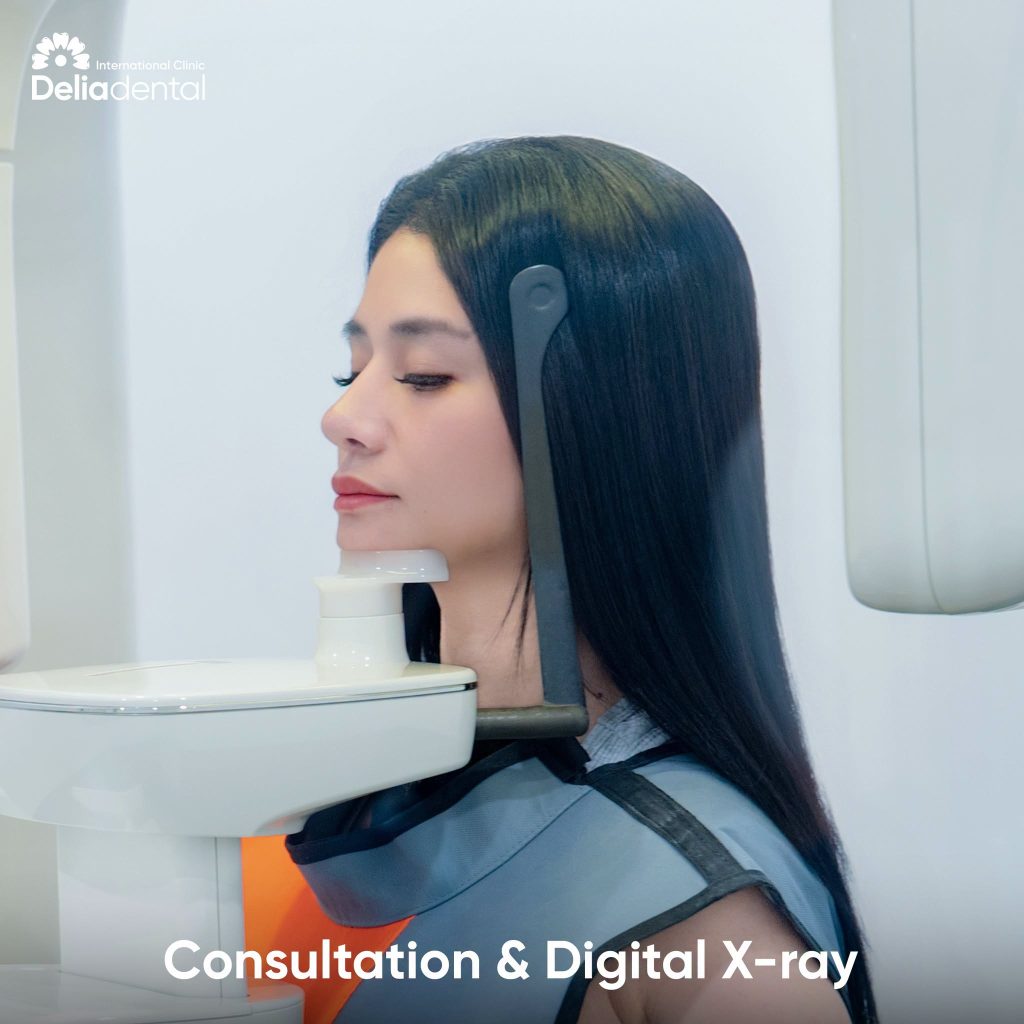
Radiation Exposure Is Higher for CBCT, But the Difference Is Small in Absolute Terms
Patients sometimes hesitate at CBCT because of the word “CT,” expecting hospital level radiation. The actual numbers are closer together than that association suggests. A dental panoramic radiograph typically delivers an effective dose in the range of 4 to 28 microsieverts, while a dental CBCT scan for implant planning generally falls in a range of roughly 20 to 200 microsieverts depending on the field of view and the scanner used, with most implant focused scans on the lower end of that range since a small or medium field of view covers only the relevant jaw section. For comparison, average annual background radiation exposure is around 2,400 to 2,700 microsieverts, meaning even a higher dose CBCT scan is a small fraction of a year’s typical background exposure.
This is not a reason to treat CBCT as risk free or to request one when it is not indicated for other imaging purposes, and dentists are still expected to select the smallest field of view that answers the clinical question. It does mean that for a patient specifically weighing a CBCT scan against a panoramic X-ray for implant planning, the radiation difference is a minor factor next to the planning accuracy difference described above.
What to Ask a Clinic That Skips CBCT for Your Case
A clinic offering to plan an implant from a panoramic X-ray or dental photos is not automatically cutting corners, particularly for a single lower posterior tooth with obviously adequate bone on the image. It is worth asking a few direct questions before accepting that plan as final rather than preliminary.
- Is this plan based on the panoramic image alone, or will a CBCT scan happen once I am at the clinic before the surgical date is confirmed
- Does my case involve the upper jaw near the sinus, a site with a history of gum disease, or any visible sign of reduced bone height on the panoramic image
- If the clinic sees something on the CBCT that changes the plan discussed remotely, what happens to the quoted price and the number of days needed
- Is a surgical guide part of the plan, since guided surgery is one of the situations where three dimensional imaging is treated as necessary rather than optional in published guidelines
A clinic that answers these specifically, and is clear about which parts of the remote plan are preliminary versus confirmed, is giving useful information regardless of whether its standard protocol requires CBCT for every case or reserves it for flagged ones.
How Delia Dental Clinic Uses CBCT in the Treatment Timeline
At Delia Dental Clinic in Hanoi and Ho Chi Minh City, the CBCT scan happens on arrival, before the surgical plan is finalized, for every implant patient. Photos, an existing X-ray, or an old panoramic image sent before travel are used to give an initial read on whether the case looks straightforward, whether grafting is likely, and roughly how many trips the treatment is expected to need, so the patient can plan flights and time off with a reasonable estimate. That estimate is explicitly preliminary, and Delia Dental Clinic does not confirm final implant brand, size, position, or grafting need until the CBCT has been reviewed in person alongside a clinical exam.
For patients with long standing tooth loss, prior periodontal disease, or visible bone loss on any earlier imaging, the CBCT scan is where the actual decision about grafting gets made, since a 2D image cannot determine bone volume with the precision that decision requires. Patients can request to see their own CBCT images and have the findings explained before the surgical plan is finalized, which gives an opportunity to ask about anything the scan shows that was not visible on the imaging sent before travel.
Frequently Asked Questions
Will my treatment quote change after the CBCT scan?
It can. Quotes based on a panoramic X-ray or photos sent before travel are preliminary estimates built from what could be seen in a 2D image, and the CBCT scan is what confirms bone density, volume, and the actual distance to nearby anatomical structures. If the CBCT shows bone grafting is needed where the preliminary plan did not anticipate it, or shows the case is more straightforward than expected, the plan and the price can shift in either direction. Confirming this possibility with the clinic before travel is more useful than assuming the initial number is final.
Can I bring a CBCT scan I already had done at home instead of getting a new one in Vietnam?
This depends on how recent the scan is and whether the clinic’s dentist can access the raw imaging file rather than only a written report. A CBCT scan taken months earlier may not reflect current bone conditions if teeth have been extracted or bone has changed since, and a written radiology report alone does not give the treatment planning software the data it needs. Ask the clinic in advance whether a prior scan file would be accepted and in what format, rather than assuming it will substitute for an in clinic scan.
Is a CBCT scan painful or does it take a long time?
No. A CBCT scan is not painful and generally takes only a few minutes for the actual scan itself, similar in experience to a panoramic X-ray, since the patient stands or sits still while the scanner rotates around the head. Most of the appointment time associated with imaging goes to positioning and image processing rather than the scan itself.
Does every clinic in Vietnam require a CBCT scan before implants?
No, and this is exactly why comparing quotes between clinics can be confusing. Some clinics plan simple single implant cases from a panoramic X-ray alone and only request CBCT for cases that show signs of complexity, which is consistent with what published guidelines technically allow. Delia Dental Clinic requires CBCT for every implant patient as a fixed part of its protocol, which is a stricter standard than the published minimum, adopted specifically because remote imaging cannot substitute for an in person clinical exam before travel.
If my case is a single straightforward implant, am I paying for a scan I do not need?
Not in the sense of the scan being wasted. Research supports panoramic imaging being adequate for some straightforward posterior mandibular cases, but that finding is a population level average from studies, not a guarantee for any individual patient’s anatomy. A CBCT scan on a case that turns out to be simple still confirms bone density and the safety margin to the nerve canal precisely rather than by visual estimate, and for a patient who has already traveled internationally, that confirmation removes the risk of a mid treatment surprise that a domestic patient could resolve with a same week follow up scan.
Understanding What Happens Before Your Implant Surgery
These guides cover the planning and quote questions that typically come up alongside imaging.
- How to Read a Dental Implant Itemised Quote Before You Deposit
- Comparing Quotes From Multiple Vietnam Clinics Without Getting Confused
- Sinus Lift Before Dental Implants in the Upper Jaw
- Second Opinion on Dental Treatment in Vietnam
Final Thoughts
CBCT is not a mandatory step for every implant case under published radiology guidelines, and panoramic imaging has real research support for straightforward posterior mandibular cases with adequate visible bone. Delia Dental Clinic still requires a CBCT scan for every implant patient because the accuracy gap between the two imaging types, however small on average, is a bigger risk for an international patient who cannot easily return the following week if a panoramic based plan turns out to be wrong.
If you are planning implant treatment in Vietnam, send your existing X-rays, CBCT files if you have them, or photos to Delia Dental Clinic via WhatsApp or Messenger for a preliminary read, understanding that the confirmed plan and pricing follow the in clinic CBCT scan.


