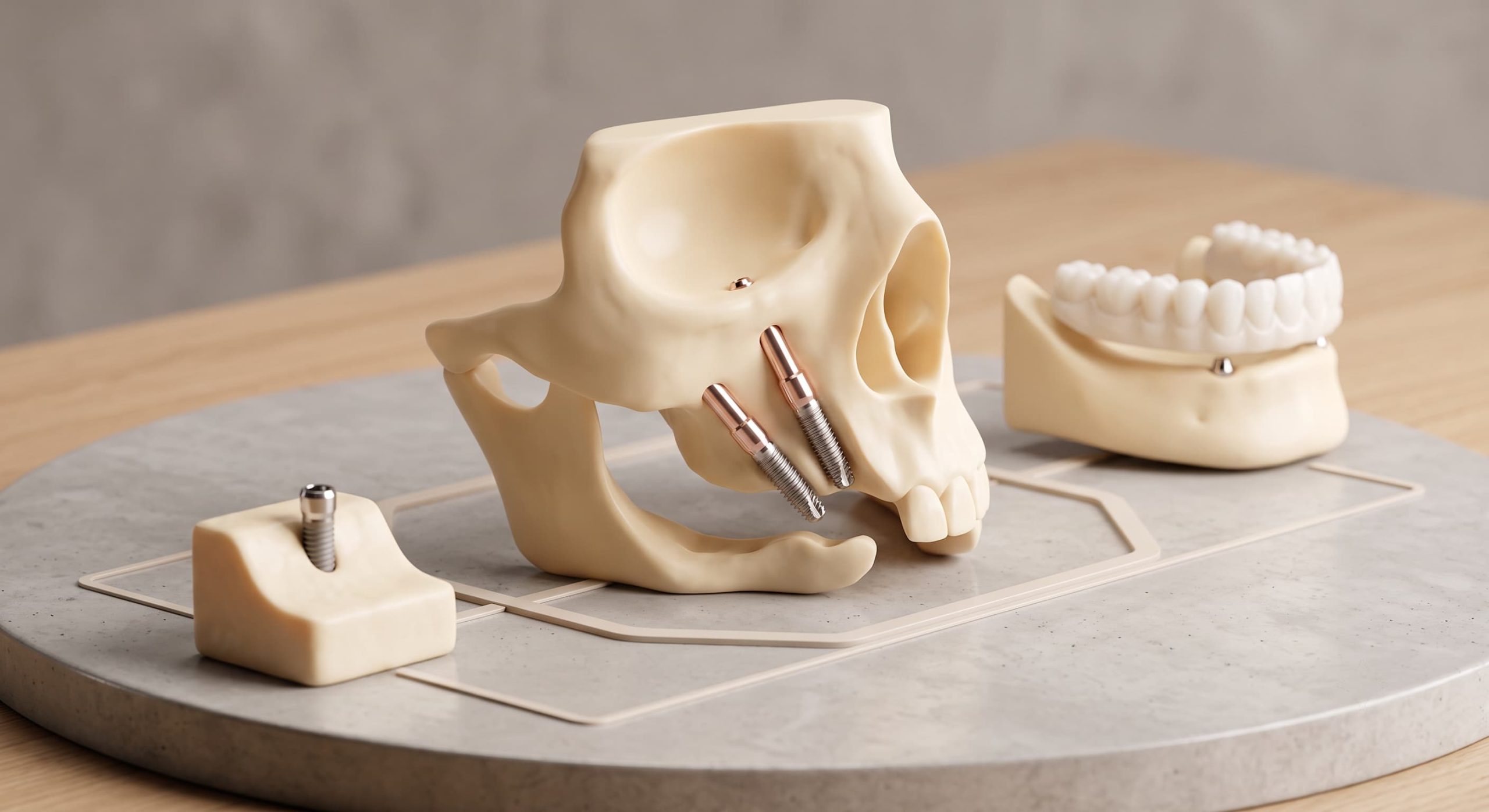
Most patients who reach the point of researching zygomatic implants have already been told something discouraging elsewhere. A dentist at home has said there is not enough bone for standard implants, not enough even for All-on-4, and the remaining options presented were usually extensive bone grafting or a removable denture. Zygomatic implants are the option that rarely gets mentioned in that conversation, largely because few clinics are set up to place them.
This is not an upgrade for anyone who simply wants a shorter timeline or a more advanced sounding procedure. Zygomatic implants solve one specific problem: a maxilla, the upper jaw, that has lost so much bone that no combination of grafting and standard implants is realistic within a reasonable timeframe. The anchor point itself is different, and that difference is what makes the rest of the plan change.
This guide covers what a zygomatic implant actually is, where the line sits between this and a standard All-on-4 or bone grafting plan, who tends to be considered a candidate, and why this decision cannot be made from photos or a description alone.
Quick Answer
Zygomatic implants anchor into the cheekbone instead of the upper jaw, and are generally considered when maxillary bone loss is too severe for standard implants or All-on-4, even with grafting. Unlike bone grafting, they work with bone that is already there rather than rebuilding what was lost. Candidacy always requires a current CT or CBCT scan and evaluation by a surgeon trained specifically in this technique.
What Are Zygomatic Implants And Why Do They Anchor Differently
A zygomatic implant is considerably longer than a standard dental implant, typically in the range of 30 to 55 millimeters compared to the 8 to 15 millimeters used for a conventional implant. Instead of being placed straight down into the upper jawbone, it is angled through the maxilla and extends into the zygomatic bone, the dense bone that forms the cheekbone.
The reason for this different anchor point is mechanical rather than cosmetic. The zygomatic bone does not go through the same resorption process as the maxilla does after teeth are lost. Where the jawbone can shrink year after year once it no longer holds a tooth root, the cheekbone stays structurally stable regardless of what has happened to the teeth or gums above it. That stability is what allows a zygomatic implant to provide secure support in a jaw that could not hold a standard implant at all.
Because the cheekbone is denser and more solid than resorbed jawbone, some cases allow a temporary prosthesis to be attached and loaded soon after surgery, something that is often not realistic with grafted bone that still needs months to integrate.
When Maxillary Bone Loss Is Severe Enough To Change The Plan
Not every patient with some bone loss needs to consider this route. The situations that typically push a case toward a zygomatic conversation share a common thread: the upper jaw has lost bone through a process that is difficult or slow to reverse with grafting alone.
| Cause | Why It Reduces Usable Bone |
|---|---|
| Long term denture wear | The jawbone continues to resorb over years once it no longer carries the load of a tooth root or implant |
| Sinus pneumatization | The maxillary sinus expands over time and can occupy space that would otherwise be used for implant placement |
| Trauma | Facial or jaw injury can remove bone structure directly, sometimes in an area needed for standard implant anchorage |
| Tumor resection | Surgery to remove a tumor in the jaw can take a section of bone along with it |
Any one of these on its own does not automatically mean zygomatic implants are the answer. What matters is how much usable bone volume remains in the upper jaw once these factors are accounted for, and that number can only be measured on a current scan, not estimated from history alone.
Zygomatic Implants Vs Standard Implants Or All-on-4
All-on-4 still requires enough bone at four specific points in the upper jaw to anchor the implants securely, even though the technique itself was designed to work with somewhat less bone than older approaches by angling the posterior implants. When that minimum is not present anywhere in the arch, even after bone grafting has been attempted or considered, a standard implant plan or All-on-4 stops being a realistic option regardless of how the case is otherwise managed.
This is the boundary that separates the two conversations. Zygomatic implants are not compared against All-on-4 as a better or more premium version of the same procedure. They come into consideration specifically at the point where All-on-4 is no longer achievable with the bone that is there, which is a smaller and more specific group of patients than the general population asking about full arch implants.
Zygomatic Implants Vs Bone Grafting: Two Different Solutions To The Same Problem
Both zygomatic implants and bone grafting exist to solve the same underlying issue, an upper jaw that does not have enough bone for standard implants. They solve it in opposite ways, and the choice between them usually comes down to how much bone loss there is and how much time and additional surgery a patient is prepared to go through.
| Factor | Bone Grafting | Zygomatic Implants |
|---|---|---|
| Approach | Rebuilds the bone that has been lost before standard implants can be placed | Uses the existing zygomatic bone instead of rebuilding the jaw |
| Typical number of surgical stages | Usually several stages, with healing time needed before implants can be placed | Implant placement and a temporary prosthesis can often happen in the same surgery |
| Overall timeline | Generally longer, due to the graft integration period | Generally shorter, since the graft integration wait is removed |
| Who tends to be considered | Cases where bone can realistically be rebuilt and a longer timeline is acceptable | Cases with severe atrophy, prior failed grafting, or a strong preference to avoid extensive grafting |
Neither option is inherently better. A patient with moderate bone loss and no urgency may be a better fit for grafting, since it works with the body’s own healing process to restore what was lost. A patient with severe, long-standing atrophy, or someone who has already gone through a failed graft, is more often the person for whom a zygomatic approach gets raised as a serious option.
Who Tends To Be Considered A Candidate
The following pattern tends to describe patients for whom this conversation is worth having, though every point still needs to be confirmed on imaging and by direct examination.
- Severe upper jaw bone loss that would not support standard implants even after grafting
- A prior bone graft that failed, or an unwillingness to go through extensive grafting
- Long term removable denture wear with a strong preference to move to a fixed prosthesis
- Adequate volume and density in the zygomatic bone itself, confirmed on a CT or CBCT scan
- No active sinus infection at the time of evaluation
A few situations tend to move a case away from this option rather than toward it:
- Chronic sinus disease that has not been brought under control
- Insufficient volume in the zygomatic bone itself, which does happen and removes this option entirely
- Certain general health conditions that a surgeon would need to assess independently before considering a more complex procedure
What Changes About The Surgical And Recovery Process
This is a more involved surgery than a standard implant placement, and the process around it reflects that. A CT or CBCT scan is not optional here, it is the basis for the entire surgical plan, since the surgeon needs to see the exact path the implant will travel through the maxilla and into the zygomatic bone before any incision is made. Surgery itself commonly takes place under general anesthesia or sedation rather than local anesthesia alone, and the procedure typically takes longer than placing standard implants.
The number of zygomatic implants used, commonly two or four depending on how much usable bone remains at the front of the jaw, is decided during this same evaluation rather than chosen in advance. Because the zygomatic bone is dense and stable, a number of cases allow a temporary fixed prosthesis to be attached soon after surgery, letting the patient leave with functional teeth rather than waiting through the kind of healing period a bone graft would require.
Risks And Complications Specific To Zygomatic Implants
The complication profile here is different from a standard implant, and patients considering this route should understand that difference rather than assuming the risks are the same as any other implant procedure. Because the implant path runs close to or through the sinus cavity, sinus related complications such as sinusitis are a recognized risk that does not apply to standard jaw implants. An oro-antral fistula, an abnormal opening between the mouth and the sinus, is another complication specific to this anatomy.
The technical demands of the surgery also mean that outcomes are closely tied to the surgeon’s specific training and experience with this technique, more so than with routine implant placement. Published research generally reports long term survival rates for zygomatic implants that compare favorably with bone grafting combined with standard implants in appropriately selected cases, but results vary across studies and are closely linked to case selection and surgical experience. This is a conversation to have directly with the treating surgeon rather than a figure to take from any single source, including this article.
Delia Dental Clinic’s Role In Reviewing A Severe Bone Loss Case
For patients who believe they may be in this situation, Delia Dental Clinic can review a recent CT or CBCT scan, or a panoramic X-ray if that is the only imaging available, along with a description of denture history, any prior grafting attempts, and how long the bone loss has been present. From that information, Delia Dental Clinic can give an initial sense of whether the case looks consistent with severe maxillary atrophy that would warrant a specialist conversation, or whether a more standard implant or All-on-4 path may still be realistic.
What this kind of remote review cannot do is confirm the volume or density of the zygomatic bone itself, decide how many zygomatic implants a case would need, or replace a direct examination and a new 3D scan taken specifically for surgical planning. Patients considering this option should expect the actual candidacy decision, and the surgical plan itself, to be confirmed only after an in person evaluation with imaging taken in Hanoi or Ho Chi Minh City.
Frequently Asked Questions
Is A Zygomatic Implant More Expensive Than A Standard Implant Or All-on-4?
Zygomatic implants are a more complex surgical procedure than a standard implant or a typical All-on-4 case, and cost is case specific rather than something that can be quoted as a fixed figure without a scan. Anyone comparing quotes across clinics should confirm exactly what is included, since figures found online for this procedure vary widely and are often not directly comparable.
Can Zygomatic Implants Be Combined With All-on-4 In The Same Arch?
In some cases, yes. Where there is still usable bone at the front of the upper jaw, a plan may combine zygomatic implants at the back with standard implants at the front, rather than relying entirely on zygomatic anchorage. Whether this applies to a specific case depends on how much anterior bone remains, which is confirmed on imaging rather than assumed in advance.
How Does Recovery Compare To A Standard Implant?
Recovery generally involves a longer surgical procedure and a period of swelling and adjustment that tends to be more noticeable than after a standard implant placement, given the more extensive nature of the surgery. Because the zygomatic bone provides strong initial stability, some patients are able to use a temporary fixed prosthesis relatively soon after surgery, which is not always the case with grafted bone still integrating.
Does Every Implant Dentist Perform Zygomatic Implants?
No. This procedure requires specific surgical training beyond general implant dentistry, given the anatomy involved and the proximity to the sinus. It is reasonable, and generally advisable, to ask directly whether the surgeon evaluating a case has specific experience with zygomatic implant placement rather than assuming any implant dentist can perform it.
What Happens If The Zygomatic Bone Itself Is Not Adequate Either?
This does happen in a smaller number of cases, and it removes zygomatic implants as an option. When neither the maxilla nor the zygomatic bone can support implants, the remaining paths typically involve more extensive bone reconstruction or continuing with a removable prosthesis, and this would be a direct discussion with the treating surgeon based on the specific scan findings.
Final Thoughts
Zygomatic implants are not a shortcut or a premium alternative for patients who simply want to avoid bone grafting. They exist for a specific and fairly narrow group of cases where the upper jaw has lost more bone than grafting can realistically restore within a reasonable timeframe. Whether a specific case fits that description is not something that can be judged from a description of symptoms or history alone, it depends on what a current CT or CBCT scan actually shows.
Send a recent CT or CBCT scan, or a panoramic X-ray if that is all you have, along with a short history of your bone loss or denture experience via WhatsApp or Messenger. Delia Dental Clinic can give an initial read on whether your case looks like a severe atrophy situation worth discussing further, or whether a more standard path remains open. Any final direction is confirmed after an in person evaluation in Hanoi or Ho Chi Minh City.


