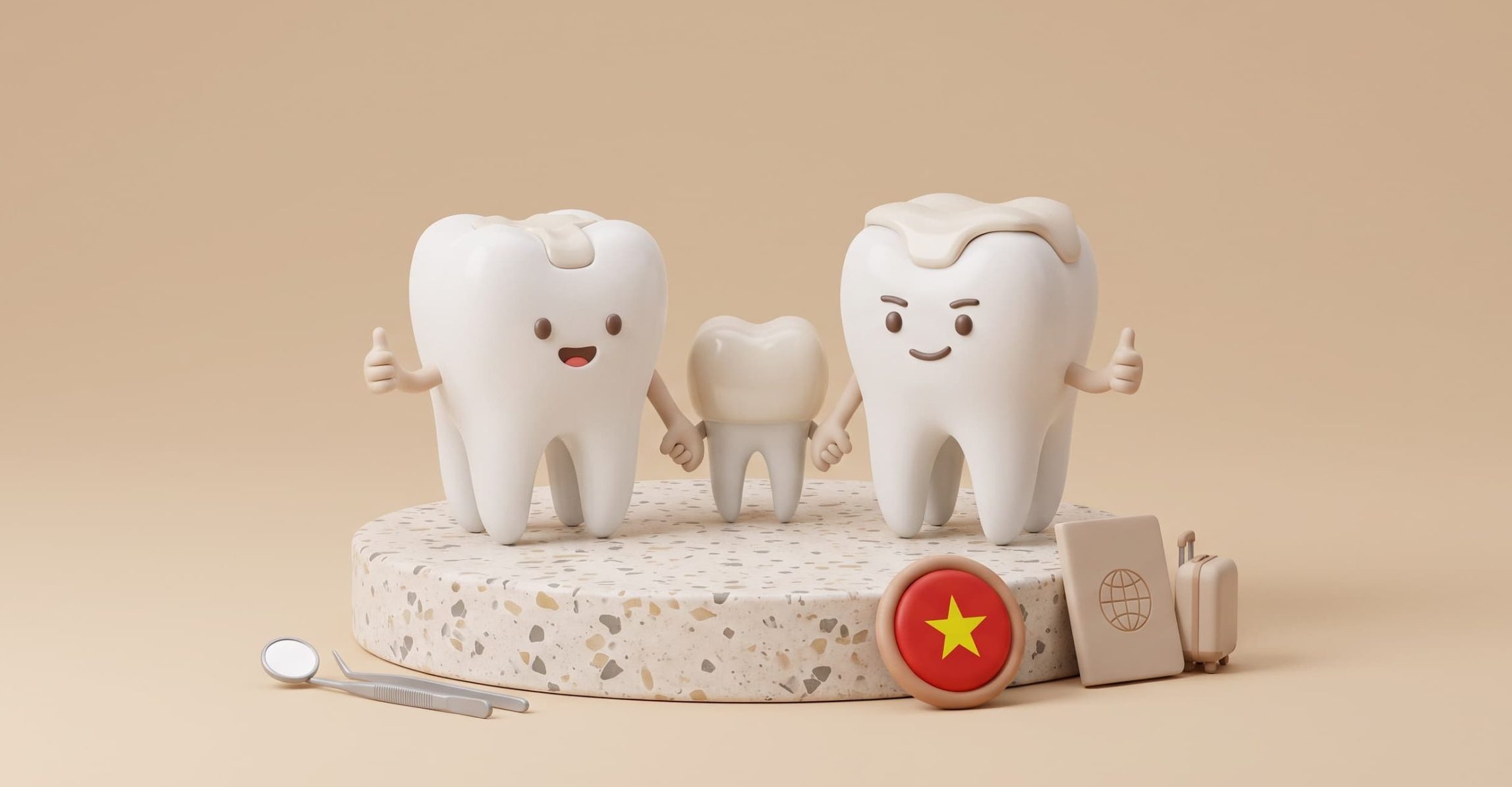
When a dentist looks at a molar with a large, ageing filling and recommends a full crown, many patients start asking about inlays and onlays instead. Grinding down a whole tooth often feels like a bigger step than it deserves, especially when most of the outer wall is still sound and the damage sits in just one part of the chewing surface.
Inlays and onlays are the middle option. They are made in a dental laboratory, usually from ceramic, and bonded into the tooth to replace only the damaged section. A crown, by contrast, reshapes the whole tooth and covers it. Which one suits a given molar depends on how much healthy structure remains, where the damage sits and how hard the tooth works when you bite, not on which procedure sounds more conservative.
This guide explains how inlays, onlays and crowns differ, which cases tend to suit a partial restoration, how the treatment is carried out, what shapes the quote, and what to send Delia Dental Clinic in Hanoi or Ho Chi Minh City before you book flights for tooth repair abroad.
Quick Answer
An inlay or onlay can replace a damaged part of a back tooth while keeping more healthy structure than a crown, provided enough sound tooth remains to support it. A crown is usually safer when walls are thin, cracked deeply, or heavily broken. The choice is confirmed after clinical examination and imaging.
What Inlays, Onlays And Crowns Each Cover
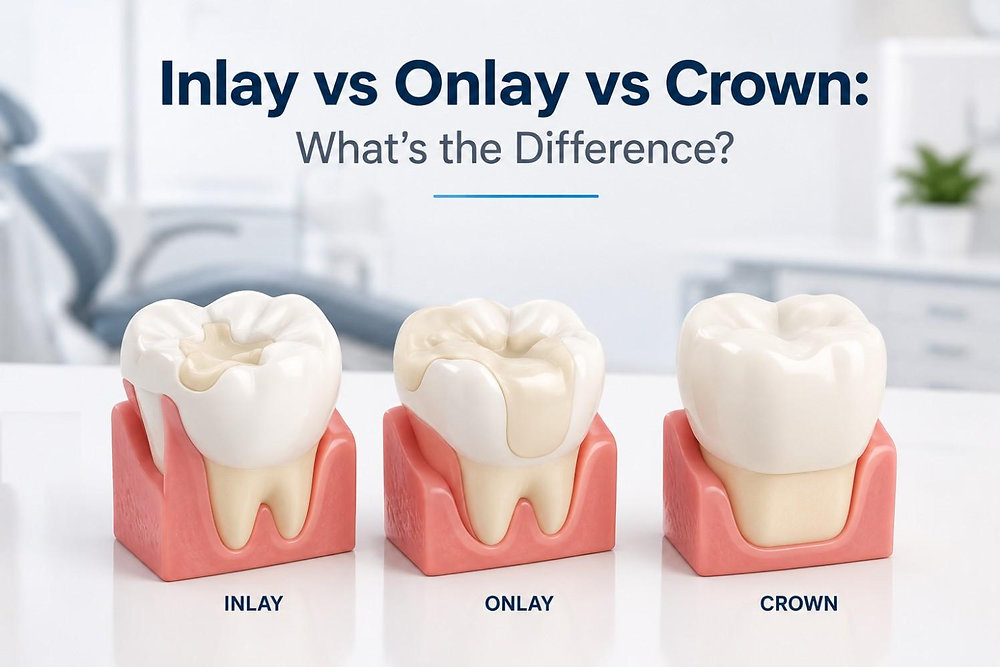
The three restorations differ by how much of the tooth they replace. An inlay sits inside the grooves of the chewing surface, between the cusps (the raised points of a molar). An onlay does the same and also extends over one or more cusps. A crown wraps the entire visible tooth above the gumline. An onlay that covers most of the cusps is sometimes called a partial crown, which is why patients searching for one term often land on pages about the other.
| Restoration | What it replaces | Natural tooth removed | Typical use |
|---|---|---|---|
| Inlay | Damage inside the cusps, within the chewing surface | Least | Moderate decay or an old filling that has failed, with all cusps intact |
| Onlay | Damage that involves one or more cusps | Moderate | Larger fillings, a cracked cusp, decay spreading toward the edges |
| Crown | The whole tooth above the gum | Most | Heavy structure loss, deep cracks, teeth after root canal treatment, major reshaping |
Compared with a direct filling placed in one visit, inlays and onlays are fabricated outside the mouth from a scan or impression. That gives the laboratory control over the contact with the neighbouring tooth and the shape of the biting surface, which is hard to achieve when a large cavity is rebuilt by hand with composite.
When A Partial Restoration Is Usually Enough
A partial restoration works when the tooth still has enough sound structure to carry the bite and to hold the bonded ceramic. Dentists assess this by looking at the remaining walls, the depth of the damage and the position of the edges, then confirming it on X-rays.
Conditions That Often Favour An Inlay Or Onlay
- A large old filling that is leaking, cracked or breaking away, with solid tooth around it
- Decay that is moderate in size and removable without undermining the cusps
- A cracked cusp where the crack does not run deep toward the root
- A tooth that needs more strength than a filling provides but where cutting it down for a crown would remove healthy structure
- Edges of the damage that sit above or at the gumline, which makes clean bonding more predictable
Why Keeping Tooth Structure Matters
Every restoration is a trade between what you replace and what you remove to make room for it. Preparing a tooth for a crown typically involves reducing it on all sides, while an onlay preparation is limited to the damaged area and the cusps that need protection. A tooth with more of its original structure left usually has more options if it needs treatment again in the future. That is the main argument for a partial restoration, and it holds only when the remaining tooth is strong enough to justify it.
When A Full Crown Is The Safer Choice
An onlay bonded to a weak tooth can fail early, so a crown is not an upgrade to be avoided but the correct answer in some cases. A crown is usually the safer choice when the tooth has lost most of its walls, when a crack runs deep, or when the margins of the damage sit well below the gumline where bonding is difficult to control.
Teeth that have had root canal treatment often fall into this group, because they tend to have lost structure through decay and access preparation. The decision is not automatic, though, and it depends on what remains.
Bite habits also matter. A patient who grinds heavily at night places more load on every restoration, and a thin ceramic onlay on a molar with several weakened cusps may not carry that load as well as full coverage would. Your dentist weighs this against the other findings rather than treating grinding as an automatic exclusion.
Some teeth cannot be restored with either option. Deep decay into the root, a vertical root fracture or severe gum and bone loss around the tooth may point toward extraction and a different replacement plan. This is another reason a photo review can only ever suggest a direction.
Checking The Pulp Before Any Restoration
Before choosing between a partial restoration and a crown, the dentist needs to know whether the pulp inside the tooth is healthy. Spontaneous pain, pain that wakes you at night, or cold and heat sensitivity that lingers after the stimulus is removed can point to a pulp problem, although none of these confirms the diagnosis on its own. A tooth can also have a damaged pulp without causing pain, so being comfortable does not rule it out.
The dentist usually combines your symptom history, cold or other pulp testing, tapping and bite tests, a clinical examination and X-rays. If the pulp is involved, root canal treatment comes first, which can add appointments and cost and can shift the plan toward full coverage. The guide on whether you need a root canal before a crown in Vietnam explains how this decision is made.
How An Inlay Or Onlay Is Made
The exact sequence varies by clinic and case, and your dentist confirms it at the consultation. A typical workflow runs as follows.
- Examination, X-rays, and pulp and bite tests to confirm the tooth is a candidate.
- Removal of the old filling or decay, then a check of how much sound structure is left. This is the point where a planned onlay can change to a crown if the tooth turns out weaker than the X-ray suggested.
- Shaping of the cavity so the restoration can fit and sit securely.
- A digital scan or impression, and shade selection, followed by a temporary restoration to protect the tooth.
- Fabrication of the restoration in the laboratory.
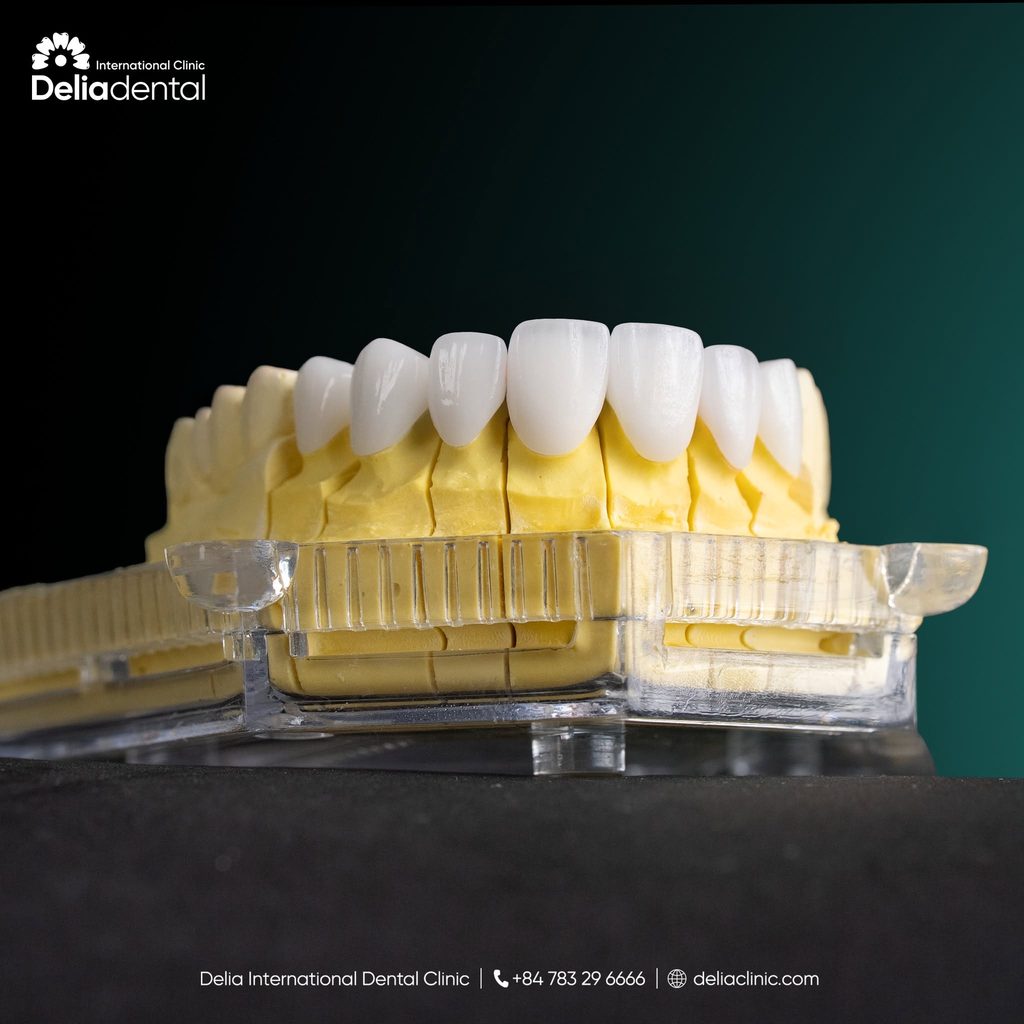
- A second visit to try in the restoration, check the fit and contact with neighbouring teeth, bond it in place, polish it and check the bite.
Because step 2 can change the plan, a quote given before the old filling is removed is an estimate rather than a final price.
Onlay Restoration Cost In Vietnam: What Shapes The Quote
Delia Dental Clinic’s published crown price list does not cover inlays or onlays, and a reliable figure cannot be given without seeing the tooth, so any online number for a specific case should be treated as a rough indication at most. What can be explained is what moves the quote up or down.
| Cost factor | How it affects the quote |
|---|---|
| Material | Ceramic type, strength and appearance requirements change laboratory cost |
| Size of the restoration | One surface, two surfaces or full cusp coverage need different amounts of laboratory work |
| Number of teeth | Treating several teeth in one trip can be planned together |
| Preparation needed first | Decay removal, a core buildup under the restoration, or gum treatment may be billed separately |
| Root canal treatment | If the pulp is involved, the tooth needs treatment before any restoration |
| Imaging and temporary restoration | May be itemised separately, so ask whether they are included |
| Bite adjustments | Teeth that need bite changes may take extra time at fitting |
For a reference point, Delia Dental Clinic’s standard crown prices run from $190 per tooth for Ceramill to $290 for E.max and up to $1,150 for Orodent Innovation. The crown price covers the selected crown, laboratory fabrication, fitting and final placement, while imaging, root canal treatment, core buildups, posts, temporary restorations and other preliminary care may be added to the quote. The full range is broken down in the guide on dental crown cost in Vietnam, and it is a useful ceiling when comparing a partial restoration with full coverage on the same tooth.
A partial restoration is not guaranteed to cost less than a crown. The ceramic and laboratory work can be comparable, and the real saving usually comes from keeping more of the tooth. Warranty terms also differ by material. Delia Dental Clinic’s published crown warranties range from 10 years to lifetime depending on the system, and any warranty for an inlay or onlay should be confirmed in writing. A warranty is not a promise that a restoration will never need repair or replacement.
An itemised written quote after review is the only way to compare the two options for your case.

How Many Days To Plan For A Short Trip
An inlay or onlay normally needs two stages, much like a crown. The first visit covers examination, tooth preparation and a scan or impression, and the second covers fitting and bonding after the laboratory has made the restoration. A temporary restoration protects the tooth in between, and the gap depends on laboratory turnaround and the clinic’s workflow, so it is confirmed when the plan is made rather than assumed.
Straightforward cases often fit within a single trip. The stay lengthens when anything needs treating first, such as active decay beneath an old filling, an infection or a root canal. It also lengthens when several teeth are treated together, and when bite adjustments are needed after bonding.
Avoid booking the return flight for the day after the final fitting. A buffer day costs little and leaves room for an adjustment if the bite feels uneven. The usual appointment pattern for restorations is covered in the guide on how long dental crowns take in Vietnam.
What To Send Before You Book A Flight
A remote review can help narrow down whether an onlay is realistic, but it cannot confirm it. The more you send, the less of the plan has to be left open.
- Recent dental X-rays, ideally bitewing or periapical images of the tooth in question
- Close, well lit photos of the tooth from above and from the side
- Any existing quote or treatment plan that recommends a crown or onlay
- A short description of symptoms, such as sensitivity to cold, pain on biting or a filling that has broken
- Notes on when the last filling or restoration was placed
- A medication and allergy list, and your planned travel dates
Guidance on what an X-ray can and cannot confirm before a trip is in the article on remote X-ray assessment for dental work in Vietnam. The same limits apply to partial restorations. Images show decay and bone, but pulp health, the strength of the remaining tooth and the way the bite behaves are judged in person.
How Delia Dental Clinic Reviews A Tooth For A Partial Restoration Or A Crown
Delia Dental Clinic, with branches in Hanoi and Ho Chi Minh City, treats the choice between a partial restoration and a crown as a tooth by tooth decision made after examination, not as a package picked in advance. International patients can send photographs, recent X-rays, treatment records or an existing quote through WhatsApp or Messenger before travelling. The international patient team reviews them, suggests a preliminary direction and lists what still has to be confirmed in the clinic, so you are not travelling on a guess.
In person, the dentist follows the workflow described above. The tooth is examined, tested and imaged, old restorations are assessed and the remaining structure is judged before the restoration is chosen. If the tooth has enough sound structure and an inlay or onlay is clinically suitable, a partial restoration can be proposed. If it does not, the plan moves to full coverage, with the reason explained before treatment begins. Where a crown is the answer, the options include E.max and several zirconia systems, and the choice is made tooth by tooth.
The written plan should state whether a root canal is confirmed, excluded on current findings or still possible, and which items are priced separately. The remote estimate is preliminary, and the final plan and price are confirmed after the in person examination.
Frequently Asked Questions
Is An Onlay Weaker Than A Crown?
Not by default. A well bonded ceramic onlay can restore strength to a tooth that still has solid walls, because the bond helps the restoration and the tooth work as one unit. A crown covers more of the tooth, which gives it an advantage when the remaining structure is thin or cracked. The right comparison is between the two on your particular tooth, not between the procedures in general.
Can I Have An Onlay On A Tooth That Has Had A Root Canal?
Sometimes, but it depends on how much structure was lost before and during the root canal treatment. Many root canal treated teeth have thin walls and benefit from full coverage, while others retain enough solid tooth for a partial restoration. The dentist usually decides this from the X-ray and from what is visible once the old filling material has been removed.
Does An Onlay Cost Less Than A Crown In Vietnam?
Not always. The ceramic and the laboratory work are similar in many cases, so the difference in price is often small. The real benefit of an onlay is usually keeping more natural tooth, not paying less. Ask for an itemised quote for both options on the same tooth so you can compare them directly.
How Long Does An Inlay Or Onlay Last?
Lifespan depends on the material, the amount of tooth structure that remains, the bite, grinding habits and how well the edges are cleaned. Well made ceramic restorations are commonly expected to last for many years, but no dentist can promise a specific number for an individual tooth. Regular checkups and keeping the margins clean make the biggest difference.
What Happens If An Onlay Comes Loose After I Fly Home?
A loose or chipped restoration should be seen by a dentist promptly, because bacteria can enter the gap and decay can develop under it. Keep the restoration if it comes out and avoid chewing on that side. Send photos and a short description to Delia Dental Clinic so the team can advise on next steps, and have a local dentist assess the tooth if there is pain or swelling.
Can An Onlay Be Completed In One Trip?
For a single straightforward tooth it usually can, because the two stages can be planned within one stay. Cases that involve infection, a root canal, several teeth or later bite adjustments need more time. The schedule is set after the examination, and it should be built around the clinical plan rather than a fixed travel date.
Choosing The Right Material And Planning The Trip
If the tooth needs a crown after all, these guides cover the material choice and the practical steps that come next.
- E.max Crown Procedure in Vietnam
- Zirconia Crowns in Vietnam Guide
- Dental Crowns Timeline in Vietnam
- Dental Crowns in Vietnam Aftercare Tips
Final Thoughts
The best restoration is the one that fits the amount of tooth you still have. An onlay makes sense when sound structure remains and the damage is contained, and a crown makes sense when it does not. Neither is better in the abstract, and a plan that explains why one was chosen over the other is a good sign in any clinic.
If you are considering tooth repair abroad, send your recent X-rays, close photos of the tooth and any existing quote to Delia Dental Clinic through WhatsApp or Messenger before booking flights. The international patient team can review what you send, suggest a preliminary direction and help estimate the likely cost and travel timeline for Hanoi or Ho Chi Minh City. The final treatment plan and quote are confirmed after an in person examination.


