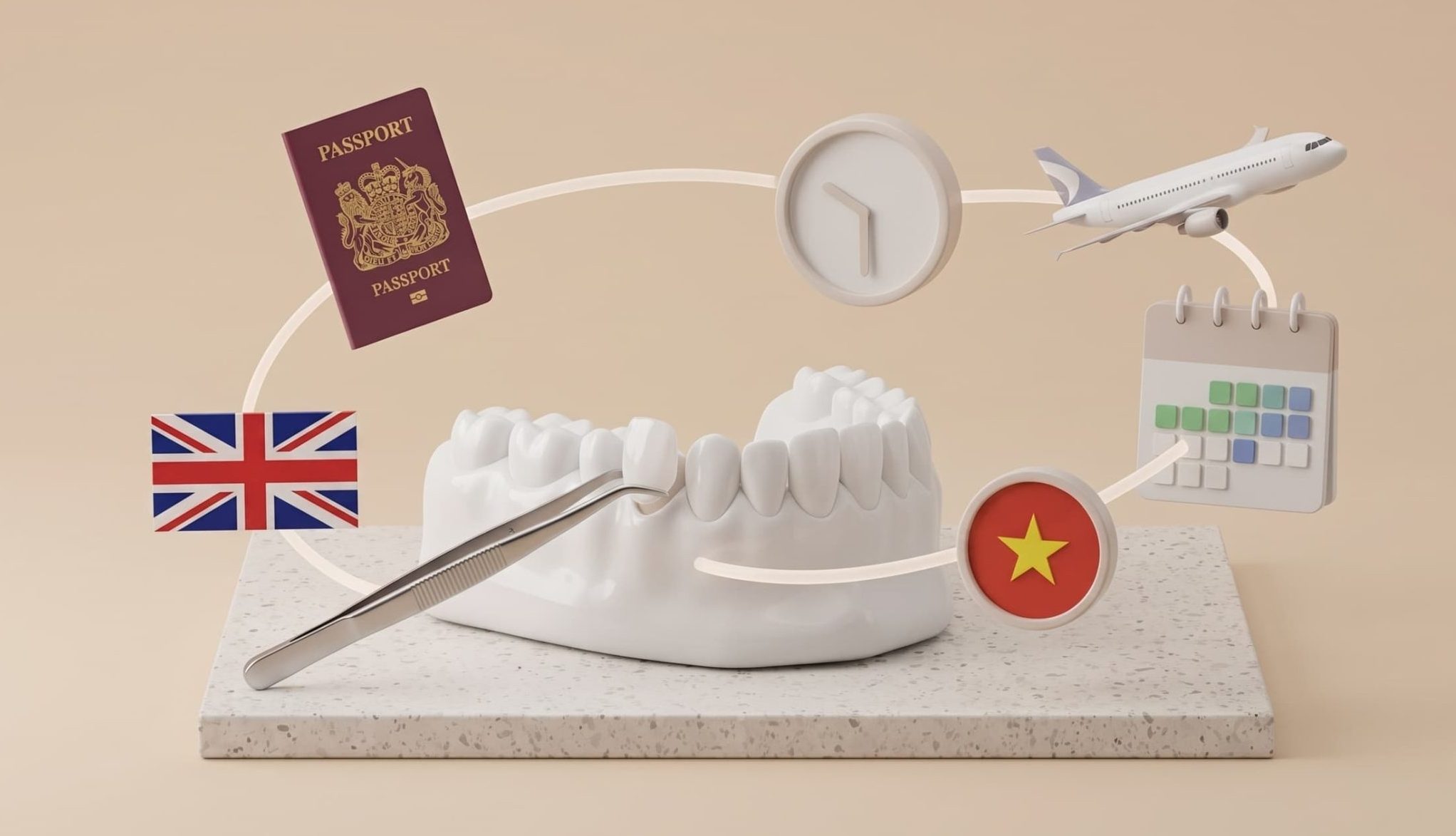
UK patients have direct flights to both Hanoi and Ho Chi Minh City, which removes most of the connection risk that affects patients booking a dental crown trip from other markets. That advantage does not extend to the clinical schedule itself. A direct flight makes a return date easier to move if one needs moving. It says nothing about whether one needs moving in the first place.
The question that actually decides how the trip goes is not which day the flight leaves. It is how much space sits between the final cementation appointment and that departure, since that gap is what determines whether a bite issue found at fitting can still be sorted out before the patient leaves the country.
Quick answer
A straightforward UK crown trip follows the same working day estimate as any other crown case. What is specific to a direct UK routing is that the flight itself is easy to move, which can tempt patients into booking the return date right against the final appointment rather than leaving room for a same day bite recheck. One buffer day after the planned cementation date is worth keeping regardless of how flexible the flight is.
Why a Convenient Flight Can Work Against the Buffer
A direct route being easy to change if needed is not the same as a return date being safe to book tightly. Because moving a UK flight is usually a single change rather than a multi leg rebooking, some patients treat that flexibility as a reason to skip planning a buffer in the first place, assuming the flight can simply shift later if the crown is not ready.
This reasoning misses the actual constraint. The crown itself still needs the same laboratory turnaround and the same bite check regardless of how easy the flight is to move, and by the time a bite issue shows up at the fitting appointment, the patient is often already checked in for a flight departing that same evening.
A same day date change, even on a flexible fare, is not guaranteed. It depends on seat availability on that specific route on that specific day, and a Heathrow to Hanoi or Ho Chi Minh City service running a few times a week has far fewer available seats to shift into than a short-haul European route with several daily departures. Treating the direct flight as a fallback assumes availability that may not actually be there on short notice, particularly around UK school holidays or the Vietnamese New Year period when demand on the route rises.
There is also a cost side to this. A same day change on a fare that permits changes usually carries a smaller fee than a full reissue requested at the airport, and requesting the change as soon as a revised appointment date is known, rather than waiting to see whether the crown is ready, keeps that cost difference on the patient’s side rather than the airline’s.

Where the Pressure Actually Sits
The risk in a UK crown trip is not the flight route. It is the gap, or lack of one, between the final cementation appointment and departure.
A cementation appointment booked for the afternoon of the planned departure day, followed by an evening flight, leaves little time to notice and correct a bite issue before leaving the country. Most bite adjustments after cementation are resolved the same day, but that only works if there is time in the schedule to return to the chair, not if the patient is already at the airport.
A bite that feels slightly off immediately after cementation is common and does not necessarily mean something has gone wrong. Local anaesthetic can still be partially active, and the mouth needs a short period to register a new contact pattern accurately. What matters for a UK trip specifically is whether there is time left in the schedule to distinguish between that normal settling and an actual high spot that needs grinding down, since the two can feel similar in the first hour but are not the same thing to fly home with.
| Departure plan | What it allows for |
|---|---|
| Same day as final cementation | Almost no room for a same day bite recheck |
| One day after cementation | Enough time for a same day adjustment if the bite needs correcting |
| Two or more days after, multi crown case | More appropriate for cases involving four or more crowns or coordinated shade work across several teeth |
This is a scheduling decision, not a clinical one. The clinic cannot promise a case will need an adjustment, only that leaving no time for one removes the option if it does.
The number of crowns involved changes how likely that scenario is, not just how long the fitting appointment runs. A single crown meets one opposing tooth and has one contact pattern to settle. Four or more crowns across the same arch have to meet each other as well as the teeth around them, and adjusting one contact can shift how the next one feels, which is why a multi crown case is more likely to need a second look at fitting than a single crown is. This is a probability shift, not a guarantee that a bigger case will run into trouble. It is the reason the buffer is worth confirming against the actual treatment plan rather than assumed from a general rule about crown trips.
What Actually Happens During a Bite Check
A bite check at cementation is not a separate procedure booked as its own appointment. It happens in the same visit as the final fitting, typically using thin articulating paper the dentist asks the patient to bite on, which marks where the teeth are making contact. High spots show up as darker marks, and the dentist adjusts and polishes the crown surface until the contact pattern matches the rest of the bite.
For a single crown, this usually takes a few minutes once the crown is confirmed to sit correctly. For a multi crown case, checking contacts across several teeth, and confirming that adjusting one crown has not changed how it meets its neighbour, can take longer and may need to be repeated after each adjustment. This is the part of the appointment most likely to run past its scheduled length, which is the actual reason a buffer day matters more than the flight route.
If the crown is cemented permanently before this check is complete, correcting a bite problem afterwards is harder. A crown that is only temporarily seated can still be removed and reworked with relative ease. Once permanent cement has set, adjustment is usually still possible for a minor high spot, but a larger correction may mean remaking the crown rather than simply grinding it down, which is a different and longer process than a same day polish.

What to Ask Before the Final Appointment Is Booked
A few direct questions to the clinic before the cementation date is confirmed can remove most of the guesswork around whether the buffer is adequate for a specific case.
Worth confirming: whether the cementation appointment is provisional or fixed, since a provisional date built around lab turnaround can still shift by a day if fabrication runs long. Worth confirming: whether the crown will be cemented with temporary or permanent cement at that visit, since a temporary cementation leaves more room to adjust later without needing a full remake. Worth confirming: what happens procedurally if a bite issue is found and there is no time left in the schedule to fix it before departure, since the answer to that question is what actually determines how much buffer is needed rather than a general rule of thumb.
A single crown case has the least reason to need a bite recheck, since there are fewer contact points to coordinate. A case involving several crowns across the same arch has more surfaces that need to meet correctly, which is why a multi crown case carries a higher chance of a same day adjustment at the fitting appointment. This does not mean a multi crown case will need extra time. It means the buffer is more worth having, and worth confirming against the treatment plan rather than assumed from case size alone.
Patients combining a crown case with other treatment, such as a root canal identified during preparation, should treat the buffer as provisional until the clinic confirms it after examination, since additional treatment changes the schedule in ways a remote review cannot fully predict.
What to Send Before the Cementation Date Gets Set
A realistic appointment date is only as good as the information behind it, and most of what shifts a cementation date from a rough estimate to something bookable comes from the patient’s side before travel, not from a question asked at the clinic.
Existing X-rays, even ones taken for a different purpose in the UK, give an early read on whether a tooth already has enough remaining structure for a straightforward crown preparation or whether a core buildup is likely, since the latter adds a step before the crown stage even starts. Recent photos of the bite, taken straight on and from both sides with the teeth closed together, help flag an existing bite irregularity unrelated to the crown itself, which is a different problem from a crown that needs adjusting and one that a remote review is more likely to catch from photos than from a description alone.
Anything that suggests a root canal might be needed on the tooth in question, whether that is sensitivity to hot or cold, lingering pain after eating, or a note from a previous UK dentist, is worth mentioning before travel rather than at the first appointment in Vietnam. A root canal identified on arrival adds a stage to the treatment plan and pushes the cementation date later than a straightforward crown prep would, which changes the whole buffer calculation covered above.
None of this replaces the in-person examination, and a remote review based on photos and existing records is a starting point for scheduling rather than a confirmed treatment plan. What it does is reduce the number of things that can only be discovered once the patient is already in the chair, which is exactly the kind of surprise that eats into a buffer built around an estimate made before any of this was known.
How Delia Dental Clinic Plans the Final Appointment for UK Patients
Delia Dental Clinic schedules the cementation appointment with enough distance from the planned departure date to allow for a same day bite adjustment if one is needed, rather than placing it on the final possible day by default. For a UK patient, the coordination team at the Hanoi or Ho Chi Minh City branch can confirm a realistic appointment date once the number of crowns and any preliminary treatment are known, so the return flight is booked around that date rather than the other way around.
Because a direct London flight is easy to treat as a safety net, confirming the cementation date first and booking the return flight around it, rather than assuming a late change will always be possible, keeps the buffer as an actual plan rather than a fallback.
Frequently Asked Questions
Does having a direct flight mean I need less buffer time?
Not for the clinical part of the schedule. A direct flight makes it easier to shift a return date if needed, but it does not shorten how long a crown takes to prepare, fabricate, and fit. The buffer exists for the treatment timeline, not the flight itself, and treating flight flexibility as a substitute for a buffer is the mistake this article is addressing.
Does the buffer change if I am flying via a connection instead of direct?
It changes the flight side of the plan, not the clinical side. The direct Heathrow route only applies to patients departing from London. A patient connecting through a hub such as Dubai, Doha or Singapore from a regional UK airport has two flights to reschedule instead of one if a bite check runs long, and a missed connection on the day of an adjustment is a different problem from moving a single nonstop departure. The buffer itself, based on the number of crowns and whether the cementation is temporary or permanent, does not change. What changes is how much room a same day change actually gives, since a delayed adjustment that only threatens a direct flight’s departure time can threaten both legs of a connecting itinerary.
How many extra days should I plan for a multi crown case?
This depends on the number of teeth and whether shade or bite coordination across several crowns is involved. A single crown rarely needs more than one buffer day. A case with four or more crowns is more likely to need a same day adjustment at fitting, so a slightly wider buffer is worth confirming with the clinic before booking.
Can the bite check happen on the same day as my flight?
It can if the cementation appointment is early enough in the day and the adjustment, if needed, is minor. Booking a return flight the day after the final appointment instead removes this time pressure and is the safer default for most cases.
What if the crown feels fine at the clinic but off once I am back in the UK?
A bite that felt correct in the chair can sometimes feel different once local anaesthetic has fully worn off and the patient has been eating and speaking normally for a day or two. This is a different situation from an unresolved high spot found at the fitting appointment itself. If something still feels wrong after returning home, contact the clinic with a description of the issue rather than assuming a UK dentist needs to intervene immediately, since many minor bite concerns can be talked through or resolved with guidance before any further treatment is needed.
Does a temporary crown affect how much buffer I need?
It can work in the patient’s favour. If the case is cemented with temporary cement at the first fitting rather than permanent cement, there is more room to adjust or even remake the crown without removing anything that has already bonded. Some clinics use this approach deliberately on larger or more complex cases specifically to keep the final days of the trip flexible. Ask whether this applies to your case before assuming the first cementation is the final one.
Is a bite check needed even for a single, straightforward crown?
Usually a brief one, yes. Even a single crown changes the contact pattern on that tooth, and checking it takes only a few minutes. The buffer question matters far less for a single crown than for a multi crown case, since there is only one surface to confirm rather than several, but skipping the check entirely is not standard practice regardless of case size.
Getting the Rest of the Trip Right
The buffer question here is one piece of a larger UK planning picture. The guides below cover the flight schedule, general crown timeline, and visa rules this article deliberately leaves out.
- Dental Tourism in Vietnam for UK Patients
- How Many Days Do Dental Crowns Take in Vietnam?
- How to Change Your Flight After a Dental Treatment Delay
- Why Does My Bite Feel Different After a Full Set of Crowns?
Final thoughts
The direct London route makes a UK crown trip easier to plan around, but it is not a reason to book the return flight tight against the final appointment. The bite check, not the flight, is where a day of slack actually matters.
Send the number of crowns involved and your planned travel dates to Delia Dental Clinic via WhatsApp or Messenger before booking. The Hanoi or Ho Chi Minh City team can confirm a realistic appointment schedule and how much buffer to leave before your return flight.


