A front tooth implant is judged by a standard a molar implant never has to meet. Nobody sees a back tooth when a patient talks, eats in front of colleagues, or smiles for a photo, but a front tooth is on display through every one of those moments, including the weeks or months between surgery and the final crown. That is why the temporary tooth placed at the front is designed around appearance from the very first day, not treated as a placeholder to tolerate until the real result arrives.
Two stages are involved in a front tooth implant case: a temporary tooth fitted around the time of surgery, and a final restoration placed once the site has finished healing. What changes between those two stages is mostly the gum tissue settling into its mature shape and the shade being reviewed again once that healing is complete, not a sign that anything went wrong along the way. Patients who understand what is normal to see shift, and what should stay stable, are far less likely to be caught off guard by the difference.
When two front teeth are missing side by side, there is a second variable to plan for beyond the individual tooth: the space between the two implants themselves. This guide covers what living with a front tooth temporary is actually like, what genuinely can and cannot change before the final crown is fitted, why two adjacent implants need their own planning conversation, and how Delia Dental Clinic approaches anterior esthetics before a patient ever leaves for Vietnam.
Quick Answer
A front tooth implant temporary is built for appearance first, with its shade, shape and gum contour set as close to the intended final look as possible. Some difference between the temporary and the final crown is still normal, mainly because the gum tissue continues to settle and mature during healing. If two front teeth next to each other are being replaced with implants, the distance between those two implants becomes its own planning factor, since the gum peak between two implants is generally harder to preserve than the peak next to a natural tooth.
Why a Front Tooth Carries Pressure a Molar Never Does
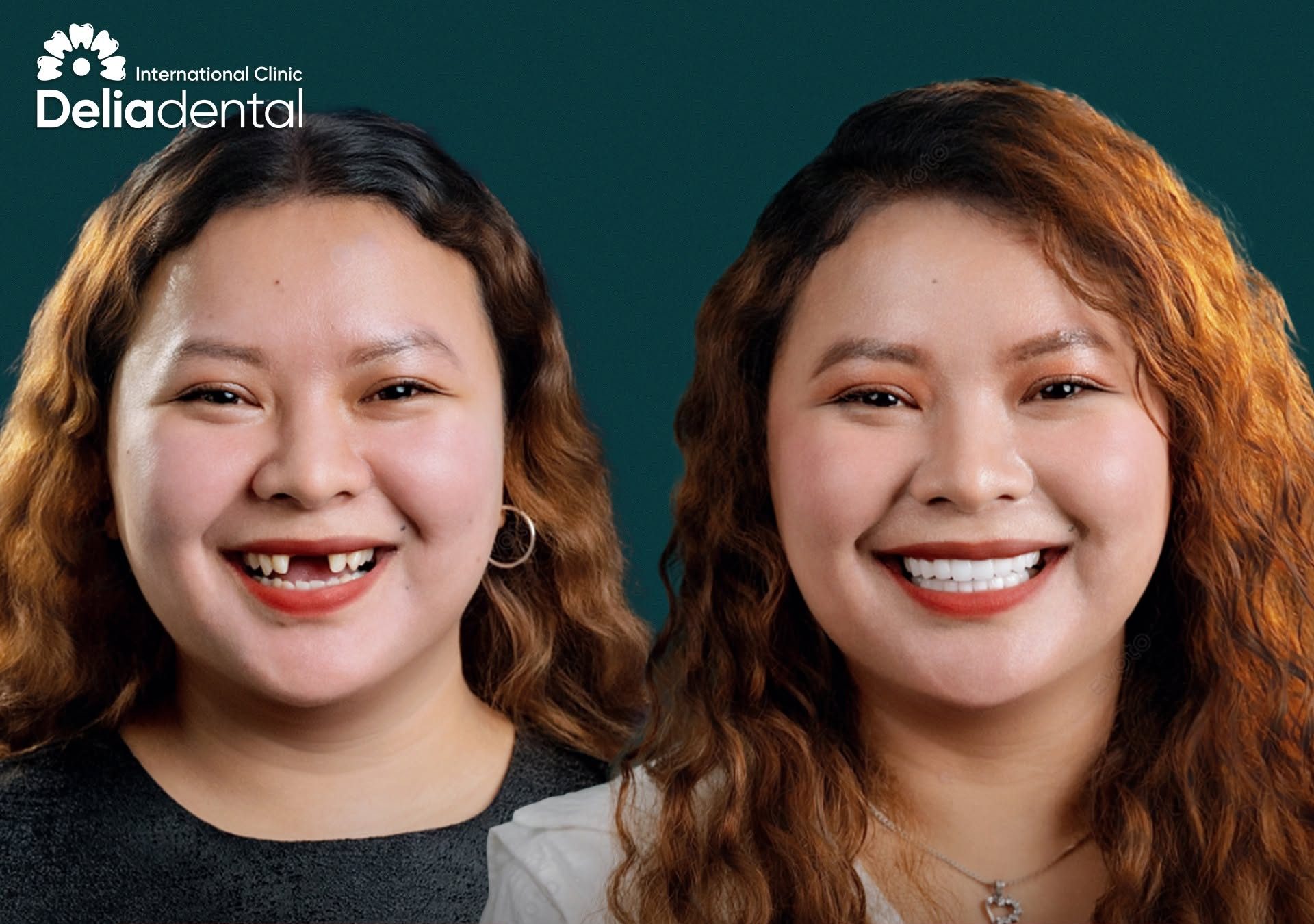
Shira Econa, a patient at Delia Dental Clinic, wore removable dentures for six years after losing her upper front teeth, replacing them three separate times along the way. The loose fit caught up with her one evening at dinner with friends when the denture came loose at the table, a moment she still describes as one of the most embarrassing of her life. It was not a chewing problem that pushed her toward implants. It was the fact that a front tooth is never off duty.
A molar sits far enough back that almost nobody else ever sees it. A front tooth is visible every time the patient speaks, laughs, or opens their mouth for a photo, and for an international patient that visibility does not pause once they fly home. It continues through video calls, work meetings, and social situations for however long the temporary stage lasts, exactly the situation that caught Shira off guard with her old denture.
This changes what counts as an acceptable temporary. A molar temporary mainly needs to survive light chewing without cracking. A front tooth temporary needs to do that too, but it also has to look and feel secure enough to wear in public for an extended period, which is why the shade, shape and gum profile receive attention from the very first fitting rather than being left until the final crown stage.
The clinical reason a temporary cannot immediately take full chewing force, and why placement timing and loading timing are sometimes separate decisions, is covered in detail in Can You Get a Temporary Tooth Immediately After Implant Surgery? and Immediate Placement vs Immediate Loading: What’s Different?. What matters for this guide is what that restriction actually looks like day to day at the front of the mouth, not the underlying mechanism.

What Living With the Front Tooth Temporary Is Actually Like
A temporary at the front is usually kept out of heavy direct biting force while the implant integrates, and in practice that means adjusting how certain foods are eaten rather than avoiding food altogether. Biting straight into an apple, a hard baguette crust, or a thick sandwich with the front teeth is generally discouraged. Cutting these foods into smaller pieces and chewing more on the back teeth for a period is a normal part of the adjustment, not a sign of a problem.
Appearance is prioritized from the outset. The temporary’s shade is matched to the surrounding teeth at the first fitting, and its shape and gum-facing contour are designed to guide the soft tissue toward a natural profile as healing progresses. This is not a passive waiting process. Research on provisional restorations in the esthetic zone describes the temporary as an active tool for shaping the tissue around the implant, with the contour adjusted over the healing period rather than fixed once and left alone.
Whether the temporary is removable or fixed in place depends on the individual case, including implant stability, the surgical plan, and how the site is expected to heal. A fixed temporary is often preferred at the front specifically because a removable one is harder to keep looking natural while speaking and eating in public, though this remains a decision confirmed for each patient rather than a fixed rule applied to every case.
What Can Still Change Between the Temporary and the Final Crown
Some difference between the temporary and the final result is expected, and understanding which parts are meant to shift helps set the right expectation before treatment begins.
Gum contour is the part most likely to change. As the tissue heals and matures around the implant, it can shrink and settle into a shape that differs slightly from how it looked at the first fitting. This is part of why the temporary’s contour is often adjusted more than once during the healing period rather than finalized on day one.
Shade can shift in a smaller way as well. The surrounding natural teeth may look slightly different once the temporary phase is over, whether from the tissue settling, changes in hydration of the teeth, or simply the passage of time, so the shade is reviewed again before the final crown is fabricated rather than copied automatically from the temporary.
What should not change is the overall design direction the patient approved at the start, meaning the general tooth shape, length and proportion relative to the rest of the smile. If those elements look meaningfully different at the final stage, that is a conversation to raise with the treating dentist rather than something to assume is standard drift.
Why Gum Appearance Becomes Its Own Design Decision
Implant spacing is not the only anterior decision that gets made per patient rather than by default. Whether the gum tissue itself is left visible or partly recreated with prosthetic material is a separate call, and one that depends entirely on what a patient’s own smile shows.
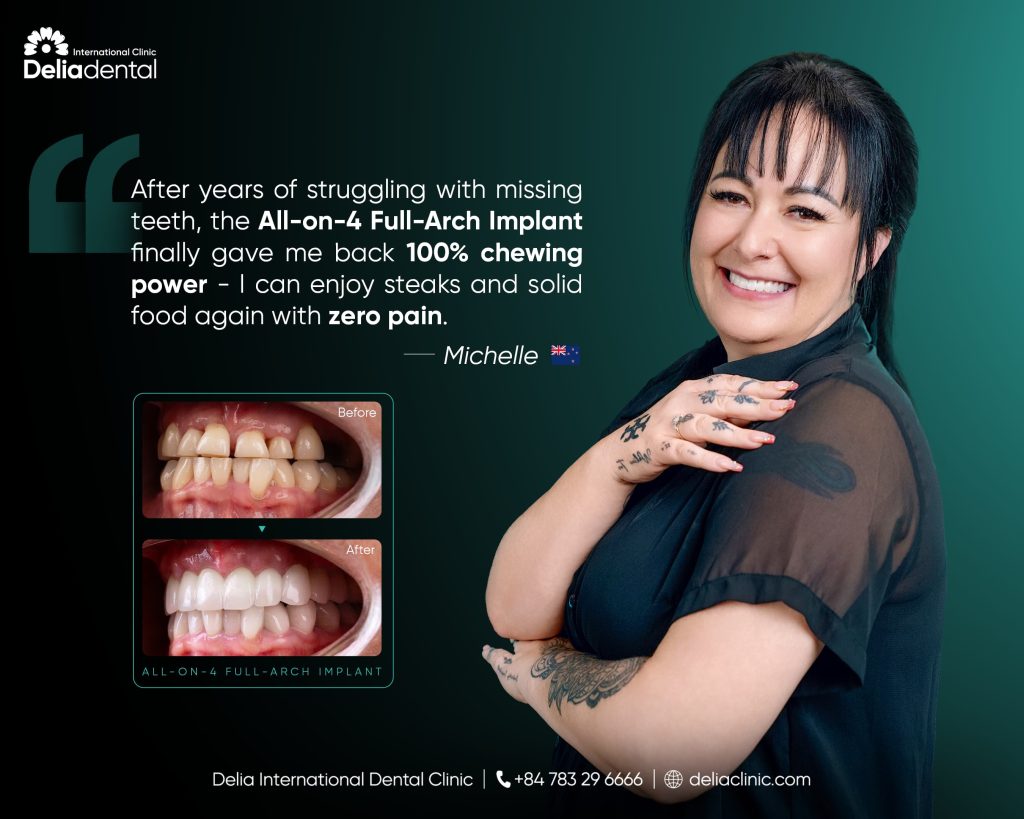
Michelle, a Delia Dental Clinic patient, needed a full-arch implant restoration after her upper front teeth could no longer be preserved due to bone loss. Cases like hers often use a gum-colored prosthetic base as part of the bridge, since it recreates the appearance of gum tissue where the arch has receded. In her case, the treating team chose not to include that gum-colored base, because her own natural gum line was already visible when she smiled and adding artificial gum material would have looked out of place rather than natural.
Michelle’s case involves a full-arch restoration, not a single or paired front tooth implant, so the gum-colored base question itself does not apply the same way to a smaller case. What carries over is the principle behind the decision: how much gum shows, and how it should look, is assessed against the individual patient’s own smile line rather than decided the same way for every anterior case, whether that case involves one implant, two adjacent implants, or a full arch.
How Delia Dental Clinic Plans a Front Tooth Case
A front tooth case at Delia Dental Clinic begins with a CBCT scan to confirm available bone and, where two adjacent implants are involved, to map spacing before surgery rather than adjusting for it afterward. Treatment generally follows a two-trip protocol, with the surgical visit and temporary placement completed first, followed by a healing period and a return trip for the final restoration at Hanoi or Ho Chi Minh once the gum has settled.
Shira and Michelle both went through this same sequence, though their starting problems were different. Shira had worn removable dentures for years before choosing a fixed implant solution for her front and back teeth, while Michelle needed a full-arch restoration with a specific decision about how her gum line should appear. Both outcomes came from the same process: a CBCT-based assessment, a temporary stage built around appearance and function, and a final result confirmed only after the clinical team could examine the case in person.
Frequently Asked Questions
Will the gum between two adjacent front implants always leave a visible gap?
Not always, but it cannot be fully guaranteed in every case either. Careful implant spacing, planned before surgery using CBCT imaging, is the main factor that reduces this risk, and in some cases a connected bridge design is used specifically to avoid the issue. The realistic goal is minimizing the risk rather than promising a specific outcome before the implants are placed.
Can I choose a different final shade if I do not like the temporary’s shade?
Yes. The temporary’s shade is a starting reference rather than a locked decision, and it is reviewed again once the surrounding teeth have settled and before the final crown is fabricated. If a patient’s preference changes during the healing period, that is a normal conversation to have with the treating dentist at the review appointment.
Can I attend a wedding or important event while wearing the front tooth temporary?
In most cases, yes, since the temporary is designed with appearance as a priority from the first fitting rather than as a rough placeholder. The main consideration is timing, since a temporary placed very recently after surgery may still need care around eating and speaking, so it is worth mentioning any upcoming event to the treating dentist so the appointment schedule can account for it.
What happens if I need to fly home before the final crown is ready?
This is the standard pattern for many implant cases, not an exception. Patients typically return home wearing the temporary while the site heals, then travel back for the return visit once the clinic confirms the site is ready for the final restoration. The temporary is designed to be worn safely for that interval, not only for a few days.
Does the front tooth temporary look obviously different from a natural tooth to other people?
Generally not at normal conversational distance, since shade and shape are matched from the first fitting rather than left generic. Small differences that remain, particularly around the gum contour while it is still settling, are usually far more noticeable to the patient examining their own smile closely than to someone else in conversation.
Planning the Rest of Your Implant Trip
A front tooth case does not exist on its own. It sits inside the same travel planning, cost transparency and warranty questions that apply to any implant trip to Vietnam, and these guides cover the parts of that planning this article does not.
- How Long Should You Stay in Vietnam for Dental Implants?
- Implant Warranty vs Prosthetic Warranty: What Is Actually Covered?
- Why Dental Implant Quotes Change After a CBCT Scan
- How to Choose a Dental Implant Specialist in Vietnam
Final Thoughts
A front tooth temporary is built to look right from the first fitting, not treated as something to get through until the real result arrives. What changes afterward is mostly the gum tissue settling into its mature shape and the shade being confirmed once healing is complete, and for two adjacent front implants, spacing that was planned before surgery ever began rather than adjusted for afterward.
Send your smile photos and any existing X-ray or CBCT file to Delia Dental Clinic via WhatsApp or Messenger before booking your flight, and mention if two adjacent front teeth are involved. The international patient team can give an initial read on the case, with implant spacing, temporary design and final treatment confirmed after an in-person examination in Hanoi or Ho Chi Minh City.


