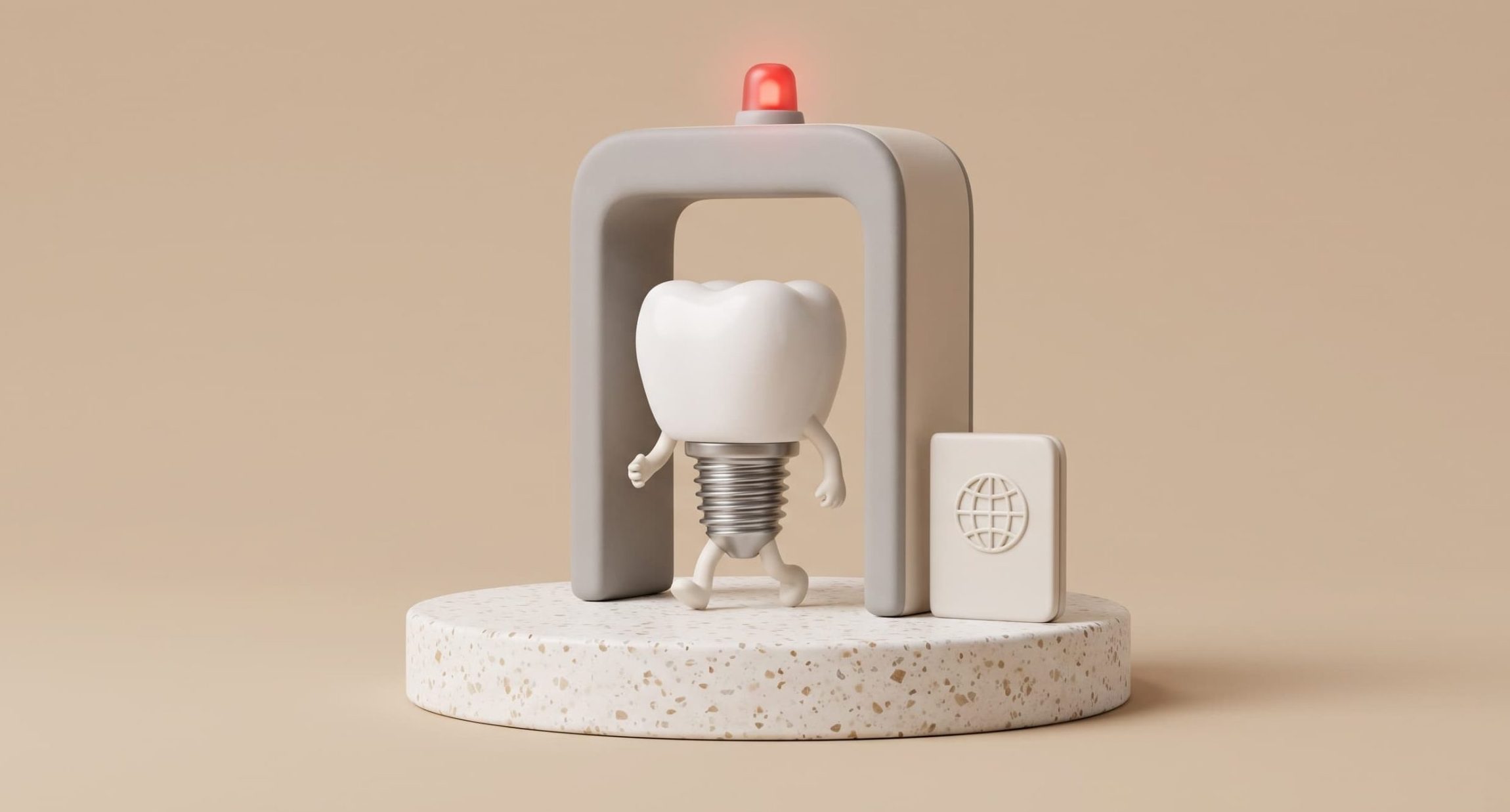
Most people with dental implants walk through airport security without any alarm. A small number get a handheld check, and that is usually the end of it. The more useful question is what to say and what to carry, because that decides how smoothly the next five minutes go.
MRI is a separate question with a separate answer. Titanium and zirconia implants are not magnetic and are generally considered safe in a scanner, but they can blur the picture when the scan is of the jaw, neck or head. That is an image quality issue for the radiology team, not a danger to the implant.
This guide separates the two situations, shows how a single implant, a crown, a veneer and an All-on-4 or All-on-6 restoration differ, and explains which documents are worth keeping in your hand luggage after treatment at Delia Dental Clinic.
Quick Answer
Dental implants rarely set off airport metal detectors, and titanium or zirconia implants are generally considered safe for MRI. Full arch restorations can contain more metal, so a handheld check is possible. Implants can blur MRI images of the jaw and neck, so tell security and radiology staff about all dental work.
Do Dental Implants Set Off Airport Metal Detectors?
Dental implants rarely set off airport metal detectors, because the amount of metal in a tooth implant is small. Most dental implants are made from titanium or a titanium alloy, and they are only a few millimetres wide and around 10 to 14 millimetres long. Dental clinics that publish on this topic consistently report that patients pass through standard walk through detectors without an alarm.
The way detectors respond to implants elsewhere in the body explains why. A widely cited study of orthopaedic implants, published in the Journal of Bone and Joint Surgery, tested 129 volunteers carrying 149 implants at airport sensitivity settings. Total joint replacements such as hips were detected routinely, while nails, plates, screws and wires were rarely detected. The study concerned orthopaedic hardware, not dental implants, so it cannot give a detection rate for teeth. It does show that the mass of metal is what matters most, and a dental implant weighs a tiny fraction of a hip replacement.
No large study has measured dental implants specifically, so the honest answer is “rarely” rather than “never”. Newer and more sensitive equipment can pick up small metal objects, and an alarm does not mean anything is wrong. It means the officer needs to check what set it off.
What Happens at Body Scanners and During a Pat Down?
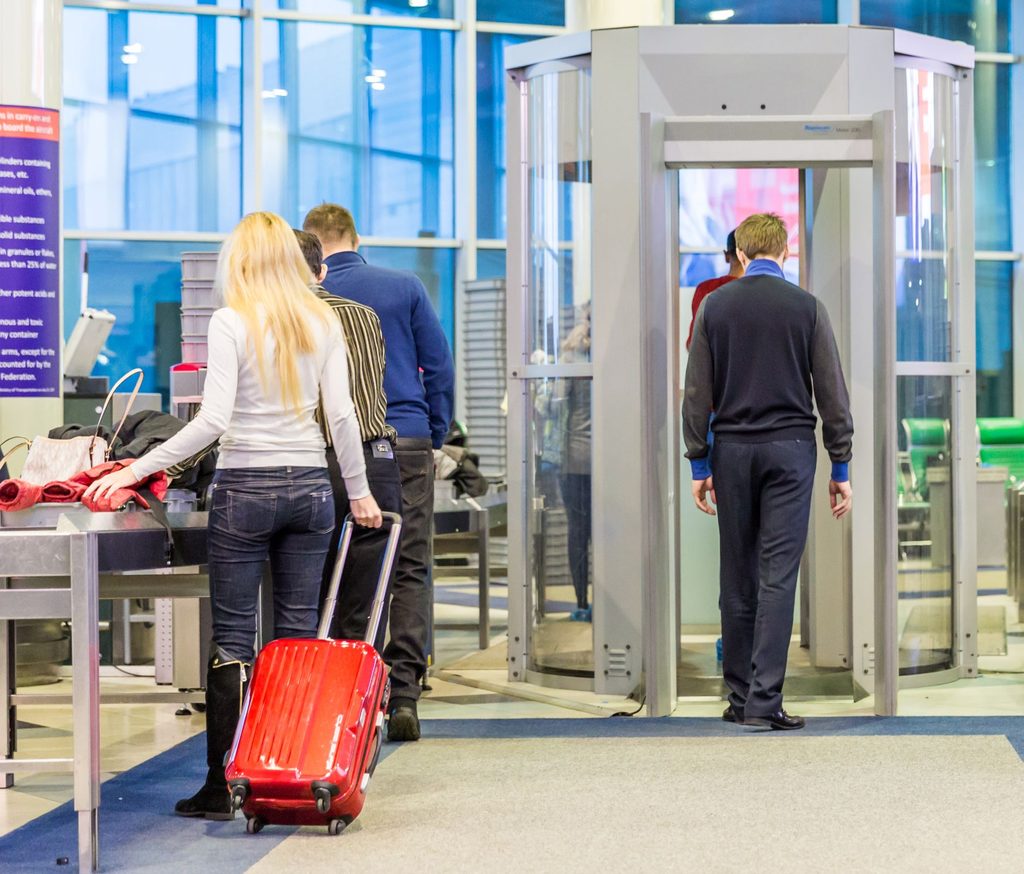
A body scanner usually does not react to dental implants, and if any screening step alarms, the result is a handheld or pat down check rather than a refusal to fly. The US Transportation Security Administration advises travellers to tell the officer about any metal implants. It also says that advanced imaging technology, the full body scanner, can make screening easier and reduces the likelihood of a pat down.
Under the same guidance, a traveller who declines the scanner, or who alarms a walk through detector, receives a pat down. Dental implants sit inside the mouth, so the check, if needed, is usually brief and focuses on the area that alarmed. The officer may ask you to explain the dental work or use a handheld wand near the face and jaw.
Other countries follow the same logic, although the exact procedure and the equipment differ from airport to airport. If you are flying home through a connecting hub, expect that you may be screened more than once. Telling the officer in plain words (“I have dental implants in my upper jaw”) is faster than waiting for the second alarm.
Do Crowns, Veneers and All-on-4 Frameworks Behave Differently?
Crowns and veneers are not a screening concern, while multi implant restorations deserve a little more preparation. What matters is how much metal a restoration contains and where it sits.
| Restoration | Typical material at Delia Dental Clinic | Airport screening | MRI |
|---|---|---|---|
| Single implant | Titanium post with an abutment | Small amount of metal, alarms rarely reported | Generally considered safe, small local image distortion possible |
| Zirconia or e.max crown | Ceramic | No metal in the crown itself | No magnetic response expected |
| Porcelain veneer | Ceramic | No metal | No effect expected |
| All-on-4 or All-on-6 | Four or six implants with a titanium bar or framework under the final bridge | More metal than a single implant, so a handheld check is possible, though patients commonly report no alarm | More metal near the jaw can enlarge the distorted area on head and neck scans |
The final prosthesis in an All-on-4 or All-on-6 package at Delia Dental Clinic is built on a titanium bar or titanium framework, which is why full arch cases sit at the top of this table. Clinics that treat full arch patients report that people with All-on-4 and All-on-6 restorations also travel without incident, but a handful of sensitive checkpoints will always exist. Disclosing the restoration before you reach the scanner keeps a possible alarm uneventful.
Are Dental Implants Safe for an MRI?
Titanium and zirconia dental implants are generally considered safe for MRI, because neither material is ferromagnetic and neither is pulled by the scanner’s magnet. A dental implant is anchored in the jawbone, so the magnet does not move or loosen it.
Implant manufacturers also test their systems in a laboratory and publish MR safety information in their instructions for use. Systems from several major makers are labelled “MR Conditional”, which means they can be scanned safely under stated conditions, typically at field strengths of 1.5 tesla and 3 tesla and within set limits for scan time and energy. Clinics that publish on the subject add that no clinically significant heating has been reported with titanium dental implants.
A review of dental materials and MRI, published in the open access literature and available through PubMed Central, reaches the same practical conclusion: the real variables are the magnetic properties of the material, its shape, position and number, and the scan settings. For a patient, that means the question is rarely “is my implant allowed” and more often “will the scan area be affected”.
When Can Dental Work Distort an MRI Image?
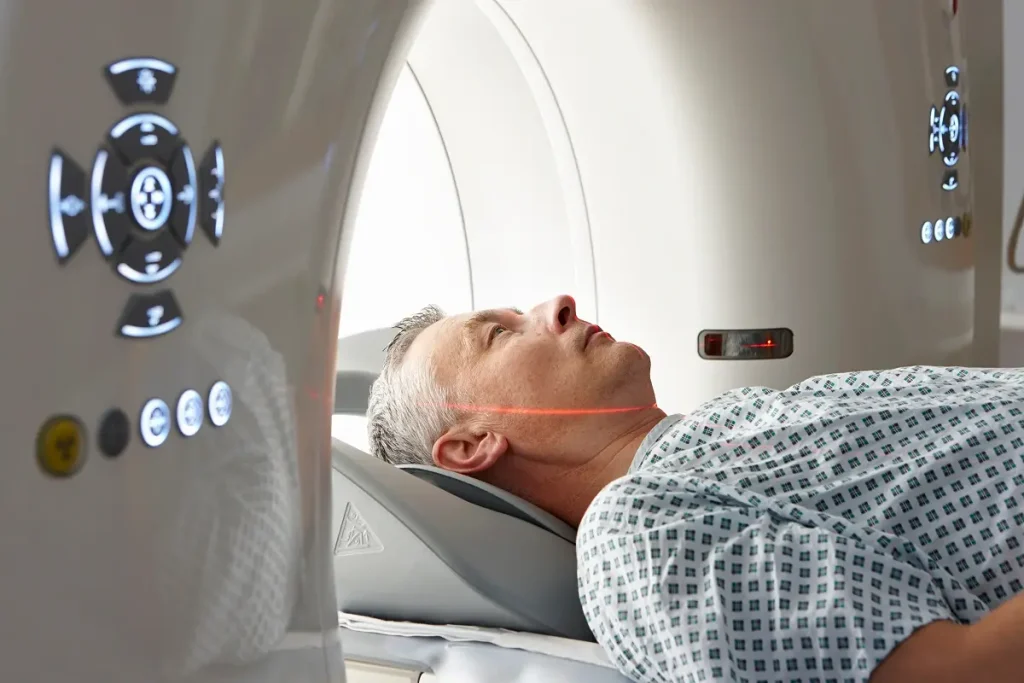
Dental implants can create an image artifact, a dark or bright patch around the metal, and it only matters when the area being scanned is close to the mouth. A scan of the knee, shoulder or abdomen is not affected. A scan of the brain, sinuses, jaw, tongue or neck might be, because the distortion appears next to the implant.
The size of the artifact depends on the material, the number of implants and the scan settings, according to the same dental materials review. Zirconia causes fewer artifacts than titanium in laboratory comparisons, but that is not a medical reason to choose one over the other, since titanium implants remain safe for MRI. Radiologists can adjust the sequence to reduce metal artifacts, which is why telling them in advance helps.
One exception applies to other kinds of dental work. Magnetic attachments used in some magnet retained dentures, and some orthodontic wires, can respond to the scanner and distort images far more than implants do. These are not part of a standard implant treatment, but if you have them from previous work, say so on the MRI screening form.
What Should You Carry and Say at Security and Before an MRI?
A short set of documents and one honest sentence cover almost every situation. Keep these in your hand luggage:
- A copy of your implant passport showing the implant system, reference number, lot number, dimensions and placement date
- The TSA notification card if you want one, which is optional and does not exempt you from screening
- Your treatment summary naming the restoration, for example single implant, crown or full arch bridge
- The contact details of the clinic that placed your implants
At security, tell the officer you have dental implants before you reach the scanner. Before an MRI, list every implant, crown, bridge and removable appliance on the screening form, and repeat it to the technologist. If the radiology team asks for the manufacturer’s MRI labelling, the reference number on your passport lets them look it up.
How Delia Dental Clinic Documents Your Implants Before You Fly Home
Delia Dental Clinic issues an implant passport as part of the written treatment record at its Hanoi and Ho Chi Minh City branches. The passport records the implant system, reference and lot numbers, dimensions and placement details, which is the information a radiology team or a home dentist needs to identify exactly what was placed. The approach to that document is covered in detail in the guide to the implant passport.
For a patient planning an MRI after treatment, the passport removes the guesswork about which system is in the jaw. Delia Dental Clinic can also confirm from your records which restoration you received, for example a single crown or a full arch bridge on a titanium bar or framework. The decision to scan, and the choice of settings, belongs to the radiology team and your treating doctor, who may ask for the manufacturer’s own safety information.
Frequently Asked Questions
Can I go through airport security a few days after implant surgery?
Yes. Walking through a detector or a body scanner is not reported to affect an implant, which is anchored in the bone. The practical questions after surgery are about the flight itself, such as swelling, comfort and timing, and those are separate from screening. Follow the advice from your treating dentist on when it is sensible to fly.
Do I need a dentist’s letter or a travel card for dental implants?
Neither is required. The TSA notification card is optional, and it does not exempt a traveller from screening. A copy of your implant passport is the most useful document, because it names the exact system if an officer or a doctor asks. Carrying it costs nothing and saves time if an alarm sounds.
Can I have an MRI soon after dental implant placement?
For many systems, yes, but the answer depends on the manufacturer’s labelling and the reason for the scan. Some implant instructions allow scanning under stated conditions straight after placement. If the scan is not urgent, ask your treating dentist and the radiology team about timing before you book. Give them the system and reference number from your passport so they can check the labelling.
Will my implants blur a head or neck MRI?
They can, if the scan area is close to the jaw. The distorted patch is usually small, and radiologists have scan settings designed to reduce it. A full arch restoration with a titanium bar or framework contains more metal than a single implant, so the affected area can be larger. Telling the radiology team in advance lets them plan the sequence rather than repeat the scan.
Are zirconia implants better than titanium for MRI?
Zirconia produces fewer image artifacts than titanium in laboratory comparisons, because it is a ceramic with no magnetic response. That matters mainly for patients who expect repeated head or jaw scans. Titanium implants remain generally considered safe for MRI, so the material is rarely a reason to change a treatment plan. Your dentist can explain which material suits your case.
Do braces, retainers or old fillings matter for an MRI?
They can. Orthodontic wires and some removable appliances may contain metals that respond to the scanner and affect image quality, so they should be listed on the screening form. Ceramic and composite restorations do not interact with MRI in the same way. When in doubt, list everything and let the technologist decide what matters.
Preparing Your Documents Before You Fly Home
The documents you carry matter as much as the implants themselves, so these guides cover the records, the trip and the flight in more detail.
- Implant Passport and Records You Take Home After Treatment
- What You Need to Travel to Vietnam for Dental Treatment
- Flying After Dental Implant Surgery
Final Thoughts
Security screening and MRI ask different questions of the same implant. One asks whether an officer needs a second look, and the other asks whether a radiologist needs to adjust the scan. In both cases, a documented implant and a clear sentence at the right moment settle it.
Send a copy of your implant passport, or your treatment date and restoration type (single crown, bridge or full arch), via WhatsApp or Messenger so Delia Dental Clinic can confirm which components you have before you travel or book a scan.


