
Traveling to Vietnam for dental treatment involves two separate checklists that patients often mix into one. The first is entry into the country itself: a valid passport, the correct visa, and now a pre-arrival declaration for some ports. The second is entry into treatment: the dental records, prescriptions, and history that let a clinic prepare a plan before you land instead of starting from zero on day one.
Skipping either one causes different problems. A missing or mismatched visa document can mean denied boarding at your home airport, not just delay at Vietnamese immigration. Missing dental records do not stop you from entering Vietnam, but they can turn a planned two or three day treatment window into a longer stay if the clinic needs to run diagnostics that could have been reviewed remotely in advance.
This guide separates what Vietnamese immigration actually requires from what a dental clinic needs to plan your case properly, so you can prepare both before you book flights rather than discovering a gap at the airport or in the consultation chair.
Quick Answer
Entering Vietnam for dental treatment requires a passport valid for at least six months, plus either a Vietnam e-visa or a qualifying visa exemption depending on nationality. Beyond immigration requirements, patients should send existing X-rays, CBCT scans, or a current quote to a clinic before booking, and carry a list of current medications if they take prescription drugs. A remote record review can suggest a preliminary direction, but the final treatment plan is confirmed after an in-person examination.
What You Need at the Border: Passport and Visa
Vietnam does not require a special visa category for dental treatment. Medical and dental tourists enter under the same tourist visa rules as any other visitor, so the requirement is standard: a passport valid for at least six months beyond your entry date, plus either an e-visa or a qualifying visa exemption.
E-visa: who needs one and how it works
Since August 2023, Vietnam’s e-visa has been open to every nationality, not a restricted list, which removes the older confusion about whether a specific passport qualifies. The e-visa is valid for up to 90 days from the date of entry, available as a single-entry visa for 25 USD or a multiple-entry visa for 50 USD, and is applied for entirely online through the official portal at evisa.gov.vn. Processing is typically listed at three working days, but applying seven to ten days before travel leaves room for delays, since weekends and Vietnamese public holidays are not counted.
One detail that catches travelers out: the e-visa application asks you to select a specific port of entry, and you must enter through that exact airport or land crossing. Exit can be through a different port. If your flight changes to a different Vietnamese airport after your e-visa is approved, the visa itself may no longer match your entry point, so it is worth applying only once travel dates and routing are close to final.
Visa exemption for some nationalities
A number of nationalities, mostly across Western Europe along with a handful of others, currently qualify for visa-free entry for a set number of days under separate government exemptions, without needing to apply for an e-visa at all. The exact list and the number of exempt days vary by country and are set through time-limited government resolutions, which means they can change. Rather than relying on a list that may be outdated by the time you travel, check current eligibility and exemption length directly on the official Vietnam immigration portal before booking flights.
The pre-arrival step some travelers now need
As of 2026, some entry points, including flights arriving into Ho Chi Minh City’s Tan Son Nhat airport, require travelers to submit a Digital Arrival Card within 72 hours before landing through Vietnam’s official pre-arrival immigration system. This is a newer requirement, and coverage across different airports and land borders can change, so it is worth confirming current pre-arrival rules through the official immigration portal shortly before departure rather than assuming last year’s process still applies.
Vietnam entry documents at a glance:
| Requirement | Applies to | Duration | Where to apply |
|---|---|---|---|
| Passport validity | All travelers | Minimum 6 months from entry date | Check your own passport |
| E-visa | Travelers not covered by an exemption | Up to 90 days, single or multiple entry | evisa.gov.vn |
| Visa exemption | Select nationalities, varies by country | Set by exemption, confirm current length | No application, confirm eligibility officially |
| Digital Arrival Card | Travelers entering through participating ports | Submit within 72 hours before landing | Official pre-arrival immigration portal |
None of these steps are handled by a dental clinic on a patient’s behalf. Visa applications, exemption eligibility, and arrival declarations are between the traveler and Vietnamese immigration authorities directly.

Dental Records to Prepare Before You Fly
Immigration requirements get you into the country. Dental records determine how efficiently your time in Vietnam is used once you arrive. There are two separate lists here, and confusing them is a common mistake.
What to send in advance for a preliminary review
Before booking flights, it is worth sending existing X-rays, recent dental photos, a CBCT or DICOM file if one exists, and any current treatment quote to a clinic so the team can review your case and suggest a preliminary treatment direction before you travel. This step does not replace a clinical examination, but it does mean the clinic already has context on your case by the time you land, rather than starting the assessment process from nothing on arrival day.
A remote review based on photos or scans can identify visible issues and outline a likely treatment path. It cannot confirm final implant position, exact grafting needs, hidden decay under an old restoration, or a complete final cost. Those depend on an in-person examination with imaging taken at the clinic itself.
What to carry with you in person
Separately from what gets sent digitally in advance, it helps to physically carry a printed or saved copy of recent X-rays or CBCT files, any existing quote from another clinic, a list of current medications and known allergies, and records of past major dental work such as previous implants, root canals, or crowns. If a scan was taken on a device that produces a physical disc or a downloadable file, bring the original format rather than only a photo of the screen, since image quality from a photographed scan is often too degraded for clinical use.
Medication and Prescriptions to Bring
If you currently take prescription medication, especially anything related to pain management, blood thinning, or a condition that could affect dental treatment or healing, bring the original prescription or a note from your prescribing doctor listing the medication, dosage, and reason. This matters most for anticoagulants, antiplatelet medication, insulin, and steroids, since dental treatment planning can depend on knowing what you are taking. Do not stop or adjust any prescribed medication before travel without checking with the doctor who prescribed it.
If your treatment plan is likely to involve pain relief or antibiotics after a procedure such as an implant placement or extraction, having your medical history and any known drug allergies documented in advance helps the treating dentist prescribe appropriately once you are in Vietnam.
If Your Treatment Needs More Than One Trip
Many implant and full-arch cases require two visits: an initial trip for consultation, imaging, and surgery, and a second visit months later for the final restoration once healing is complete. Each trip is a separate entry into Vietnam, which means each one needs its own valid visa coverage. A single-entry e-visa covers one trip only. If your treatment plan is likely to need a second visit and you want to avoid applying for a new visa each time, a multiple-entry e-visa is worth considering from the start, since it covers more than one entry within the same 90-day validity window.
If the gap between your first and second trip is likely to exceed 90 days, which is common for implant cases where healing takes several months, plan on applying for a fresh visa ahead of the second trip rather than assuming the first one carries over.
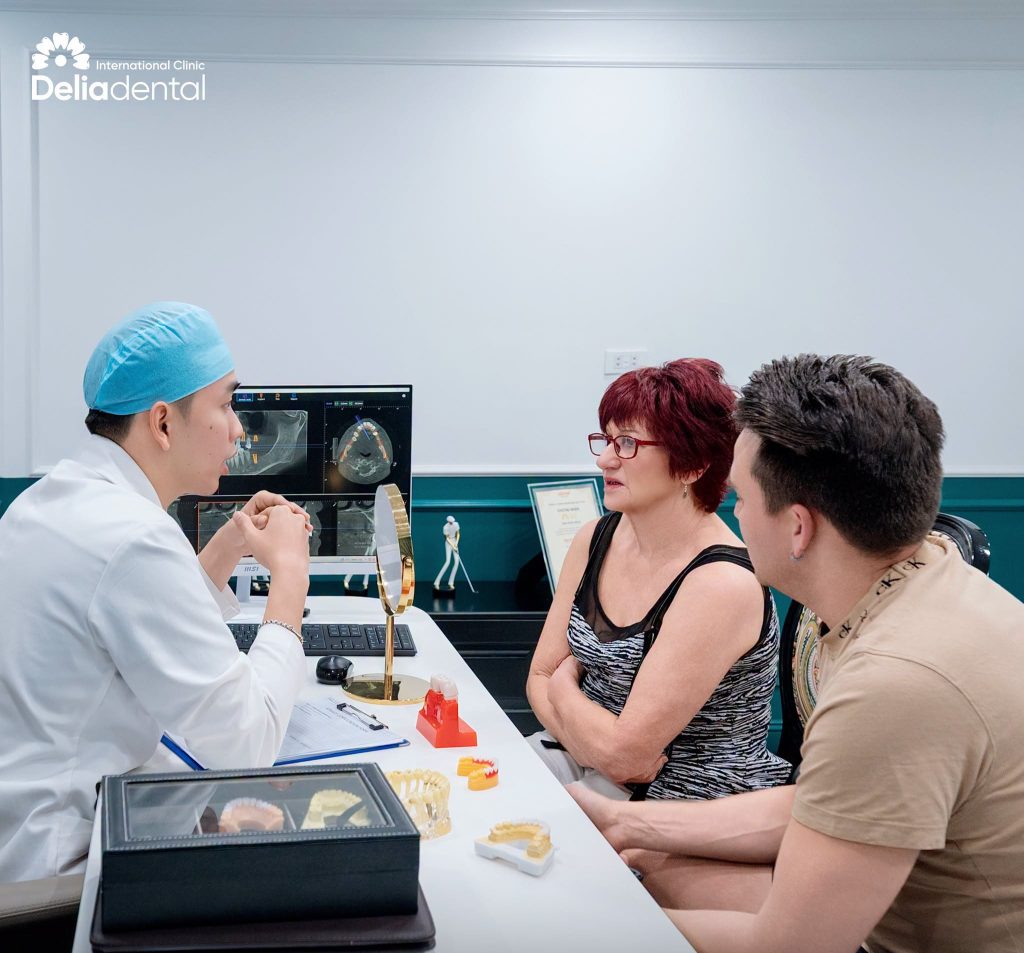
What Delia Dental Clinic Reviews Before You Arrive
Delia Dental Clinic, with branches in Hanoi and Ho Chi Minh City, reviews records sent in advance through WhatsApp or Messenger to identify what can be assessed remotely and what still needs an in-person visit. For implant and full-arch cases, this typically means checking existing X-rays or CBCT files for visible bone condition and prior dental work, and flagging where a fresh CBCT scan at the clinic will be needed regardless, since implant planning depends on current, clinic-taken imaging rather than an older scan alone.
For patients whose case is likely to need two trips, the coordination team can also flag that early, so the choice between a single-entry and multiple-entry e-visa is made with the likely treatment timeline in mind rather than as an afterthought once the first trip is already booked. This preliminary review gives a treatment direction and an estimated cost range, but the confirmed treatment plan and final pricing are set after the clinical examination and imaging taken in Hanoi or Ho Chi Minh City.
Frequently Asked Questions
Do I need travel insurance to enter Vietnam for dental treatment?
Vietnam does not currently require proof of travel insurance as an entry condition for tourist or e-visa holders. That said, most dental clinics and travel advisors recommend travel insurance that covers medical complications, trip cancellation, and delays, since a standard travel policy does not always cover elective dental treatment itself. It is worth checking with your insurer directly about what a policy covers if a procedure needs follow-up care while you are still in the country.
Can I apply for an e-visa just a few days before I fly?
You can, but it is riskier than it needs to be. Official processing is listed at three working days, but that excludes weekends and Vietnamese public holidays, and delays do happen. Applying seven to ten days ahead of travel gives enough buffer to fix a rejected application, such as one flagged for an unclear photo, without affecting your flight.
Does sending X-rays in advance replace the need for an exam in Vietnam?
No. A remote review of X-rays or photos can suggest a likely treatment direction and help the clinic prepare before you arrive, but it cannot confirm the final diagnosis, exact treatment scope, or complete cost. Those are only confirmed after a clinical examination and imaging taken at the clinic itself, which is why the in-clinic appointment remains part of every treatment plan regardless of what was reviewed beforehand.
What if my passport has less than six months of validity left?
Renew it before applying for a Vietnam e-visa or attempting entry under a visa exemption. The six-month validity rule is a standard immigration requirement, and travelers with a passport close to expiry risk being denied boarding by the airline before they even reach Vietnamese immigration, since airlines check this against destination country requirements at check-in.
Can I bring my own painkillers or prescribed medication into Vietnam?
Most personal prescription medication for standard use, such as pain relief or blood pressure medication, can be brought into Vietnam for personal use, but it is worth carrying it in its original packaging along with the prescription or a doctor’s note, particularly for anything classified as a controlled substance. Rules on specific medications can vary, so if you take a controlled or unusual medication, it is worth confirming current import rules before you pack it.
If my implant case needs a second trip, do I need a new visa each time?
It depends on the type of e-visa and the gap between trips. A single-entry e-visa only covers one entry, so a second trip needs a separate visa application. A multiple-entry e-visa covers more than one entry, but only within its 90-day validity window, which is often shorter than the gap between an implant surgery trip and a final restoration trip. In most cases, patients end up applying for a fresh e-visa ahead of the second visit rather than relying on the first one to still be valid.
Final Thoughts
Getting into Vietnam and getting your treatment planned properly are two different checklists, and treating them as one is where most last-minute stress comes from. The visa side is fixed by immigration rules that do not bend for dental tourism specifically, so it is worth confirming current e-visa or exemption details on the official portal close to your travel dates rather than relying on older information. The records side is more flexible: the earlier a clinic sees your X-rays, photos, or existing quote, the more of the diagnostic groundwork can happen before you land instead of during your limited time in the country.
Send your X-rays, dental photos, existing quote, and current medication list to Delia Dental Clinic via WhatsApp or Messenger before you book flights. The international patient team can review what is available, suggest a preliminary treatment direction, and flag whether a single-entry or multiple-entry visa fits your likely timeline better, whether that is for Hanoi or Ho Chi Minh City. The confirmed treatment plan is set after an in-person examination.


