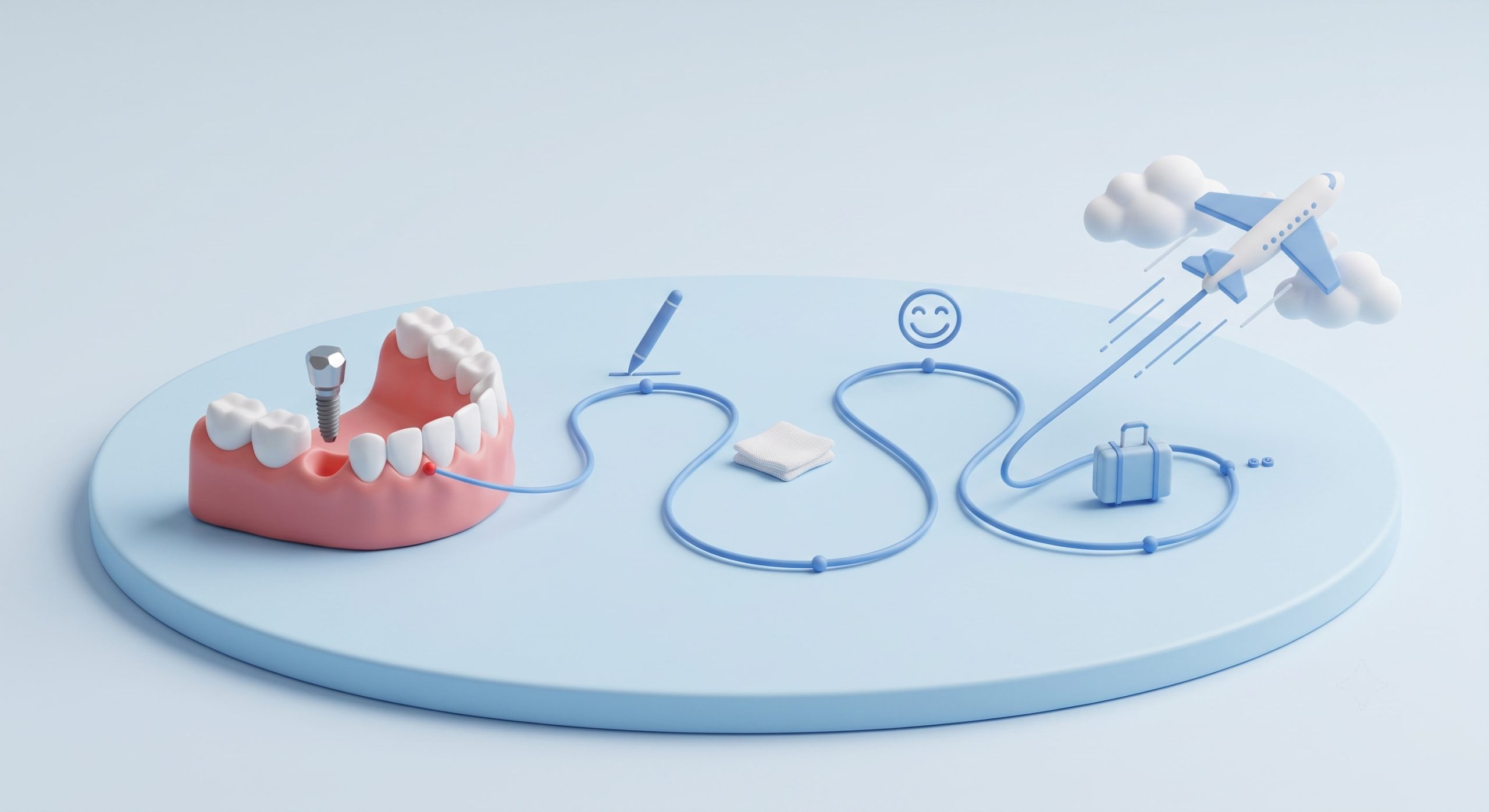
There is no single waiting period for flying after dental implant surgery. A patient who has received one uncomplicated implant does not have the same recovery or travel restrictions as someone who has undergone bone grafting, a sinus lift or full-arch implant surgery.
For most implant procedures, the practical concerns are not that cabin pressure will make the implant move. They are uncontrolled bleeding, swelling that has not yet peaked, pain, medication effects and the difficulty of reaching the treating dentist during a flight.
A sinus lift requires separate consideration because it involves an air-filled sinus that is affected by pressure changes. This is why patients should not apply a general implant timeline to a sinus-related procedure.
Quick Answer
There is no universal waiting period for flying after dental implant surgery. An uncomplicated single implant, a grafted site, a sinus lift and full-arch surgery require different travel plans. Do not fly while bleeding is uncontrolled, swelling is worsening or complications are suspected. Your treating surgeon should provide case-specific clearance before departure.
Why There Is No Single “Safe to Fly” Number
Published evidence on air travel immediately after dental treatment remains limited.
A 2023 review on dental treatment and air-travel-related barotrauma proposed minimum intervals of 72 hours after implant placement and at least two weeks after a sinus lift. However, the same paper gave more conservative planning recommendations of approximately one week after most dental procedures and six weeks after a sinus lift.
These numbers are not interchangeable. A minimum interval describes the earliest boundary suggested by the review, while the longer recommendation provides a more cautious planning reference. The authors also acknowledged that there is little direct research in this area and that much of the available evidence comes from military aircrew rather than ordinary commercial passengers.
The number of implants is only one factor. Extractions, grafting, the size and location of the surgical area, sedation, medical history, infection, the type of sutures and whether temporary teeth were fitted may all affect the departure plan.
The most relevant instruction is the one given by the surgeon who knows what was actually completed and has reviewed the patient’s early recovery.

What Matters Before You Board a Flight
Bleeding Must Be Controlled
Slightly blood-tinged saliva can occur after oral surgery. Active or persistent bleeding is different and should be addressed before travelling to the airport.
On a plane, it is harder to apply pressure properly, replace gauze or return quickly to the treating clinic. Guy’s and St Thomas’ NHS Foundation Trust advises patients to apply firm pressure if bleeding occurs after implant treatment and to seek urgent care if it does not stop.
A patient should not use a departure deadline as a reason to ignore continuing bleeding.
Swelling Should Be Following an Expected Pattern
Swelling does not necessarily reach its highest point immediately after surgery. It may continue to increase during the first few postoperative days, depending on the extent of treatment.
This means that a patient who feels reasonably comfortable on the evening of surgery may feel more swollen during a flight the following day. That does not automatically indicate a complication, but it can make a long journey significantly more difficult and may hide a problem that would have been easier to assess near the clinic.
According to the NHS guidance on recovery after dental implant treatment, soreness, swelling, bleeding and bruising may occur after implant placement. The question before departure is not whether every sign of swelling has disappeared. It is whether recovery is progressing as expected rather than becoming unexpectedly worse.
Sedation and Medication Can Affect Travel Readiness
Recovery from the anaesthetic or sedative must be considered separately from recovery at the implant site.
If sedation or general anaesthesia was used, the patient must follow the clinic’s restrictions concerning driving, travelling alone and other activities requiring coordination or judgement. Feeling awake does not automatically mean that all sedative effects have passed.
Before flying, the patient should also be able to drink adequately, tolerate suitable food and take prescribed medication without persistent nausea, vomiting, marked dizziness or excessive drowsiness.
Medication should be carried in its original packaging, together with the prescription or treatment documentation required for the journey. Patients should not change the dose or add decongestants, antibiotics or blood-thinning medication without suitable clinical advice.
A Postoperative Review May Change the Decision
A review appointment can identify a problem that is not obvious to the patient.
The dentist may examine the wound, bleeding, swelling, sutures and signs of infection. If temporary teeth were placed, the review may also include their stability and the way the bite meets.
Not every patient has to remain in Vietnam until sutures are removed. Some sutures dissolve, while others require a later appointment. The clinic should explain which reviews must occur before departure and which can be coordinated with a dentist after the patient returns home.
Flying After a Single Uncomplicated Implant
One implant placed without a sinus procedure, extensive grafting or another major intervention generally creates a simpler travel-planning situation than full-arch surgery.
However, “possible to fly” and “well planned” are not the same thing.
The 2023 air-travel review described 72 hours as a suggested minimum interval after implant placement but recommended approximately one week after most dental interventions as a more cautious reference. These figures should not be used as automatic clearance.
A waiting period gives the patient time to confirm that bleeding is controlled, observe how swelling develops, assess the response to medication and attend an early review when required. It also reduces the likelihood of discovering a postoperative problem during a long flight or transit.
If the implant was placed next to the maxillary sinus, combined with an extraction or supported by grafting material, the case should not automatically be treated as a routine single implant. The patient needs to ask what additional procedure was performed and whether it creates a separate restriction.
Flying After Bone Grafting
Grafting That Does Not Involve the Sinus
A small graft placed around an implant site is different from a larger staged graft used to rebuild a substantial bone defect. There is no single flight interval validated for every non-sinus graft.
The timing depends on the graft location and size, whether the implant was placed at the same appointment, how the wound was closed and whether early recovery is stable. Larger or more complex grafts may require additional observation even if they do not involve the sinus.
The surgeon should state whether the flight advice is based on implant placement alone or on the combined effect of the implant, extraction and grafting procedures.
Grafting Associated With a Sinus Lift
A sinus lift belongs in a separate category. Although bone grafting material may be used, the procedure also affects the maxillary sinus and requires sinus-specific precautions.
A patient should not assume that the flight advice given for a small non-sinus graft applies after a sinus lift.
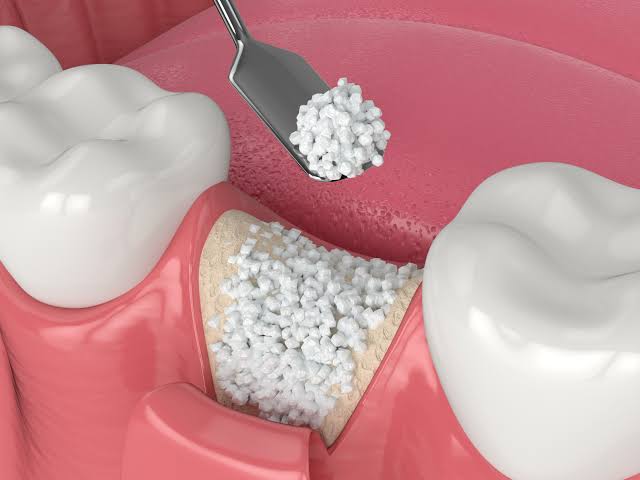
How Long After a Sinus Lift Can You Fly?
Patients should follow the restriction issued by the surgeon who performed the sinus lift.
During a flight, cabin pressure changes during ascent and descent. A recently treated maxillary sinus may not equalise pressure normally, particularly if there is postoperative swelling, congestion or disruption of the sinus lining. This may cause pain or other pressure-related complications.
This does not mean cabin pressure simply “pushes the graft out” or makes an implant pop loose. The concern is the effect of pressure change on a healing sinus and the tissues involved in the procedure.
These differences are precisely why patients should not select their own departure date from one online source. The appropriate interval may be affected by the surgical approach, condition of the sinus membrane, size of the graft, any communication between the mouth and sinus, existing sinus disease and the patient’s recovery.
Contact the surgeon before flying if there is increasing sinus pain or pressure, unusual nasal bleeding, fever, worsening swelling or a sensation of air passing through the surgical site. McGill’s instructions specifically advise patients to arrange follow-up if they feel airflow through the treated area.
Do not use a nasal decongestant simply to make an earlier flight possible unless the surgeon or another appropriate clinician has advised it and checked that it is suitable for you.
Flying After All-on-4 or All-on-6 Surgery
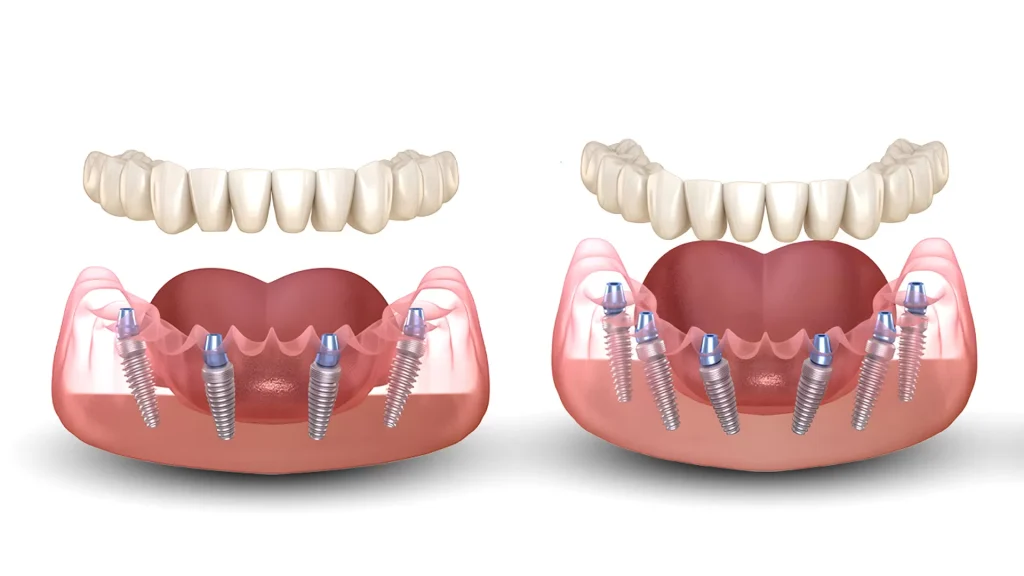
Full-arch implant treatment is more than four or six isolated implant placements.
The procedure may involve multiple extractions, several surgical sites, bone management and a fixed provisional bridge. Swelling and fatigue may be greater than after one implant, while the new temporary teeth also need to be assessed before a long journey.
There is no validated waiting period that applies to every All-on-4 or All-on-6 patient. The departure plan needs to allow enough time to confirm that the surgical sites are stable and that the temporary bridge is functioning as intended.
A postoperative appointment may be used to check the fit and stability of the bridge, identify a strong bite contact and make adjustments before the patient leaves Vietnam. A bridge that feels loose, causes concentrated pain when biting or has fractured should be reviewed before departure.
Temporary and final full-arch restorations also serve different purposes. Delia’s guide to temporary versus final full-arch implant teeth explains why the provisional bridge fitted during the surgical stage should not be treated as the completed final restoration.
A patient should be able to maintain a soft diet, drink adequately, clean around the provisional bridge as instructed and take medication correctly before beginning the journey home.
Does a Long-Haul Flight Change the Plan?
A longer flight does not necessarily change how the implant integrates with the bone. It changes the burden of travelling while recovering.
During a long-haul journey, the patient spends more time away from the treating clinic and has fewer options if bleeding, pain or bridge problems develop. Connections, airport queues and baggage handling also extend the journey beyond the hours shown on the flight ticket.
Eating suitable food, maintaining oral hygiene and keeping medication on schedule may be more difficult across a long itinerary. Fatigue, nausea and poor fluid intake can make the early recovery period less manageable.
Patients with separate medical risks related to long-distance air travel should ask the appropriate doctor for advice. A dental article cannot determine whether someone needs medication or other precautions for a non-dental medical condition.
Do Not Fly Yet If You Have These Warning Signs
Delay departure and contact the treating clinic if you have:
- Bleeding that remains active or cannot be controlled with pressure.
- Pain or swelling that is increasing unexpectedly instead of stabilising.
- Fever, pus, an unpleasant discharge or other signs of infection.
- Persistent vomiting, marked dizziness or an inability to drink enough fluid.
- Unusual sinus pain, pressure, nasal bleeding or airflow through the surgical site after a sinus lift.
- A temporary crown or full-arch bridge that is loose, fractured or causing significant bite pain.
- A further review requested by the surgeon before departure.
Difficulty breathing or swallowing, severe uncontrolled bleeding or rapidly progressing swelling requires urgent medical assessment. Do not rely only on an online message to the dental clinic in an emergency.
What to Confirm Before Booking Your Return Flight
Do not book the shortest possible itinerary merely because the surgical appointment fits before the flight.
| Question to ask the clinic | Why it affects the departure plan |
|---|---|
| What exactly is expected during surgery? | Implant placement, extractions, grafting and sinus lift procedures have different recovery considerations |
| When is swelling likely to peak in my case? | This reduces the risk of travelling during the period when symptoms need closer observation |
| When will my postoperative review take place? | The wound and any temporary restoration may need to be checked before departure |
| Are my sutures dissolvable? | This determines whether another local appointment or planned removal is required |
| Which symptoms would postpone my flight? | The patient needs a clear decision rule before the departure date |
| Who should I contact after returning home? | Remote and local follow-up should be arranged before a problem occurs |
| Has my surgeon cleared the proposed flight? | The final decision should be based on the completed procedure and actual recovery |
The clinic should also explain whether the quoted “length of stay” includes enough time after surgery for observation and review. The number of days required for treatment is not automatically the same as the earliest appropriate departure date.
How Delia Dental Clinic Plans Implant Surgery Around International Flights
Before an international patient books a flight, Delia Dental Clinic can review recent X-rays or CBCT files, clear dental photographs, relevant medical information, an existing treatment plan and proposed travel dates.
This preliminary review may help determine whether the case is likely to involve implant placement alone or whether extraction, grafting, sinus assessment or temporary teeth may also need to be considered. It can also establish an estimated stay window and identify which decisions cannot be confirmed remotely.
The final procedure may change after an in-person examination. For that reason, departure timing should be checked again after treatment according to what was actually performed and how early recovery is progressing.
At Delia’s Hanoi or Ho Chi Minh City clinic, the postoperative review may include the surgical site, swelling, bite and provisional restoration where relevant. The treating dentist can then explain whether the planned flight remains appropriate or should be delayed.
Delia’s guide to how long international patients should stay in Vietnam for dental implants covers the number of days commonly required for each treatment trip. The present question is narrower: whether the recovery and procedure-specific requirements for flying have been met before departure.
Send your recent X-rays or CBCT files, clear dental photos, existing treatment plan and proposed flight dates via WhatsApp or Messenger. Delia’s international team in Hanoi or Ho Chi Minh City can review the likely procedure, suggest a preliminary stay window and explain which departure conditions still require confirmation by the treating surgeon.
Frequently Asked Questions
Can I Fly the Day After a Dental Implant?
Do not assume that flying the following day is appropriate. Even after an uncomplicated implant, bleeding, swelling, sedation, medication effects and the need for postoperative review must be considered. If extraction, grafting or sinus treatment was also performed, a separate restriction may apply.
Does Cabin Pressure Damage Dental Implants?
There is no good basis for telling routine implant patients that cabin pressure will make a properly placed implant move. The more immediate concerns are postoperative bleeding, swelling, pain and access to care. Sinus lift surgery is different because pressure changes may affect the healing sinus.
How Long Should I Wait to Fly After All-on-4?
There is no universal interval for flying after All-on-4 or All-on-6. Timing depends on extractions, grafting, the number of surgical sites, swelling, the provisional bridge and the required postoperative review. The treating surgeon should confirm the departure date after assessing early recovery.
Can I Fly After a Bone Graft?
Possibly, but the type of graft matters. A small graft that does not involve the sinus should not automatically receive the same restriction as a sinus lift. Ask where the graft was placed, how extensive it was and whether sinus-specific flight restrictions apply.
Why Is Flying After a Sinus Lift Different?
A sinus lift affects an air-filled maxillary sinus that responds to pressure changes during ascent and descent. Postoperative swelling or disruption of the sinus lining may interfere with pressure equalisation. Patients therefore need sinus-specific precautions and clearance from the surgeon who performed the procedure.
Should I Have a Check-Up Before Flying Home?
International implant patients should receive a clear review plan. The clinic should explain whether the wound, sutures, bite or temporary restoration must be checked before departure and how follow-up will continue at home. A review is especially important when symptoms change or full-arch provisional teeth require adjustment.
Final Thoughts
The right departure date is not simply a number counted from surgery.
It is the first date on which the procedure-specific restriction has been met, early recovery is progressing as expected, any required review has been completed and the treating surgeon agrees that the patient can travel.
A single implant, non-sinus bone graft, sinus lift and full-arch procedure should not be placed on the same flight timetable. Planning the return journey around the actual treatment—rather than forcing treatment into a fixed ticket—gives the patient a safer and more manageable recovery.


