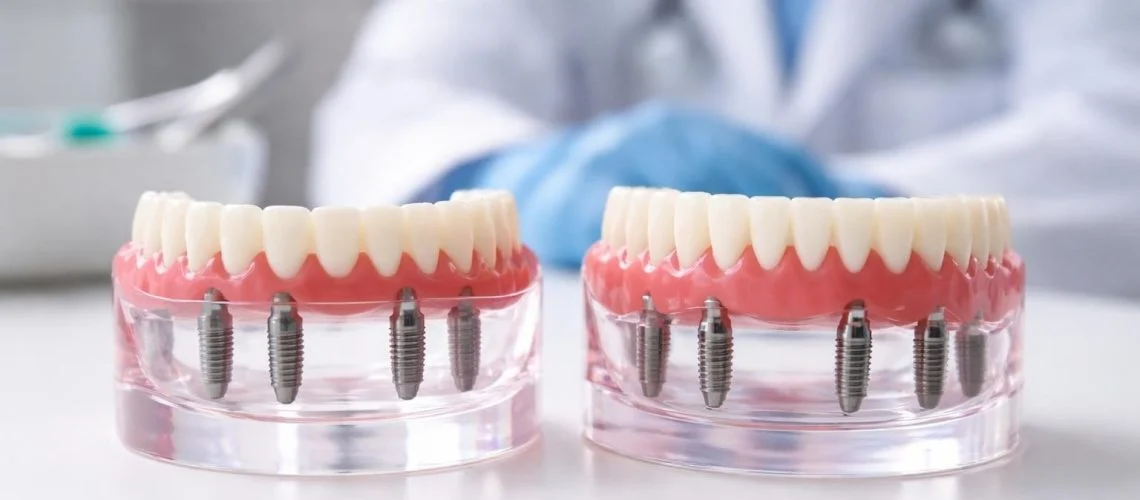
All-on-4 and All-on-6 both replace an entire arch of teeth with a fixed bridge supported by implants, and the difference is not as simple as six being better than four. The right option depends on your bone condition, bite force and what the CBCT scan shows, so it is decided case by case after examination.
Both treatments are usually planned across two trips, with a healing period at home in between, and both are quoted as packages rather than as a number of single implants. This article explains how each approach works, which situations may suit each one, what changes the cost of full mouth dental implants in Vietnam and how the planning works before you travel.
Delia Dental Clinic can review your X-rays or CBCT files before you book, so you know which direction is likely before you commit to flights. The final plan and quote are confirmed after an in-person examination.
Quick Answer
All-on-4 uses four implants per arch and All-on-6 uses six. Neither is automatically better. The choice depends on bone volume and density, bite force, arch size and what the CBCT scan shows, and it is confirmed after examination. Both usually need two trips, so ask for an itemized package quote before booking flights.
What All-on-4 and All-on-6 Actually Are
Both treatments follow the same principle: instead of placing one implant for each missing tooth, a small number of implants anchor a fixed full-arch bridge. This can make full-arch treatment possible for patients with bone loss who could not support an implant for every tooth without extensive grafting. Full mouth dental implants do not always mean All-on-4 on both jaws, because some patients need only one arch treated, and others keep natural teeth and combine implants with crowns or bridges.
All-on-4 uses four implants per arch. The back implants are commonly angled, which lets the surgeon use the denser bone toward the front of the jaw and, in some cases, may reduce the need for bone grafting even when bone loss is advanced. Whether that applies to you depends on your scan.
All-on-6 follows the same general approach with two additional implants, giving six anchor points per arch. The extra implants spread the biting load across a wider span of bone, which may matter for patients with higher bite forces, bruxism or a wider arch. More implants do not suit every patient, because the available bone and the surgical plan set the limit.
How All-on-4 and All-on-6 Compare
| Feature | All-on-4 | All-on-6 |
|---|---|---|
| Implants per arch | 4 | 6 |
| Load distribution | Concentrated on four anchor points | Spread across a wider span |
| Bone grafting | May be avoided in some cases | May be considered more often, depending on bone |
| Often considered when | Bone volume is limited but the front of the jaw is dense enough | Bite force is high, the arch is wide or bone supports more implants |
| Cost | Fewer implants, usually a lower package price | More implants, usually a higher package price |
This table shows tendencies, not rules. A patient with strong bone and no grinding habit may be well served by four implants, while another with similar teeth but a heavy bite may need six. Only the CBCT scan and clinical examination can say which applies.
Who May Suit All-on-4
1. Patients With Limited Bone Who Want to Avoid Grafting Where Possible
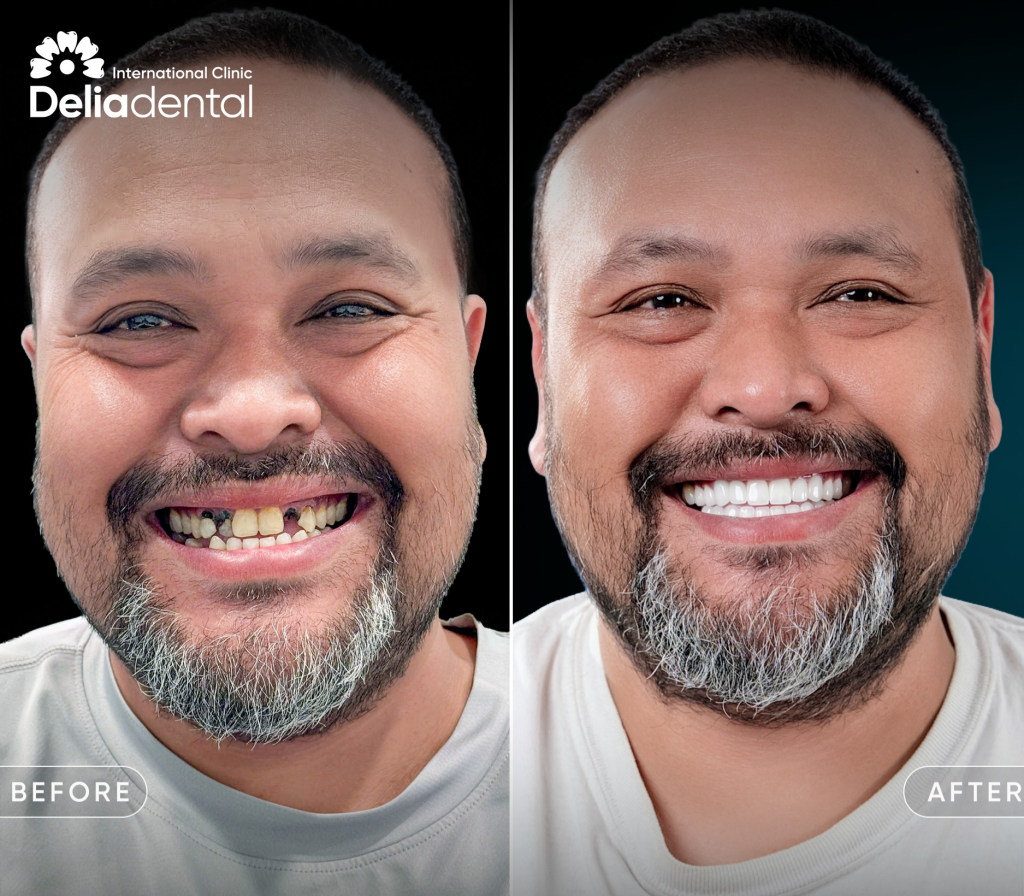
The angled back implants in All-on-4 are designed to work with the bone that is available. In some cases, a patient who would otherwise need a sinus lift or bone graft before implants can proceed with All-on-4 without that extra stage, which may shorten the timeline and reduce surgical complexity. Whether grafting is needed is judged from CBCT imaging and not from a description alone.
2. Patients Looking for a Fixed Result With Fewer Implants
All-on-4 usually has a lower package price than All-on-6 because fewer implants are involved. For a patient with suitable bone and no significantly elevated bite forces, it can provide a stable fixed result without the added cost of two more fixtures per arch. The saving is only worthwhile if the clinical plan supports four implants.
3. Patients With Standard Arch Size and Good Front Bone
All-on-4 relies on the front of the jaw having enough bone to anchor the straight implants securely. A patient with a standard arch width and no history of heavy grinding is more likely to be comfortable with four implants carrying the bridge. The dentist still checks this on the scan rather than assuming i
Who May Suit All-on-6
1. Patients With Lower Bone Density or More Bone Loss
When the jawbone has lost more volume or density, six implants spread the load across a wider area and reduce the pressure on each fixture. This may matter more in the upper jaw, where bone is often less dense than in the lower jaw. A scan decides whether six implants can actually be placed, since very limited bone may call for grafting or a different plan.
2. Patients With Wider Arches or Longer Bridge Spans
A wider arch needs a longer bridge, and extra anchor points may reduce the leverage at the ends of that bridge, where stress tends to concentrate under repeated biting. For a patient with a broad jaw, the dentist may recommend six implants for that reason.
3. Patients With Bruxism or Heavy Bite Forces
Grinding and clenching place higher loads on implants than normal chewing. For a patient with a confirmed history of bruxism, additional implants may provide extra support, and the dentist may also discuss a night guard after treatment. Even so, six implants are not a guarantee against wear or loosening, and regular maintenance still matters.
What Changes the Cost of All-on-4 and All-on-6
All-on-4, All-on-5 and All-on-6 are quoted as packages. A package typically covers the implants, the matching abutments, an immediate temporary prosthesis and the final prosthesis, and its price changes with the implant brand, the number of implants and the type of final prosthesis. For example, a ceramic bridge fixed on a titanium bar is priced differently from separate zirconia crowns set on a titanium framework. Sinus lift, bone grafting, sedation and any other treatment identified after examination are billed separately.
Delia Dental Clinic’s standard implant prices by brand, covering the implant post and abutment only, are shown below. These are not All-on-4 or All-on-6 package prices and should never be multiplied to estimate one.
| Implant system | Implant + abutment (standard) | Published warranty |
|---|---|---|
| Osstem | $700 | 10 years |
| Dentium | $800 | 15 years |
| HIOSSEN | $1,200 | 30 years |
| ETK | $1,300 | 30 years |
| SIC | $1,400 | 30 years |
| Straumann SLA | $2,000 | Lifetime |
| Straumann SLActive | $2,300 | Lifetime |
The brand affects the price because manufacturing, clinical data and warranty terms differ between systems. The fixture warranty, the abutment and the prosthesis are covered separately, so ask for the terms of each in the written plan. To compare with a quote from another country, ask that quote for the same brand, the same number of implants, the same type of final prosthesis and the same inclusions.
Treatment Timeline for Both Options
Both options commonly follow the same two-trip structure, and the number of implants does not by itself change the timeline. Treat the stages below as an estimate that is confirmed after examination.
- First trip: examination, CBCT imaging and a confirmed treatment plan, any extractions needed, then implant surgery. Where the case allows, a temporary prosthesis may be fitted soon after surgery. A full arch first trip often runs around 10 to 14 days, depending on the case.
- Healing period: commonly around three to six months at home. Osseointegration happens during this time, so you do not need to stay in Vietnam. The team follows your progress remotely through WhatsApp, and a local dentist can review healing using the treatment records.
- Second trip: the team confirms that the implants have integrated and the case is ready, then the final prosthesis is fitted. Written warranty documentation is provided.
The temporary and final prostheses are not the same product, so having teeth after surgery does not mean the case is finished. If healing takes longer than expected, or if bone grafting was part of the plan, the second trip may move and an extra visit may be needed. The second trip date can often be adjusted when the coordinator is told in advance.
How Delia Dental Clinic Decides Between All-on-4 and All-on-6
The choice cannot be made from a description alone. It comes down to what the CBCT scan shows about bone density, bone volume and arch dimensions, and these look different in every patient, even when their situations seem similar from the outside.
At Delia Dental Clinic, CBCT assessment is part of the planning before treatment is confirmed. The implantologist reviews which configuration the available bone can support over the long term rather than defaulting to one option for every case. Before you travel, the team can look at your existing X-rays or CBCT files and suggest a preliminary direction, an estimated cost and a likely timeline. That remote review is not a diagnosis, and the final plan and quote are confirmed after an in-person examination.
For example, a patient with a wide arch and a history of grinding might be told early that six implants are likely, while a patient with strong front bone and a standard arch may be told that four are worth considering. Either way, the plan names the implant system and the written warranty terms, and patients can ask to see the unopened implant packaging and check the brand codes on the manufacturer’s website before agreeing to treatment.
Book a free consultation here.
Frequently Asked Questions
Does More Implants Mean the Result Will Last Longer?
Not automatically. Longevity depends on the bone available, the bite, the prosthesis design, hygiene and regular maintenance as much as on the implant count. A well planned All-on-4 in a patient with healthy bone and a moderate bite may perform better than a poorly planned All-on-6 in a patient with a heavy bite and weak aftercare. Extra implants may add load sharing, but they also add surgical complexity and cost. The dentist weighs these trade-offs on the scan, and any claim about how long a case will last should be treated as an estimate. Ask what maintenance schedule the clinic expects.
Can the Plan Change After the CBCT Scan?
Yes. A remote review can suggest a direction, but the CBCT scan taken during an in-person visit shows bone volume, density, sinus position and nerve location in three dimensions, and these can change the plan. An All-on-4 recommendation might become All-on-5 or All-on-6, or the scan might show that grafting or extractions are needed first. The quote is then updated to match the plan, which is why a remote estimate is described as preliminary. If the plan changes, the coordinator explains the reason and the cost difference before you agree to proceed.
Do I Need Both Arches Treated at the Same Time?
Not necessarily. Some patients need only the upper or the lower arch, and others keep natural teeth in one arch while replacing the other. When both arches need treatment, the dentist decides whether to treat them in the same visit or in stages, based on your health, bone and schedule. Full mouth treatment does not always mean All-on-4 on both jaws, because it may combine implants, crowns and bridges. Prices are quoted for the specific plan, so ask for an itemized quote that lists each arch.
Will I Leave Vietnam With Teeth After Surgery?
In many cases a temporary prosthesis can be fitted soon after surgery, but it depends on the case. Some patients need a staged approach, such as a removable temporary on one arch while the other is treated. The temporary prosthesis is not the final bridge, and you should follow the team’s instructions about food, cleaning and activity while the implants heal. Immediate placement does not automatically mean immediate final teeth. Ask at the planning stage what your own temporary arrangement will look like.
What Should I Send for a Remote Review?
Send what you already have: a recent panoramic X-ray, CBCT files if available, clear photos of your smile and bite, any existing implant quote and a short medical history with a list of medications. Mention your main concern, such as loose teeth, missing teeth or a failing bridge, and your preferred travel dates. A panoramic X-ray can support a preliminary direction but cannot measure bone volume and density in three dimensions, so a CBCT scan in the clinic is still needed for implant planning. The team will tell you if anything important is missing.
Planning Your Full Arch Treatment Further
These articles cover what changes the cost, how temporary and final teeth differ and how full arch and full mouth plans compare.
- All-on-4 Dental Implants Vietnam: What Australians Need to Know
- Full Arch Dental Implants Vietnam: Temporary vs Final Teeth
- Bridge vs Implant: Which Lasts Longer and Costs Less
- Is a CBCT Scan Required Before Every Dental Implant in Vietnam?
Final Thoughts
Send your panoramic X-ray, CBCT files or existing quote via WhatsApp or Messenger before you book flights, and Delia Dental Clinic can suggest which configuration is worth considering for Hanoi or Ho Chi Minh City.


