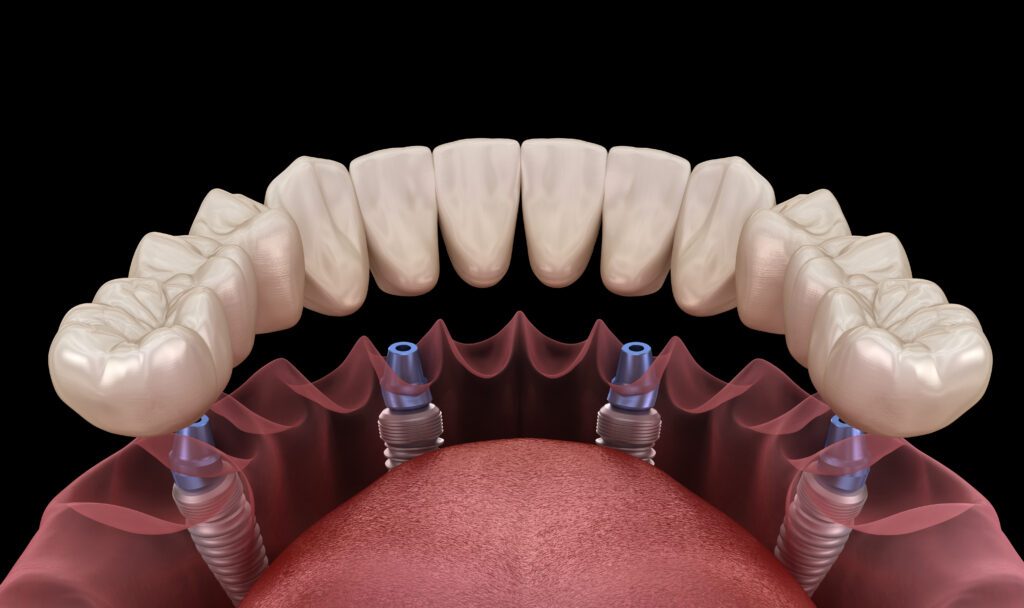
A lisp or slurred speech in the days after All-on-4 or All-on-6 surgery is one of the most common things patients notice, and one of the least discussed before treatment. Talking with new teeth feels different for almost everyone at first, and it catches people off guard because nobody warns them how much word sounds can shift in the early weeks.
The short version: speech changes after dental implants are a normal part of the adjustment period, not a sign that anything went wrong with the surgery. The tongue and lips need time to relearn how to shape sounds around the new prosthesis, and for most patients that adjustment settles within a few weeks.
This article covers why speech changes happen with All-on-4 and All-on-6, what a typical adjustment timeline looks like, and how to tell normal adjustment apart from something worth flagging to your clinic.
Quick answer
Yes, temporary speech changes are normal after All-on-4 or All-on-6. Most patients notice a lisp or difficulty with certain sounds in the first week, with steady improvement over the following two to four weeks as the tongue and lips adapt. Speech that hasn’t improved after four to six weeks, or that gets worse instead of better, is worth checking with your clinic rather than waiting out.
Why can speech change after full-arch dental implants?
Speech depends on a series of precise contacts between the tongue, teeth, lips and roof of the mouth. Replacing an entire dental arch changes several of these reference points at once.
The implants themselves are underneath the prosthesis and are not normally the direct cause of a lisp. Speech is more likely to be influenced by the design and position of the teeth placed on top of them.
Possible factors include:
- Swelling or numbness immediately after surgery.
- A temporary prosthesis that feels bulkier than the patient’s previous teeth.
- Changes in the position or length of the front teeth.
- A thicker palatal or lingual contour.
- Reduced space for the tongue.
- A change in bite height or jaw position.
- Air escaping through spaces around the prosthesis.
- Increased saliva or a dry mouth during recovery.
- The need to relearn tongue placement after a long period with missing teeth or removable dentures.
A fixed full-arch bridge does not usually cover the whole palate in the way a conventional upper denture does. Even so, a relatively small change in the contour behind the upper teeth can alter how the tongue directs air during speech.
What does the research show?
Speech outcomes after fixed full-arch implant treatment vary more than many clinic websites suggest.
One study of patients with All-on-4 fixed prostheses found that 53% reported some effect on speech, although overall prosthesis satisfaction remained high. This does not mean that every patient developed a severe or lasting speech problem. It shows that speech changes are common enough to discuss before treatment but are not experienced by everyone.
A separate clinical study followed ten patients who received fixed implant restorations in the upper jaw. Seven experienced an immediate decline in speech, and none of those seven had returned to baseline after three weeks through adaptation alone. Reducing the palatal volume of the prosthesis restored baseline speech in five and improved speech in the remaining two.
A systematic review of speech with implant-supported and removable full-arch prostheses found limited and varied evidence. Some patients adapted over several months, while prosthesis type and arch design influenced the result.
These studies are relatively small, so they cannot provide one reliable deadline for every patient. They do support two practical conclusions:
- Adaptation can take longer than two to four weeks.
- Prosthesis design should be assessed when a clear speech problem persists.
A realistic adjustment timeline
There is no single timeline that applies to every All-on-4 or All-on-6 patient. The following stages are better used as checkpoints than deadlines.
| Stage | What may happen | What to monitor |
| First 24–72 hours | Swelling, numbness, fatigue and increased saliva may make speech less clear | Speech should be interpreted alongside the normal surgical recovery |
| First 1–3 weeks | The tongue begins learning new tooth and prosthesis contours | Look for gradual improvement rather than perfect speech |
| Weeks 3–6 | Some patients sound close to normal, while others still notice particular sounds | Report sounds that remain consistently difficult or show no improvement |
| Several months | Further neuromuscular adaptation may occur | Persistent problems should already have been reviewed rather than ignored until this point |
You do not need to wait six weeks before contacting the clinic. If the same sound remains clearly distorted after the initial swelling and numbness have settled, describe it to the dental team. They may recommend more adaptation time, review a recording or arrange a physical examination.
Upper and lower full-arch teeth may affect speech differently
Speech concerns are often more noticeable with an upper full-arch prosthesis because the tongue uses the upper teeth and the area immediately behind them to form many consonants.
The shape behind the upper premolars can also affect airflow and tongue movement. This is why palatal contour is an important part of the prosthetic assessment.
A lower full-arch prosthesis can still affect speech if it reduces tongue space or changes the bite relationship. The effect is simply not determined by whether four or six implants were placed.
In other words, All-on-6 does not automatically create more speech disruption than All-on-4. Implant number mainly concerns the support beneath the bridge. Speech is more closely related to the shape, tooth position and spatial design of the prosthesis above it.
When is slurred speech an emergency?
A predictable lisp on certain sounds after receiving new teeth is different from a sudden inability to speak clearly.
Seek emergency medical help immediately if speech suddenly becomes slurred or confused, especially when accompanied by:
- Drooping or weakness on one side of the face.
- Weakness or numbness in an arm or leg.
- Difficulty understanding speech.
- Sudden loss of balance or vision.
- A severe unexplained headache.
These may be signs of a stroke. Call your local emergency number rather than contacting the dental clinic first or assuming the implants caused the change.
Ways to practise while your mouth adapts
Simple practice may help the tongue build new movement patterns when the prosthesis has already been checked and no physical correction is required.
Read aloud for a few minutes each day
Use a book, news article or familiar text. Start slowly and aim for clear sounds rather than normal speaking speed.
Practise the sounds that feel difficult
If S sounds are the main problem, repeat words such as “sixty”, “seven”, “success” and “sister”. For F and V sounds, try words such as “five”, “very” and “favourite”.
Short, regular practice is more useful than forcing the mouth through a long session.
Make recordings
Record the same paragraph every few days. Listening back can reveal improvement that is difficult to notice while speaking. The recordings can also help your dentist identify which sounds remain affected.
Stay hydrated
Dryness may make speech feel more difficult. Drink water regularly unless your treating dentist has given different postoperative instructions.
Avoid building permanent compensations too quickly
Some patients begin moving their jaw or tongue unnaturally to avoid one difficult sound. If the bridge requires adjustment, repeatedly practising around the wrong contour can make the problem more frustrating. Report a consistent obstruction instead of assuming you must adapt to every design issue.
How Delia Dental Clinic handles this
Patients recovering from All-on-4 or All-on-6 at Delia Dental Clinic get a clear picture of what to expect with speech before they leave the chair, so the first week doesn’t come as a surprise. For patients still in Ho Chi Minh and Hanoi, the clinical team can check the prosthesis fit directly if speech feels off in a way that doesn’t match the expected pattern.
For patients who have already returned home, Delia Dental Clinic stays reachable through WhatsApp or Messenger during the adjustment period. Send a short description of what you’re noticing, or a short voice note if that’s easier to explain than write, and the team can help you work out whether it fits the normal timeline or whether it’s worth arranging a local check. This kind of remote review is for triage and guidance. It doesn’t replace an in-person exam, and if there’s ever pain or a physical problem with the prosthesis, seeing a dentist near you directly is the safer first step.
FAQ
Does All-on-6 cause more speech disruption than All-on-4?
Not meaningfully. Speech adjustment is driven more by the shape and coverage of the prosthesis than by the number of implants underneath it, so both procedures follow a similar pattern.
Will speech ever go back to exactly how it was before?
Most patients reach a point where the difference is no longer noticeable to others or to themselves. Some report a very slight, permanent difference in a few sounds, which is a reasonable trade-off most patients accept given the alternative of missing or failing teeth.
Does this happen with veneers or crowns too?
Not to the same degree. Veneers and crowns change the shape of individual teeth but not the overall arch or palate coverage, so they rarely cause the kind of adjustment period seen with a full-arch prosthesis like All-on-4 or All-on-6.
Is the adjustment different for patients who already wore dentures?
Often, yes. Patients who already wore removable dentures tend to adjust faster, since their mouth already has experience compensating for an artificial arch. Patients moving directly from natural teeth typically need a bit more time.
Final thoughts
A lisp or slurred speech in the first few weeks after All-on-4 or All-on-6 is one of the most predictable parts of recovery, and for nearly all patients it resolves well before it becomes a long-term issue. The main thing to track isn’t whether speech changes at all, since it almost always does, but whether it’s following the expected direction of improvement.
If your speech isn’t improving on the timeline above, or something feels physically off with the prosthesis, send a description of what you’re experiencing to Delia Dental Clinic via WhatsApp or Messenger, and the team can help you figure out the next step.


