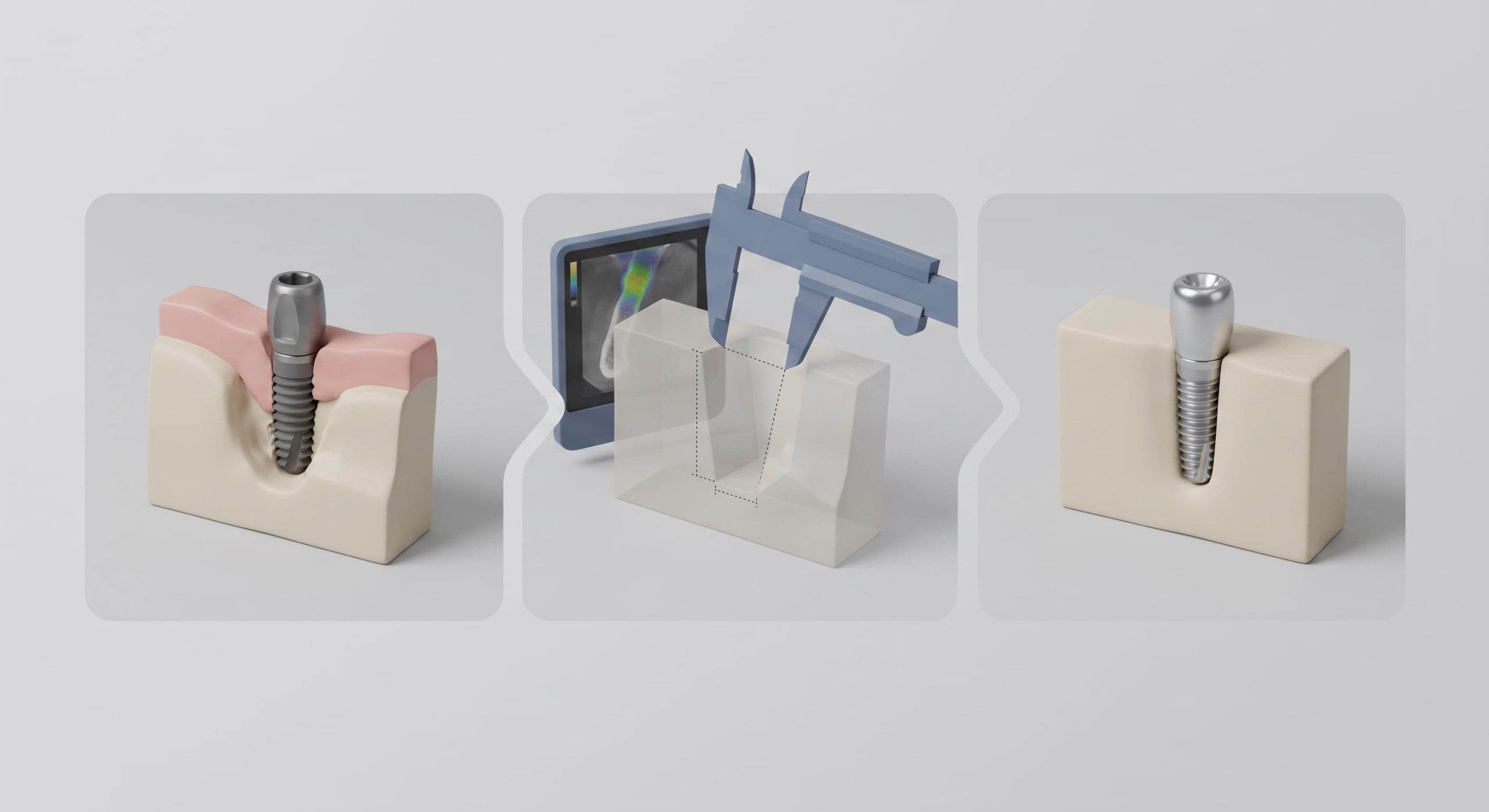
Failed implants does not automatically mean a new one goes in at the next appointment. Before any replacement can be planned, the site needs to be evaluated on its own terms: whether the infection or inflammation that caused the failure has actually cleared, how much bone is left once the old implant comes out, and what went wrong the first time. Skipping this step is one of the more common reasons a second implant fails again.
This matters because removal and replacement are two separate clinical decisions, not one continuous procedure. A patient who assumes the new implant will go in on the same day as the removal is often working from a different timeline than what the site actually needs. The gap between those two expectations is where most of the frustration around failed implant cases comes from.
This article covers what a clinic should be checking before committing to a replacement plan, why the original cause of failure changes what happens next, and what a revised treatment plan realistically looks like for someone dealing with a failed implant, whether that implant was placed in Vietnam or elsewhere.
Quick Answer
Not every failed implant can be replaced immediately. Before a new implant is placed, the clinic needs to confirm the infection or inflammation has resolved, assess remaining bone volume with a CT scan, and identify why the original implant failed. Depending on these findings, replacement may happen right away, after grafting, or at a different position.
Why failed implants cannot always be replaced right away
Implant failure generally falls into two patterns. Early failure happens in the first few months, before the bone has fully integrated with the implant surface, and usually shows up as looseness or infection at the surgical site. Late failure develops after a year or more in place, most often driven by peri implantitis, a bacterial process around the neck of the implant that gradually breaks down the surrounding bone. A more detailed breakdown of what typically causes implant failure and how it is usually classified is covered separately.
What matters for replacement planning is that removing a failed implant does not automatically restore the site to a condition ready for another one. If the failure involved active infection, that infection needs to be resolved before a new implant is introduced into the same tissue. If bone loss occurred around the implant before it was removed, the socket left behind may no longer have enough volume to support a new fixture without additional work. Treating removal and replacement as a single event skips the part of the process that actually determines whether the second attempt succeeds.
What must be assessed before a replacement implant is placed
Replacing failed dental implants depends on a handful of specific findings, not a general sense that “enough time has passed.” Each of these needs to be checked individually before a revised treatment plan can be written.
Whether infection or inflammation has fully resolved
If the original failure involved peri implantitis or an active infection at the site, placing a new implant before that tissue has settled tends to repeat the same outcome. A dentist typically looks for the absence of swelling, discharge, and tenderness at the site, along with clinical signs that the soft tissue has healed rather than simply quieted down temporarily. In cases involving a peri implantitis revision, this healing period is often the single biggest factor in how soon a new implant can go in, and rushing it is one of the more avoidable reasons a second implant fails.
How much bone remains at the site
A CT scan taken after the failed implant has been removed, not before, is what actually shows the usable bone volume at that point. The scan taken for the original implant reflects bone conditions that may no longer apply, since implant failure itself, and the removal process, can both reduce bone volume further. This scan is what determines whether a new implant can go directly into the socket, whether grafting is needed first, or whether the site cannot reliably support an implant at all without a different approach.
What caused the original implant to fail
The cause of the first failure changes what the re implant treatment plan should look like. A failure driven by poor initial positioning or inadequate planning points toward a different surgical approach the second time, not necessarily a different implant brand. A failure driven by infection points toward stricter hygiene protocols and a longer waiting period before replacement. A failure linked to an unbranded or low quality implant, which is a known risk specific to some dental tourism clinics, points toward using a documented implant system with traceable manufacturing records this time. Understanding the original cause is not an academic exercise. It is the difference between fixing the actual problem and repeating it with a new implant.
The patient’s current health status
Factors like uncontrolled diabetes, smoking, and bruxism affect healing after any implant placement, and they matter more, not less, the second time around. If any of these were present during the original failure and remain unmanaged, a replacement implant carries a higher risk of encountering the same complications. This is one of the more direct conversations a clinic should have before agreeing to a replacement timeline, rather than after.

Immediate replacement, delayed replacement, or a different site
Once infection status, bone volume, and cause of failure have all been assessed, the findings usually point toward one of three directions. If the site is free of infection and has sufficient bone volume, an implant can sometimes be placed at the same visit as the removal, though this depends entirely on the individual case rather than being a default option. If bone volume is insufficient, grafting is typically needed first, followed by a healing period before the new implant can be placed. If the original site has been compromised by repeated failure or significant bone loss, moving to an adjacent position with healthier bone is sometimes the more reliable option than trying to force a second attempt into the same spot.
None of these three paths can be decided without the assessment steps above completed first. A clinic that offers a firm replacement date before that evaluation has happened is making a commitment it cannot actually support with clinical findings yet.
What a revised treatment plan may include
A replacement treatment plan is often more involved than the original one, not less. Bone grafting is common enough in failed implant cases that it should be treated as a realistic possibility rather than an exception. Healing time before the new implant goes in can run longer than a first time case, particularly if grafting was required or infection needed extended time to resolve. For international patients, this often means the treatment now needs two separate trips rather than one, with time at home between them for healing to progress. Written documentation, including implant brand, serial number, and warranty terms specific to the replacement, should be provided again, separate from whatever documentation existed for the original implant that failed.
Delia Dental Clinic‘s approach to assessing a failed Implant
Delia Dental Clinic reviews failed implant cases the same way regardless of where the original implant was placed, including implants placed at other clinics before the patient reaches out. The process usually starts with existing X rays or photos of the site sent through WhatsApp or Messenger, which allow an initial read on what may be going on before the patient travels. That initial review is preliminary by nature. It can flag obvious signs of infection or give a rough sense of what the case involves, but it cannot replace the CT scan taken in person at the Hanoi or Ho Chi Minh City clinic, which is what actually confirms bone volume and readiness for a new implant.
Delia Dental Clinic does not commit to a same day replacement before that in person assessment has happened, since doing so would mean setting a treatment plan before the infection status and bone volume are actually known. Depending on what the CT scan and clinical exam show, the team lays out whether replacement can proceed immediately, whether grafting and a waiting period are needed first, or whether an adjacent site makes more sense. For patients who need a staged approach, the international patient team coordinates timing between the two visits so the second trip lines up with when the site is actually ready.
Frequently Asked Questions
Does a failed implant always need to be removed?
Not in every case. If the implant is still stable and the surrounding tissue shows no signs of infection or ongoing bone loss, some clinics may choose to monitor and manage the site rather than remove the implant outright. Removal becomes necessary when the implant is mobile, when there is persistent infection that cannot be controlled with the implant still in place, or when imaging shows bone loss has progressed to a point where the implant can no longer be supported. The decision depends on the specific findings at the site rather than the fact that a complication occurred at some point. A dentist reviewing X rays and clinical symptoms is in a better position to make this call than a general rule can provide.
Can the old implant be removed and a new one placed on the same day?
Sometimes, but this is the exception rather than the standard approach. Same day replacement is only realistic when the removal shows no active infection and the bone at the site is clearly sufficient to support a new implant without grafting. In cases involving peri implantitis, bone loss, or an unclear cause of failure, placing a new implant immediately after removal skips the healing window that the tissue actually needs. Most failed implant cases end up following a staged approach instead, with removal and assessment happening first and replacement scheduled once the site meets the criteria described earlier in this article.
Can a failed implant from another clinic be assessed remotely before traveling?
To a limited extent. Sending existing X rays, photos of the site, and details about when the implant was placed and how the failure presented itself allows for a preliminary read on what the case likely involves. This can help set expectations about whether infection appears to be present or whether the case looks more straightforward. It cannot replace an in person CT scan and clinical exam, since photos and older X rays do not show current bone volume or confirm that any infection has actually resolved. Patients dealing with a failed implant from elsewhere are welcome to send this information ahead of travel so the clinical team has context before the in person assessment.
Does a replacement implant come with the same warranty as the original?
The warranty terms apply to the specific implant placed during the replacement, and documentation including the implant brand, serial number, and warranty period is issued separately from whatever paperwork existed for the implant that failed. This means the warranty clock effectively restarts with the new implant rather than continuing from wherever the original coverage left off. Patients should keep both sets of documentation, since the original records may still be relevant if the cause of failure needs to be reviewed again in the future.
Is the cost of replacing a failed implant the same as the original treatment?
Not usually, since a replacement case often involves additional steps that a first time implant does not require. Bone grafting, an extended healing period, and sometimes an additional CT scan all add cost beyond the base price of the implant itself. The exact figure depends on what the assessment finds at the site, which is why a case based quote after reviewing the imaging is more accurate than trying to estimate cost from the original implant price alone.
Final Thoughts
A failed implant is not the end of the road, but replacing it responsibly means letting the site tell you what it needs before committing to a date. Infection status, remaining bone volume, and the original cause of failure together determine whether a new implant can go in right away, needs grafting first, or is better placed somewhere else entirely. Patients dealing with a failed implant, whether it was placed at Delia Dental Clinic or somewhere else, can send existing X rays or photos of the site along with details of when the implant was placed and how the failure showed up through WhatsApp or Messenger. The international patient team can offer a preliminary read on the case and outline what an in person assessment in Hanoi or Ho Chi Minh City would need to confirm before any replacement date is set.


