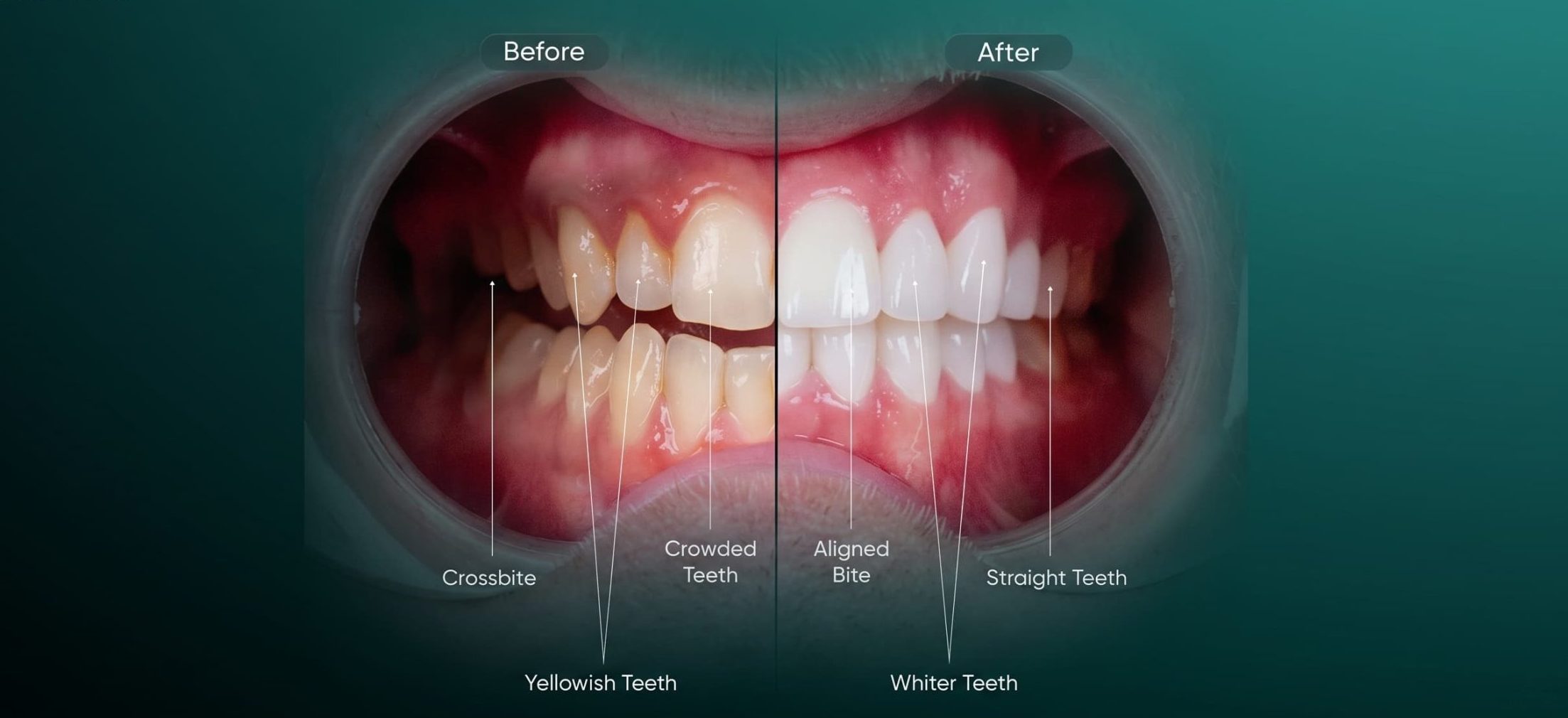
A dental before and after photo is real evidence, but it is selected evidence. It proves that a clinic completed one specific result on one specific patient. It does not prove that the same result is likely for you, and it says very little about how the treatment feels, functions or holds up over the years.
That gap between what a photo proves and what a reader assumes it proves is where most disappointment starts. A patient sees a bright, even smile on a clinic website, reads it as a preview of their own outcome, and only later learns that the photo showed the best angle of the most suitable case, taken under favourable light.
This guide explains what before and after photos can and cannot tell you, how lighting, angles, editing and case selection change what you see, and what to ask any clinic, in Vietnam or elsewhere, before you rely on a gallery to make a decision.
Quick Answer
Dental before and after photos prove that a clinic has completed a specific visual result, and they show its aesthetic style. They do not prove function, durability, bone health under an implant, or that your case will look the same. Check the lighting and angles, ask how the case was selected, and use photos as a starting point for a consultation rather than a promise.
What before and after photos prove
A photo set proves, first, that the work exists. A clinic that shows fifteen veneer cases with consistent shape and colour has, at minimum, produced results in that range, which is more than a clinic with no visual record can say.
Photos also reveal a clinic’s aesthetic preference in a way that written descriptions cannot. Some clinics favour a very bright, uniform look, others a softer and more varied one that follows natural tooth variation. Two clinics can both describe their work as “natural looking” and produce visibly different results, so the photos are the only reliable way to see which style you would be signing up for.
A series matters more than a single image. When the same clinic shows several cases of the same treatment, taken from the front, at an angle and in profile, you can judge consistency, not just one good outcome. The Delia Dental Clinic before and after gallery presents front, 45 degree and profile views for a case, and that kind of multi-angle set is what is worth looking for anywhere you browse.

What they cannot prove
Function and bite
A photo cannot show how a bite feels or whether a patient can chew comfortably. A restoration can look excellent and still sit slightly high on one side, and that problem appears in the mouth over days and weeks, not in the image. This is why a beautiful result and a comfortable result are two separate questions, and why adjustment after fitting is a normal part of good treatment rather than a sign of a bad photo.
How long the result lasts
Before and after photos are almost always taken shortly after treatment, when everything looks its best. They say nothing about how the result looks after three years of eating, brushing and normal wear. If longevity matters to you, ask whether the clinic can show cases photographed a year or more after treatment, and read the written warranty terms rather than inferring durability from a fresh photo.
What is under the surface
For implants, an outward photo of the finished teeth shows the crown or bridge, not the implant or the bone around it. Whether an implant is well positioned, whether bone grafting was needed, and whether the surrounding tissue is healthy are questions for X-rays or a CBCT scan, not for a smile photo. For veneers, the image does not show how much natural tooth was prepared underneath, which affects how reversible the treatment is later.
| What the photo shows | What the photo does not show |
|---|---|
| Shape, colour and alignment at one moment | How the bite feels or whether adjustment was needed |
| The clinic’s aesthetic style | Longevity, wear or maintenance needs |
| The finished crown, veneer or bridge | Implant position, bone level or tooth preparation |
| A result that the patient agreed to share | How typical that result is across all patients |
Lighting, angles, editing and case selection
Four things change what a photo looks like without changing the teeth, and they are worth checking one at a time.
Lighting and framing come first. Clinical photography guidance from dental educators consistently stresses that comparison photos should use the same angles, distances and retractors, and controlled lighting rather than natural light, because even small deviations make a before and after pair less reliable. If the before photo is dim and shot from a phone while the after photo is bright and taken with a ring flash, the difference you see is partly the camera. Look at whether the background, the framing and the amount of visible gum are the same in both images.
Retraction and the state of the teeth matter next. Cheek retractors that pull the lips wide show the whole tooth surface evenly, while a relaxed smile shows less and hides the gum line. Teeth photographed dry can also look chalkier than teeth photographed wet. None of this is dishonest, but it means two photos of the same result can look different.
Editing is the point most readers worry about, and it is fair to ask. Digital photos are routinely adjusted for exposure and white balance, and some sources on dental marketing warn against heavier alterations such as digitally whitening teeth. The practical test is whether the result looks plausible against the person’s face and skin tone in the same image, and whether the clinic can show you the case in person or on video. Video is harder to alter convincingly than a still, so a clinic that publishes video of patients is giving you an additional check.
Case selection is the least visible of the four. A gallery is a curated set, and curated sets lean toward the most dramatic and most successful cases. That is normal marketing, not deception, but it means a gallery shows the top of the range rather than the average. Some clinic galleries note this themselves. The Delia Dental Clinic gallery states that images may look different from the real appearance depending on the shooting conditions and were posted with the patient’s agreement, which is a reminder that a photo is a record of one moment under specific conditions.

Three questions worth asking any clinic
- How long after treatment was this photo taken?
- Is this a typical case for this treatment, or one of your best?
- Do you have a case similar to mine, with a similar starting point?
If the answer to the second question is “one of our best,” that is useful information rather than a reason to walk away, because it tells you where to set your expectations.
Realistic expectations by treatment type
The three main treatments in the Delia Dental Clinic gallery, veneers and crowns, single implants and full arch implants, leave different gaps between what a photo shows and what you need to know.
| Treatment | What photos usually show well | What they miss | What to ask |
|---|---|---|---|
| Veneers and crowns | Shape, colour, alignment, symmetry | Tooth preparation, bite comfort, how the shade looks in different light | Was there a mock-up or try-in, and how did the final compare to it? |
| Single implant | The finished crown next to natural teeth | Implant position, bone level, gum health, healing time | Can I see the X-ray or CBCT for a similar case? |
| Full arch implants | The finished arch and smile line | Function while eating, temporary versus final teeth, cleaning access under the bridge | Is this the final prosthesis or the temporary one, and how long after surgery? |
Full arch cases deserve particular care, because a photo may show either the temporary teeth fitted on the day of surgery or the final prosthesis fitted months later. These are different products, and a before and after that does not say which one it shows can mislead the reader about both appearance and timeline. The distinction is explained further in temporary versus final full arch implants.
How to use photos in your own consultation
The most productive use of a before and after gallery is not to pick a result and ask for a copy. It is to bring your own photos and a few reference images to a conversation and ask what is realistic for your teeth.
Send clear photos of your current teeth, taken in daylight from the front and at an angle, and add one or two images of a look you like. A clinician can then tell you which parts of that look are achievable with your tooth position, gum line and bite, and which are not. Reference photos work best as a way to describe a style, such as tooth length, brightness or how much natural variation you want, rather than as a target to duplicate on a different face.
Treat the answer as a preliminary direction. Photos help a clinic understand what you want, but they do not replace an examination, and a responsible plan is confirmed after X-rays and an in person assessment. For implants and full arch work in particular, the records that matter most are X-rays or CBCT files, not smile photographs.
How Delia Dental Clinic handles photos and case discussion before you fly
Delia Dental Clinic publishes its before and after cases on a dedicated gallery page, organised by treatment and shown from several angles, alongside longer patient accounts on the client review page. These are the places to apply the checks in this guide, and to notice which cases resemble yours.
For patients considering veneers or crowns, the clinic uses Digital Smile Design, a mock-up and a try-in, which means you can review a proposed result on your own teeth before the final restoration is completed. That preview is more relevant to your decision than any gallery photo, because it shows your mouth rather than someone else’s.
Before you travel, patients can send photos, X-rays or CBCT files by WhatsApp or Messenger to the international patient team in Hanoi or Ho Chi Minh City. The team can give a preliminary treatment direction and a likely timeline, and the final plan and quote are confirmed after an in person examination.
Frequently Asked Questions
Are dental before and after photos usually edited?
Some adjustment is common, since digital photos are routinely corrected for exposure and white balance, and some marketing guidance warns against heavier changes such as digitally whitening teeth. You cannot confirm from a still image alone what was changed. The more reliable checks are whether the result looks plausible against the face and skin tone, whether the clinic publishes video of real patients, and whether it will show or discuss a case in detail when asked. Asking directly is reasonable, and the way a clinic answers tells you something in itself.
How long after treatment should the after photo be taken?
There is no single correct interval, and it depends on the treatment. A veneer or crown case can be photographed once the restorations are fitted and the gums have settled, while an implant case needs healing time before the final teeth are placed, so a meaningful after photo comes later. The useful question is simply how long after treatment the image was taken. A photo from the day of fitting shows the best case, while one taken months or years later says more about how the result holds up.
Can a before and after photo show whether an implant is successful?
Not by itself. A photo shows the visible crown or bridge, which can look excellent while the implant underneath has problems, or look ordinary while the implant is sound. Implant success depends on bone integration, position and long term health, which are assessed through X-rays, CBCT imaging and follow up examinations. If you want evidence of implant quality, ask about the clinic’s imaging, its warranty terms and its follow up process, and treat the smile photo as evidence of appearance only.
Should I ask for photos of average cases rather than the best ones?
Yes, and it is a fair request. A gallery tends to show the most successful and most dramatic cases, so asking whether a photo is typical or exceptional helps you set expectations. Ask to see a range of cases for the treatment you are considering, including ones with a starting point similar to yours. A clinic may not be able to show every case, since patient consent limits what can be shared, but it should be able to describe honestly what a typical result looks like.
Can I ask a clinic to show a case similar to mine?
You can, and it is one of the most useful things to ask. Describe your situation, for example the number of teeth involved, whether you have missing teeth, or the type of change you want, and ask whether the clinic has comparable cases it can share. Sending your own photos and X-rays first makes the comparison more accurate. A similar case is still an example rather than a forecast, because every mouth differs, but it gives you a much better reference than an unrelated gallery image.
Getting the rest of the decision right
A gallery is only one input into choosing a clinic, and these guides cover the surrounding questions on trust, safety and how to weigh a second opinion.
- Why International Patients Choose Delia Dental Clinic Vietnam
- Is Dental Care in Vietnam Safe? What International Patients Should Know
- Second Opinion Dental Treatment in Vietnam
- How to Read an Dental Implant Itemised Quote Before You Deposit
Final Thoughts
A before and after photo is best read as a claim that has been partly proven. The clinic did produce that result on that patient, and you can see its style, but the photo cannot tell you about comfort, durability or what lies beneath the surface, and it cannot promise the same outcome for you.
The most useful habit is to move from the gallery to a conversation about your own case. Ask how the photo was taken, how typical it is, and what can be confirmed about your teeth before travel.
Send your current dental photos and any X-rays or CBCT files to Delia Dental Clinic via WhatsApp or Messenger before booking your flight. The international patient team can review what you send, suggest a preliminary treatment direction and help estimate the likely cost and travel timeline for Hanoi or Ho Chi Minh City. The final treatment plan and quote are confirmed after an in person examination.


