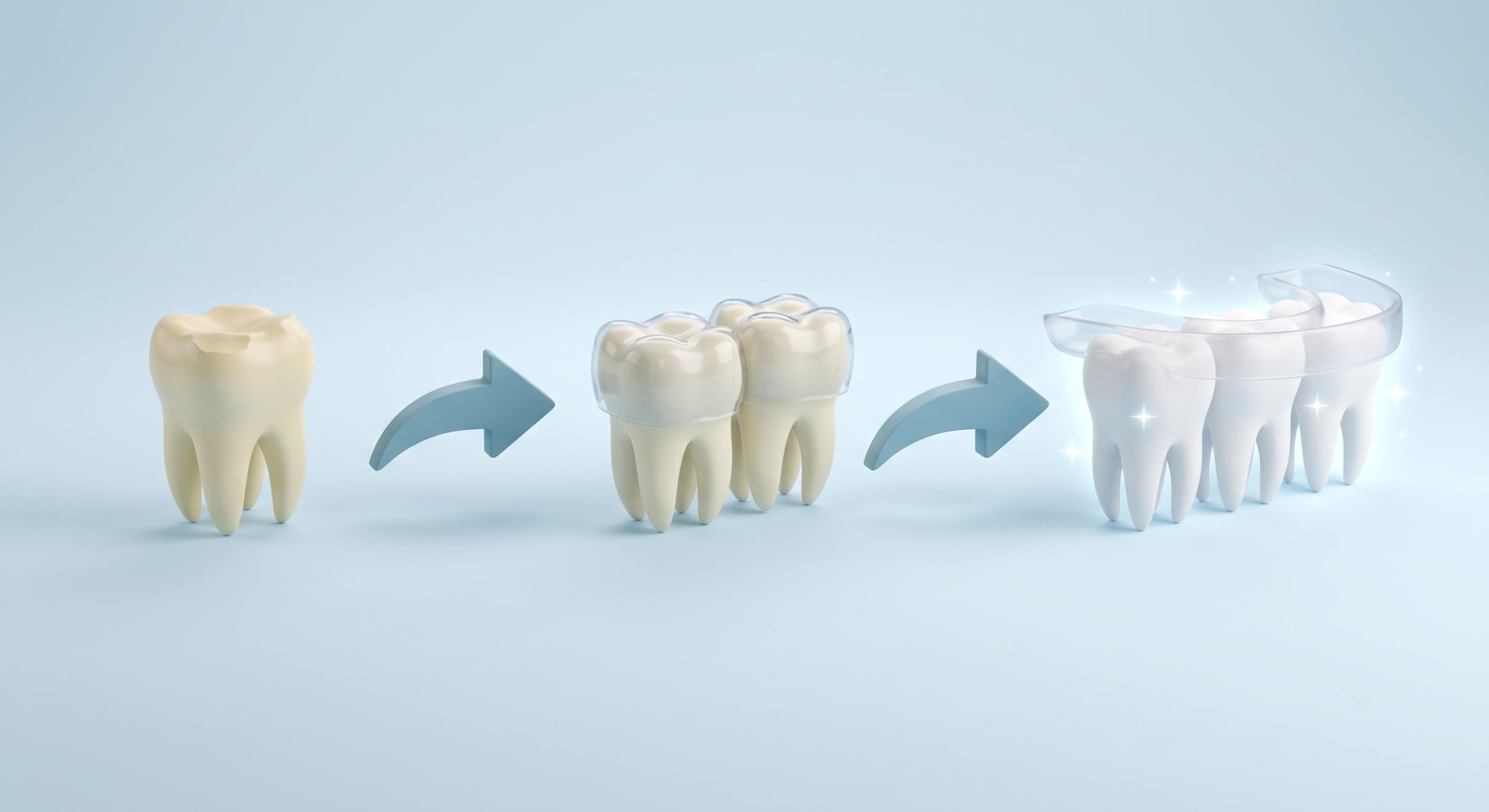
Most patients looking at worn, yellow and uneven teeth assume they are looking at one problem with three symptoms. In most cases they are actually looking at three separate issues that happen to show up on the same smile at the same time. Treating them as one problem, usually by jumping straight to veneers, is one of the more common reasons a smile makeover does not hold up well over time.
The wear, the color and the unevenness usually come from different sources and often need to be assessed in a specific order before any restorative material is chosen. Skipping that order does not always cause an immediate problem, but it tends to show up later as premature wear on new restorations, a bite that never quite settles, or a result that looks close but never fully matches what the patient pictured.
This guide walks through the order clinicians typically follow when a patient presents with all three issues at once, from the checks that happen before any cosmetic conversation starts through to the point where material selection is finally decided.
Quick Answer
Worn, yellow and uneven teeth are usually not treated all at once. The sequence typically starts with confirming the wear is stable and the bite is not actively causing further damage, then testing how the teeth respond to whitening, then assessing how much tooth length has been lost, before alignment, gum line and trial design are finalized. Material selection is one of the last decisions, not the first.
Why Worn, Yellow And Uneven Teeth Rarely Share One Cause
Wear on the biting edges of the teeth is usually mechanical or chemical. Grinding, clenching, an uneven bite, or acid erosion from diet or reflux can all shorten the visible part of a tooth over time, and each of these causes points toward a different starting treatment.
Yellowing is a separate process. It can come from surface staining that sits on the enamel, or from a change happening underneath the enamel where the dentin shows through. These two look similar to the eye but respond completely differently to whitening, which matters for what gets planned next.
Unevenness is the third variable, and it is often the most misread. Teeth can look uneven because they are genuinely out of position, because wear has shortened some teeth more than others, or because an old crown, filling or veneer no longer matches the surrounding teeth. Each of these has a different fix, and none of them is solved by simply covering everything with the same material.
Because the three issues usually have three different mechanisms, a single blanket solution, most often a full set of veneers placed without addressing the underlying cause, tends to mask the problem rather than resolve it. That is why the assessment order matters more than the choice of material.

What Gets Checked Before Any Cosmetic Decision Is Made
Before wear, color or alignment are discussed as cosmetic issues, a few baseline checks confirm that the mouth is actually ready for cosmetic planning.
| Check | Purpose | Why it changes the plan |
|---|---|---|
| Decay and infection status | Rules out active disease that needs treatment first | A crown or veneer placed over decay or infection will fail regardless of how well it is shaped or shaded |
| Bite and occlusion stability | Confirms whether the wear is still progressing | If the bite has not stabilized, new restorations are likely to wear down again |
| Gum baseline health | Identifies inflammation that needs treatment before cosmetic work | Inflamed gums distort how tooth proportions actually look, which throws off the final design |
These checks are not cosmetic steps themselves. They exist to confirm that whatever gets built on top of them will actually last.
The Treatment Order For A Multi Problem Smile
Once the baseline checks are clear, the sequence below is the order clinicians generally work through when wear, color and unevenness are all present in the same case.
Confirm The Wear Is Stable Before Fixing The Look
The first question is not what the worn teeth should look like, but whether the wear has actually stopped. Wear coming from an active habit such as bruxism, or from a bite that puts uneven pressure on certain teeth every time the jaw closes, does not pause just because a cosmetic plan has started. If new crowns, veneers or bonded edges are placed on top of a bite that is still doing the same damage as before, the same wear pattern tends to reappear on the new material within a few years, sometimes faster than it did on the natural tooth.
Confirming stability usually means looking at how sharp or rounded the wear facets are, whether there is active muscle tenderness or jaw fatigue reported by the patient, and whether a period wearing a night guard changes the pattern. A patient whose wear stopped years ago after an old habit resolved is in a very different position from one whose wear is still actively progressing, even if the two mouths look similar at a glance.
The boundary here is practical rather than absolute: stability does not always mean the habit is completely gone, it means the forces acting on the teeth have been brought under enough control that a new restoration has a reasonable chance of surviving. Where a night guard or a bite adjustment is recommended, it is usually treated as a prerequisite step rather than something to revisit later, since building a smile makeover on an unstable bite is one of the more expensive mistakes to correct after the fact.
Test Whitening Response Before Deciding Veneers Or Crowns
Color is often the reason patients ask about a smile makeover in the first place, but it is also the variable most likely to change the scope of the plan once it is actually tested rather than assumed. Whitening response separates two situations that look identical to the eye: staining that sits on the surface of the enamel, which usually lightens well, and a color change coming from the dentin underneath the enamel, which whitening cannot fully reach.
Teeth that respond well to whitening may not need a veneer or crown purely for color reasons, which can shrink what initially looked like a full smile makeover down to a smaller, less invasive plan. Teeth that barely change with whitening, often because of old trauma, tetracycline staining, or a heavily filled tooth with a grayish tone showing through, are the ones more likely to need a coverage restoration if color correction is a priority.
Skipping this test and moving straight to veneers means paying for and preparing a restoration on teeth that might have responded to a far simpler and more reversible step. It also affects shade selection later, since a tooth that has been allowed to whiten first gives a more accurate baseline for matching any remaining restorations to the rest of the smile.

Assess How Much Length Has Been Lost
Wear does not usually take length off every tooth evenly. The front teeth, particularly the lower incisors and the edges of the upper front teeth, tend to shorten first and most visibly, which is part of why a worn smile can make someone look years older than they actually are, independent of skin or facial changes.
This step measures the gap between the current, worn edge and where a natural, unworn tooth edge would sit, usually using a mix of visual assessment, study models or digital scans, and sometimes photos from years earlier if the patient has them. The amount of length lost has a direct effect on what happens later: a tooth that has lost a millimeter or two of length may only need surface reshaping and color correction, while a tooth that has lost several millimeters usually needs a restoration built to add that length back, which changes both the material choice and the amount of tooth preparation required.
Patients sometimes assume more length has been lost than actually has, because a discolored or chipped edge draws the eye even when the underlying length loss is minor. Measuring this properly avoids over treating a tooth that mainly needs a cosmetic touch up, and under treating one that genuinely needs the length rebuilt.
Decide Whether Alignment Needs Correction Or Just Visual Balancing
Not every uneven smile is an alignment problem, and not every alignment problem needs correcting before cosmetic work can start. Some patients have teeth that are genuinely out of position, rotated, overlapping, or angled differently from their neighbors, where orthodontic movement is worth discussing as a first step so that any restoration built afterward sits on a properly positioned tooth rather than compensating for a crooked one.
In other cases, the teeth are in a reasonable position, but uneven wear, a chipped edge, or an old crown or filling that no longer matches its neighbor creates the appearance of unevenness without the teeth actually being misaligned. This second situation is usually resolved through the restorative plan itself, without orthodontics, by rebuilding shape and proportion to visually balance the smile.
The distinction matters because recommending orthodontics for a case that is really just a wear and shade mismatch adds unnecessary time and cost, while trying to mask a genuine alignment problem with veneers alone can produce a result that looks slightly off no matter how well the shade and shape are matched. Determining which situation applies is usually done through a direct visual and photographic assessment of tooth position relative to the midline and the opposing arch.
Evaluate The Gum Line Before Finalizing Tooth Proportions
Tooth proportions are judged relative to the gum line, not in isolation, which is why two teeth of identical length can look mismatched if the gum sits higher on one side than the other. An uneven gum line is a common but often overlooked contributor to a smile that reads as uneven even when the teeth themselves are fairly consistent in size.
This step involves checking gum symmetry across the visible smile, identifying any excess gum tissue that is shortening the apparent length of specific teeth, and confirming gum health is stable enough for any recontouring to be planned. Where gum contouring is needed, it is generally sequenced before the final tooth proportions are locked into the design, since building a restoration first and adjusting the gum afterward makes it far harder to hit the intended proportions.
Skipping this check is one of the more common reasons a finished smile makeover looks slightly uneven in photos even after the restorations themselves are technically well made, since the eye is comparing tooth to gum ratios rather than tooth length alone.
Build The Trial Design Before Committing To Material
By the time bite stability, whitening response, length loss, alignment and gum line have all been assessed, there is enough information to build a trial version of the proposed result, typically through a mock up placed directly in the mouth or a digital smile design created from photos and scans. This step exists to let the patient see and, in the case of a physical mock up, physically feel the proposed shape and length before any natural tooth structure is permanently altered.
The trial design is where mismatches get caught cheaply. Adjusting a wax mock up or a digital rendering takes minutes and costs nothing structurally. Adjusting a finished ceramic restoration that has already been cemented means removing it, which is a far more invasive and costly correction. Patients evaluating the trial should be looking specifically at tooth length relative to the lip line, how the proposed shape looks when speaking and smiling naturally rather than only in a static photo, and whether the color direction feels right compared to the rest of the face.
Material Selection Comes Last
Once the trial design has been reviewed and adjusted to the patient’s satisfaction, material selection becomes the active decision, and it is made tooth by tooth rather than as one blanket choice applied to the whole smile. A tooth that mainly needed color correction and had minimal length loss might only need a thin veneer, while a tooth that lost significant structure to wear or decay may need the broader coverage a crown provides. Mixing materials within the same smile is common and is usually planned around what each specific tooth needs structurally, not around picking one material for the whole case for simplicity.
This sequencing, checks first, then wear stability, whitening response, length, alignment, gum line and trial design, and only then material, is also why starting with a material decision tends to produce weaker results. A veneer chosen before the length loss has been measured, or a crown chosen before whitening has been tested, is a decision made with incomplete information. The tooth by tooth material logic itself, including how veneers and crowns are typically distributed across a mixed case, is covered in more detail in combining veneers and crowns in one treatment plan.

How Delia Dental Clinic Sequences A Multi Problem Smile Case
For patients sending photos before travel, Delia Dental Clinic reviews the same factors in roughly the same order a clinical exam would follow: visible wear pattern on the biting edges, signs of an uneven bite such as flattened or chipped areas concentrated on specific teeth, how uniform or patchy the tooth color looks across the smile, and whether the gum line and tooth proportions appear even from the available photos. Photos taken straight on and from the side, along with a description of when the wear or color change was first noticed, tend to give the clearest starting picture.
From that review, Delia Dental Clinic can usually suggest a likely starting point in the sequence, for example flagging that the wear pattern looks consistent with an active bite issue that would need addressing before cosmetic steps, or noting that the discoloration looks more like surface staining that whitening may resolve. This gives the patient a realistic sense of scope, whether the case is likely to stay relatively simple or involve several of the steps above, before they commit to travel.
What a remote review cannot do is confirm bite stability, measure actual gum health, or test how the teeth respond to whitening, since each of those requires direct clinical assessment and, in some cases, a period of observation that cannot happen over photos alone. Patients traveling to Hanoi or Ho Chi Minh City for this type of case should expect the exact sequence, and the point in that sequence where their case actually sits, to be confirmed after an in person examination, with the remote review serving as a starting direction rather than a final plan.
Frequently Asked Questions
Do All These Steps Happen In One Visit?
Not usually. Confirming bite stability and testing whitening response can take longer than a single appointment, especially if a night guard or a period of observation is needed first. Steps such as the trial design and material selection tend to happen later in the treatment plan, once the earlier checks are complete. The overall timeline depends on how many of the seven steps apply to a specific case.
Can Whitening Alone Fix Yellow And Uneven Teeth Without Veneers Or Crowns?
Whitening can resolve the color issue on its own if the discoloration is mainly surface staining and the teeth respond well. It does not change tooth length, shape or position, so if the unevenness comes from wear or alignment rather than color, whitening alone will not fully address the smile. In some cases, whitening followed by minor bonding is enough without moving to veneers or crowns.
What If My Teeth Are Worn But Have Not Lost Much Length Yet?
Early wear with minimal length loss usually means there is more flexibility in the plan, since less has to be added back through restoration. This is often the stage where addressing the cause of the wear, such as a bite adjustment or a night guard, has the most long term value, since it can prevent the wear from progressing to the point where restorations are needed for length as well as color.
Does Gum Contouring Happen Before Or After Crowns And Veneers?
Gum contouring, when it is needed, is generally planned and often completed before the final crowns or veneers are placed, since the gum line affects how the final tooth proportions will look. Placing restorations first and adjusting the gum line afterward tends to make it harder to match the final result to the original design.
Can This Sequence Change If I Already Have Old Crowns Or Fillings?
Existing crowns or fillings are usually assessed as part of the same process, since they can be a source of the unevenness or color mismatch in the first place. Depending on their condition, they may be kept, replaced, or factored into the trial design stage rather than treated as a separate issue outside this sequence.
Final Thoughts
The order in which worn, yellow and uneven teeth are assessed matters more than which material eventually gets used. Skipping bite stability or whitening response to move straight to veneers is one of the more common reasons a smile makeover does not hold up as expected, since the underlying cause is still there once the new restorations are in place. Working through the sequence in order gives the final material choice, whether that ends up being dental crowns, veneers, or a mix of both, a much better chance of lasting.
Send your smile photos, close up dental photos and a short description of what bothers you most about your smile, whether that is color, wear or unevenness, via WhatsApp or Messenger. Delia Dental Clinic can review which step of this sequence your case is likely at before you travel. The final sequence and material plan are confirmed after an in person examination in Hanoi or Ho Chi Minh City.


