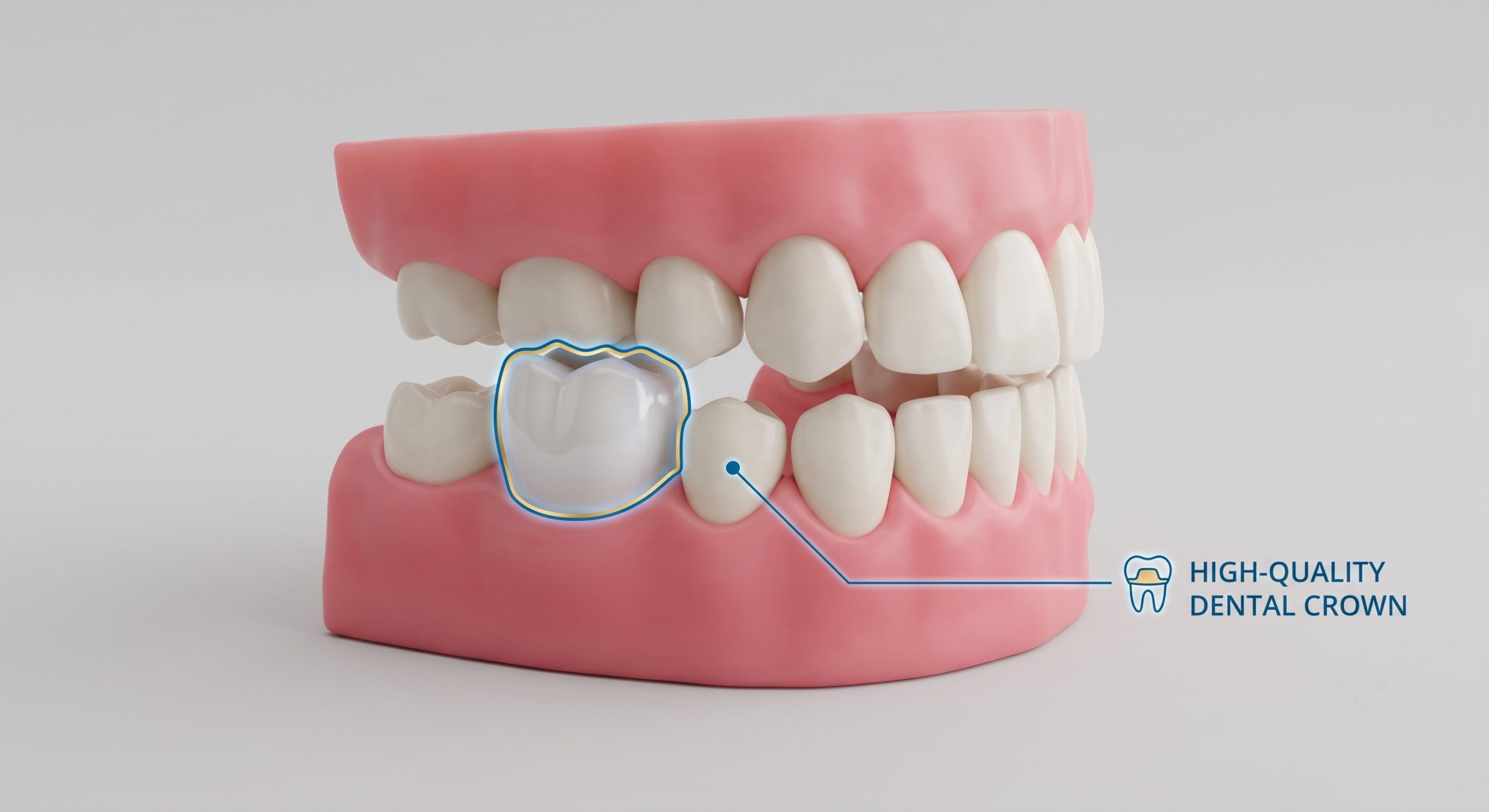
A new dental crown can look completely normal and still make your bite feel wrong. The difference may be very small, but if the crown contacts the opposing tooth before the rest of your teeth meet, the pressure can become noticeable every time you close your mouth or chew.
However, not every unfamiliar sensation means the crown is too high. Your tongue may simply be noticing a new shape, or the gum around the tooth may still be tender after treatment. The important distinction is whether the crown merely feels new or repeatedly takes the first and strongest contact when you bite.
Quick Answer
A new crown can feel too high when it contacts the opposing tooth before the rest of your bite. Mild awareness of a new shape may settle, but repeated first contact, concentrated pressure or pain when biting may require professional bite adjustment. Do not file, sand or attempt to reshape the crown yourself.
What Does a “High Crown” Mean, and Why Can It Happen?
A crown is considered high when part of its biting surface creates premature contact. In practical terms, the crowned tooth touches its opposing tooth before the other teeth reach their normal position.
This does not always mean the crown is visibly taller than the surrounding teeth. A restoration may appear level but still interfere with the bite during closing, chewing or side-to-side jaw movement.
The most direct cause is a small difference between the shape of the crown and the patient’s actual bite. Even when impressions or digital scans are accurate, the final crown still needs to be checked inside the mouth because the jaw moves in more than one direction.
Bite records can also be affected when the patient has held their mouth open for a long time, is still numb or closes their jaw differently during the recording. Grinding, clenching or an already unstable bite can make the final contact pattern harder to reproduce. When several crowns are fitted together, there may also be fewer untreated teeth available as reference points.
Occasionally, the crown may not be fully seated in its intended position. Internal contact, cement or another fitting issue can affect how it sits on the prepared tooth. A patient cannot reliably determine this by looking in a mirror, and a crown that feels high should not automatically be blamed on excess cement.
There is also a less concerning possibility: the crown may simply have a shape that feels unfamiliar. The tongue is highly sensitive to small changes in width, contour and surface texture. A new crown may therefore feel bulky or unusually noticeable even when the biting contacts are balanced.
The key difference is repetition. Awareness of a new shape may gradually fade. A crowned tooth that consistently hits first every time the mouth closes should be assessed rather than expected to “settle into place.”
Is the Crown Simply New, or Does the Bite Need Checking?
Mild gum tenderness, temporary temperature sensitivity and awareness of a different tooth shape can occur after crown fitting. These symptoms should generally become less noticeable rather than progressively worse.
A high bite tends to produce a more specific pattern. The patient may feel that the crowned tooth stops the jaw from closing naturally, that pressure is concentrated in one area or that the tooth hurts only when chewing. Some people begin avoiding that side of the mouth without consciously deciding to do so.
The following comparison can help patients describe the problem, but it cannot confirm the diagnosis without an examination.
| What you notice | May represent short-term adjustment | Reason to arrange a dental check |
|---|---|---|
| The crown feels like a new shape when touched by the tongue | Yes | If it has a sharp or rough area that irritates the tongue or cheek |
| Mild cold sensitivity that is steadily improving | Yes | If it becomes stronger, lasts after the stimulus or does not improve |
| The crowned tooth contacts before the other teeth | Unlikely | Yes |
| Pressure is repeatedly concentrated on the same tooth | Unlikely | Yes |
| Pain occurs when biting down | Should not be dismissed as adaptation | Yes |
| Pain occurs when releasing the bite | No | A crack or another cause may need to be excluded |
| The crown feels loose or moves | No | Prompt assessment is needed |
| Spontaneous pain, night pain, swelling, fever or a bad taste | No | Earlier assessment is needed |
There is no useful rule that every patient should wait exactly 24, 48 or 72 hours. The pattern matters more than a fixed number. A sensation that is mild and clearly improving is different from a crown that hits first at every meal or becomes increasingly painful.
Patients should also avoid trying to confirm the problem with ordinary paper, foil or articulating paper bought online. Dentists check the bite while the jaw closes and moves in different directions. The size or darkness of one coloured mark does not, by itself, show how much force that point receives.
Why Can a High Crown Hurt, and Could Something Else Be Causing the Pain?
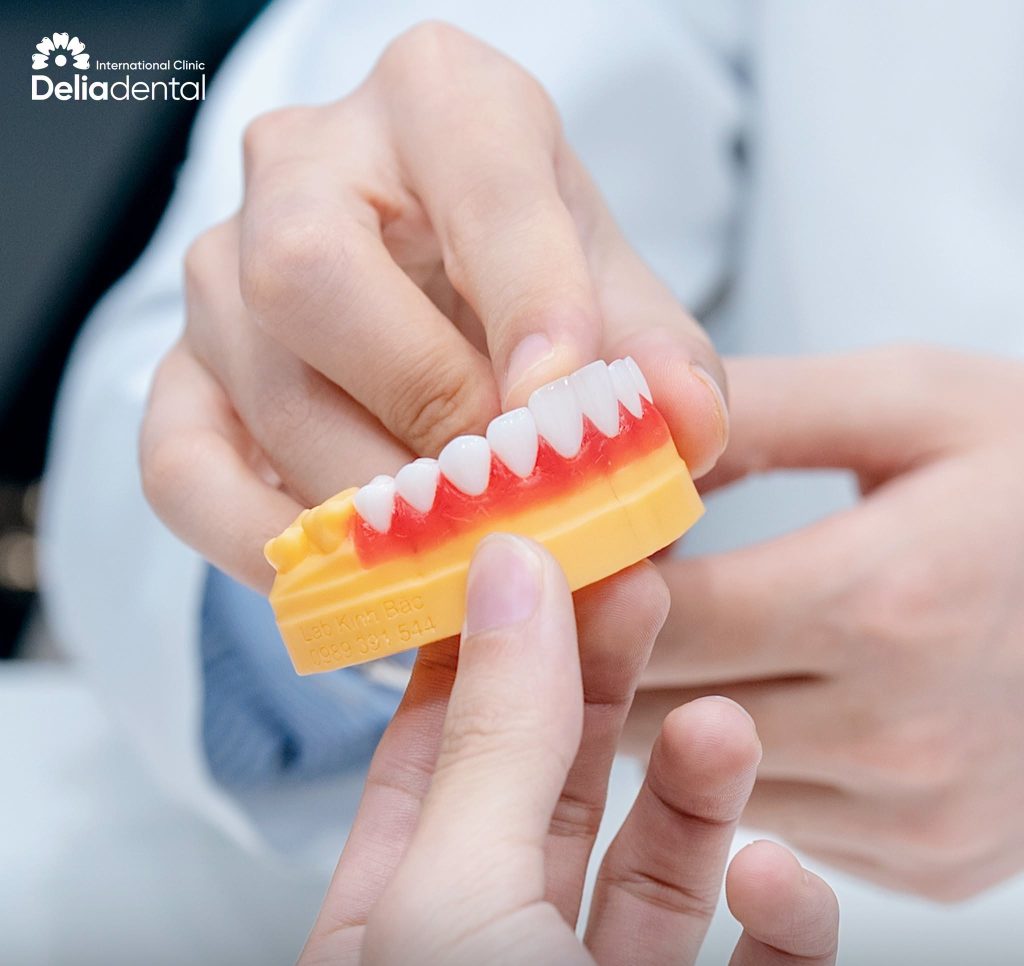
When a natural tooth repeatedly receives force before the rest of the bite, the periodontal ligament around its root may become tender. This ligament connects the tooth to the surrounding bone and contains sensory receptors that respond to pressure.
The result may feel like a bruised tooth. The patient may be comfortable when not eating but experience a sharp or aching sensation when biting on that particular crown. Continuing to chew through the discomfort can maintain the irritation and cause the patient to alter how they use the rest of the mouth.
A high contact may therefore explain biting pain, but it is not the only possible cause.
On a tooth that still has a living pulp, discomfort could also be related to inflammation inside the tooth after preparation. Cold sensitivity that lingers, spontaneous throbbing or pain that wakes the patient at night cannot be explained solely by the crown feeling high. These symptoms may require pulp testing or other investigation. Delia’s guide to whether a root canal is needed before a crown explains why root canal treatment is based on the condition of the tooth rather than performed automatically for every crown.
A root-canal-treated tooth can still hurt when biting. Although the pulp has been removed, the periodontal ligament and tissues around the root remain capable of sensing pressure and inflammation. A crack, infection around the root, loose restoration or concentrated bite force may still produce pain.
An implant crown requires a different interpretation. A dental implant does not have the same periodontal ligament as a natural tooth, so it does not respond or adapt to force in exactly the same way. Reviews of implant occlusion describe this difference as one reason clinicians must assess how force is distributed across implant-supported restorations. However, a strong contact does not prove that the implant is failing. It means the bite and restoration should be examined rather than waiting for the implant crown to adjust by itself. See the clinical review on occlusion and restorative treatment.
Other conditions can also resemble a high bite, including a crack in the remaining tooth structure, pulp inflammation, unstable cementation, gum inflammation, infection, an inaccurate crown margin or pain referred from a neighbouring tooth.
Pain when biting is therefore a reason for evaluation, not proof that the crown simply needs to be ground down. The NHS includes pain when biting, fever, red gums, a bad taste and cheek or jaw swelling among the signs that warrant dental assessment. View the NHS toothache guidance.
If an isolated premature contact remains uncorrected, it may continue to irritate the tooth-supporting tissues, change the patient’s chewing pattern or place unnecessary stress on the restoration. Depending on the crown, underlying tooth and biting habits, uneven force may also contribute to chipping, loosening or jaw-muscle fatigue.
This does not mean that every high crown will cause root canal problems, temporomandibular joint disorders or implant failure. Those conclusions are too broad. The practical reason to have the bite checked is to remove a correctable source of repeated pressure and confirm that another problem is not being overlooked.
How Does a Dentist Check and Adjust a Crown That Feels Too High?
The dentist first needs to understand when the discomfort occurs. Pain as the teeth come together, pain while chewing and pain when the pressure is released can point towards different problems.
The examination may include the way the teeth meet during normal closing, firmer biting and jaw movements to the side or forward. The crown’s fit, margin, stability and surrounding gum tissue should also be assessed. If symptoms suggest a problem inside or around the tooth, further tests or imaging may be appropriate.
When an isolated premature contact is confirmed, the dentist can selectively adjust the relevant area rather than reshaping the entire crown. The bite is then checked again to make sure the crowned tooth no longer receives inappropriate first contact and that necessary contacts have not been removed.
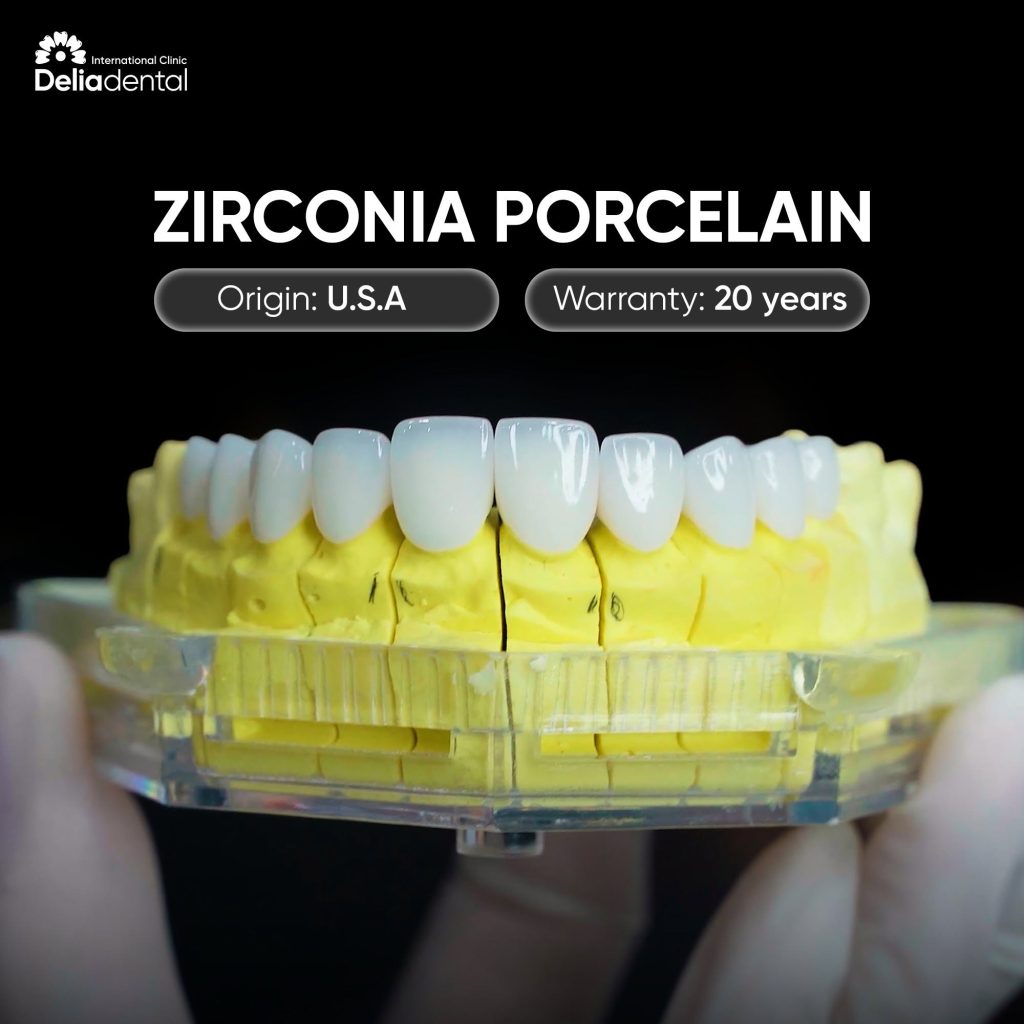
The adjusted surface must also be finished correctly. This is particularly important with zirconia crowns because a surface that has been adjusted should not be left rough. Appropriate polishing reduces roughness and helps protect the opposing tooth. Delia’s guide to checking zirconia crown quality explains why bite assessment and surface finishing are part of crown quality, not optional cosmetic details.
If the bite appears balanced but the tooth still hurts, repeated grinding is not the answer. The dentist should reconsider whether the pain comes from the pulp, root, remaining tooth structure, crown fit, cementation or another tooth.
Patients should never attempt this adjustment themselves. A nail file, sandpaper or rotary tool can remove material from the wrong area, alter the crown’s anatomy, leave a rough surface or weaken the restoration. It may also remove a contact the tooth actually needs while leaving the true interference untouched.
Trying to bite forcefully to “push the crown down” is also inappropriate. Once a permanent crown has been cemented, repeated heavy biting is not a safe method of correcting its position.
What Should You Do If the Bite Still Feels Wrong?
Contact the treating clinic if the crowned tooth repeatedly touches first, chewing causes concentrated pressure, the pain is not improving or you cannot close your jaw comfortably. A crown that feels loose, produces increasing pain or causes you to avoid normal chewing should also be reviewed.
When contacting the clinic, describe the symptom precisely:
- Which tooth or area was treated.
- When the permanent crown was fitted.
- Whether it feels bulky to the tongue or actually contacts first.
- Whether pain occurs while biting down, while releasing pressure or without biting.
- Whether hot or cold sensitivity lingers.
- Whether there is swelling, a bad taste, movement or visible damage.
- Whether the problem is improving, unchanged or worsening.
Photos and short videos may help the clinic identify visible damage, crown location or gum changes. They cannot show the complete contact pattern between the upper and lower teeth, so remote assessment cannot confirm every high bite.
If you have already returned home after dental treatment abroad, the original clinic can review the treatment history and advise whether an in-person examination by a local dentist is needed. Treatment records can help the local dentist understand the crown material, tooth condition and work already completed.
Before another provider adjusts an implant crown or a restoration covered by warranty, contact the original clinic where possible and confirm how local treatment may affect the warranty. This should not delay urgent care.
Seek prompt dental assessment if the crown is loose, pain is becoming stronger, you cannot chew normally, or the tooth hurts spontaneously. Swelling, fever, pus, a bad taste, severe pain or difficulty opening the mouth requires earlier attention. If swelling makes it difficult to breathe, swallow or speak, seek urgent medical care rather than waiting for an online response.
How Delia Dental Clinic Checks Crown Fit for International Patients
At Delia Dental Clinic in Hanoi and Ho Chi Minh City, crown assessment may include a trial fitting to review the shape, neighbouring contacts and bite before final placement.
The dentist can check how the crown contacts the opposing teeth during closing and jaw movement. If an adjustment is required, the restoration should be appropriately finished and polished before the bite is checked again.
For international patients, a follow-up appointment before departure also provides an opportunity to reassess the crown after the numbness has worn off and the patient has used the new bite during normal daily activities. This is useful because a contact that was difficult to identify immediately after fitting may become easier for the patient to describe later.
If the bite begins to feel wrong after the patient has returned home, Delia can review the available treatment information and advise whether a local physical assessment is appropriate. Remote photographs can support communication, but they cannot replace an examination of how the teeth contact.
Send your dental photos, treatment records and a description of when the crowned tooth makes contact via WhatsApp or Messenger. Delia’s team in Hanoi or Ho Chi Minh City can review the treatment history, identify whether an in-person bite check may be needed and explain the appropriate follow-up step.
Will a High Crown Settle Down on Its Own?
Awareness of a new crown shape may become less noticeable as the tongue and mouth adapt. A crown that repeatedly contacts before the other teeth should not be expected to correct itself. Arrange a bite assessment if the first contact or biting pressure continues.
How Do I Know If My Crown Needs a Bite Adjustment?
Repeated first contact, concentrated pressure, difficulty closing naturally or pain when chewing are reasons to have the bite checked. These symptoms do not prove that adjustment is the only treatment, because the dentist must also assess the crown, tooth and surrounding tissues.
Why Does My New Crown Hurt Only When I Bite?
A premature contact may overload the periodontal ligament around the tooth and make it tender during biting. However, a crack, pulp inflammation, loose restoration or infection may cause a similar symptom. An examination is needed before the pain is attributed solely to the bite.
Can a Root-Canal-Treated Crown Still Hurt From a High Bite?
Yes. Root canal treatment removes the pulp inside the tooth, but the ligament and tissues around the root can still respond to pressure or inflammation. A root-canal-treated tooth can therefore hurt when a crown takes excessive biting force.
Can a Dentist Adjust a Zirconia Crown?
Yes, a zirconia crown can be adjusted when clinically appropriate. The adjusted area should then be finished and polished using a suitable protocol so that it is not left rough. Patients should not attempt to adjust zirconia at home.
Can a Photo Show Whether My Crown Is Too High?
Usually not. A photograph may show the crown’s shape, visible damage or surrounding gum tissue, but it cannot record the complete contact pattern as the jaw closes and moves. A physical bite examination is usually required.
Should I Return to the Original Clinic for the Adjustment?
The original clinic has the treatment plan and restoration details, so contacting it first is useful. If you have returned home, a local dentist may be able to examine and adjust the bite. Share the treatment records and check any warranty conditions before the crown is altered, unless urgent care is required.
Final Thoughts
A crown that merely feels new may become less noticeable. A crown that repeatedly hits first should be assessed rather than forced into use.
Bite adjustment is often conservative when premature contact is the cause, but pain should not automatically be blamed on the bite. The correct follow-up is to check the contact, examine the restoration and rule out other problems before deciding what needs to be adjusted.


