Hearing “full-arch implants” often gets translated in a patient’s head as “every remaining tooth comes out.” That’s not always accurate, and the gap between what full-arch treatment actually requires and what patients assume it requires is where a lot of unnecessary anxiety comes from before the first consultation even happens.
Full mouth extraction for dental implants is sometimes the right plan, but it’s a conclusion reached tooth by tooth, not a default step applied to every case labeled full-arch. Some patients keep a few stable teeth even while most of the arch is being treated. Others genuinely do need everything removed, because nothing left is worth keeping.
This article breaks down the actual criteria used to decide, tooth by tooth, what stays and what goes, so the decision doesn’t feel like a blanket rule handed down without explanation.
Quick answer
Not every failing tooth automatically needs removal for full-arch implants. The decision is made tooth by tooth, based on how much bone support remains, whether the tooth is stable or mobile, and whether the periodontal condition around it is treatable. A tooth in genuinely poor condition, with significant bone loss or advanced mobility, is usually not worth keeping even if it’s still technically in the mouth. A tooth with a treatable issue and adequate bone support may be kept, sometimes even as extra support during the treatment plan.
Does full-arch implants treatment always require removing every tooth?
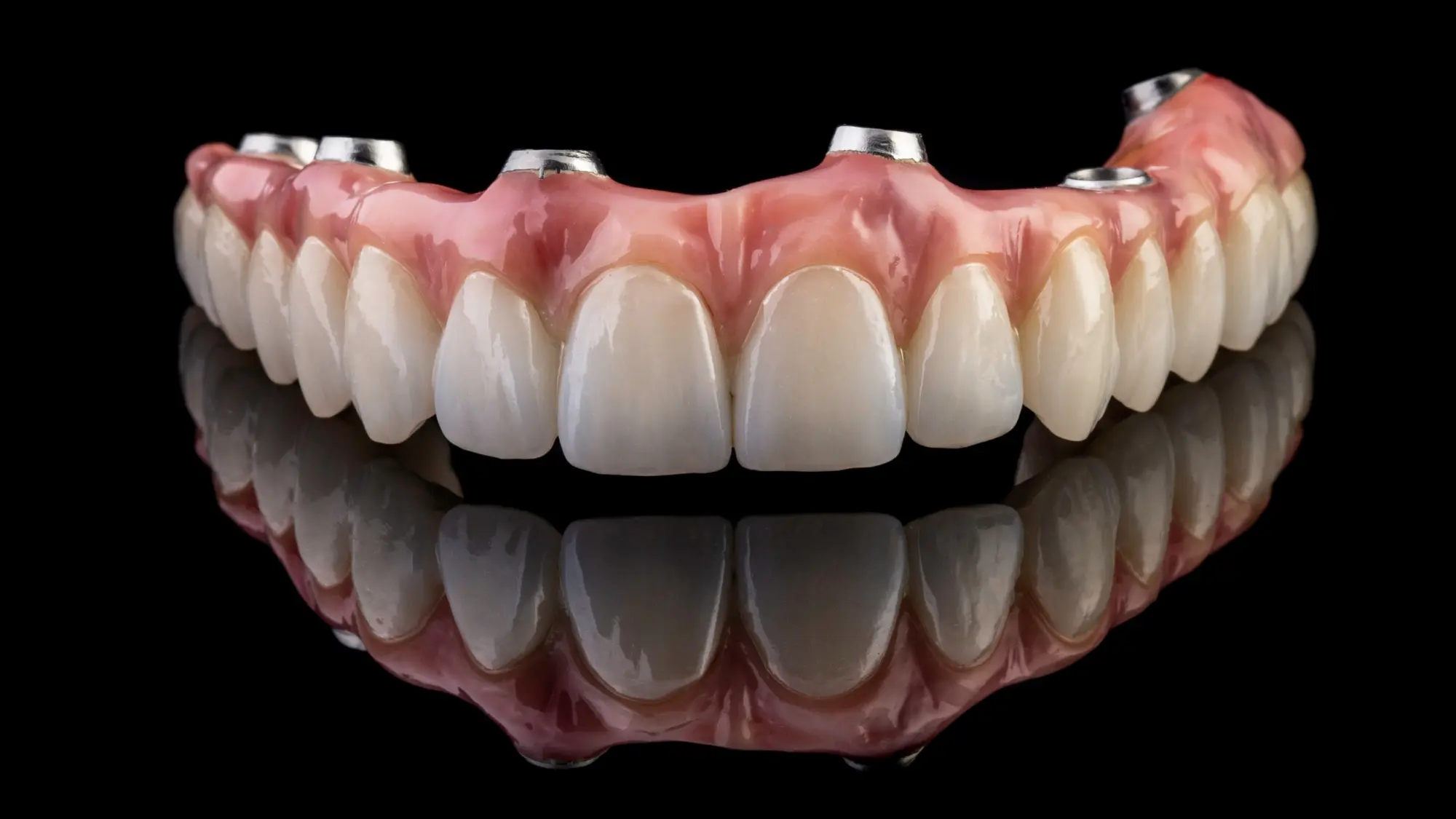
A fixed full-arch implant bridge is designed to replace a complete dental arch. Therefore, any natural teeth occupying the area covered by that bridge would normally need to be removed before the definitive full-arch restoration is fitted.
However, this does not mean the treatment label should determine which teeth are extracted.
The correct sequence is:
- Assess the prognosis of the remaining teeth.
- Identify which teeth can be predictably maintained.
- Compare tooth-preserving and extraction-based options.
- Select the restorative design that best fits those findings.
If one or more useful natural teeth can be retained, the patient may no longer need a conventional fixed full-arch bridge. The alternative could involve segmental implant bridges, crowns, a removable overdenture, staged treatment or another combination of natural teeth and implants.
The important question is therefore not simply, “Does full-arch treatment require extraction?” It is, “Does this patient actually need a full-arch restoration in the first place?”
When a tooth may still be worth keeping
A damaged tooth may remain maintainable when:
- Periodontal support is adequate or can be stabilised
- Mobility is absent or manageable
- Decay can be removed without leaving insufficient tooth structure
- A crack does not extend into a non-restorable part of the root
- Endodontic treatment or retreatment has a reasonable prognosis
- The patient can maintain the tooth and surrounding tissues
- Retaining it is compatible with a sound restorative plan
The presence of some bone loss does not automatically make a tooth hopeless. Severity, progression, tooth anatomy, response to periodontal treatment and long-term maintenance all matter.
Likewise, a tooth that has received root canal treatment, a crown or periodontal therapy should not automatically be classified as failing. Previous treatment must be assessed, but treatment history alone is not an extraction indication.
A tooth may also look acceptable on a photograph while having problems beneath the gum or around the root. This is why dental photos can support a preliminary review but cannot establish the final prognosis.
When removing all the teeth in an arch may be the right choice
Complete extraction may be reasonable when the remaining teeth collectively cannot support a predictable, maintainable restoration.
Examples may include:
- Advanced periodontal destruction affecting most of the arch
- Severe mobility across multiple teeth
- Multiple non-restorable teeth or root fractures
- Extensive decay extending below a restorable level
- Recurrent infection associated with teeth that cannot be predictably treated
- A severely compromised bite that cannot be reconstructed around the remaining teeth
- Too few strategically useful teeth to support an alternative restorative design
- A combination of poor tooth prognosis, limited hygiene access and high future maintenance risk
Even in these situations, the plan should explain why the remaining teeth have been classified as non-maintainable and what alternatives were considered.
A recommendation for complete extraction should not rely only on phrases such as “your teeth are bad,” “implants will be stronger” or “this is easier for the clinic.”
How keeping one or two teeth can change the treatment plan
Retaining a useful tooth does not simply mean placing a full-arch bridge around it.
A conventional fixed full-arch implant prosthesis replaces the complete row of teeth in that arch. If natural teeth remain, the restorative design may need to change to accommodate them.
Depending on the case, retaining teeth could lead to:
- Individual crowns on maintainable natural teeth
- A segmental implant-supported bridge
- Separate natural-tooth and implant-supported restorations
- A tooth- or implant-assisted removable prosthesis
- Staged treatment in which selected teeth remain during the transition
- Treatment of one part of the arch while another part is monitored
A natural tooth and an implant do not respond to biting forces in exactly the same way. For this reason, a patient should not assume that retained teeth will automatically be joined to the same fixed bridge as the implants.
The written plan should identify whether a retained tooth is intended to remain permanently, be used only during a transitional stage or be reassessed later.
When removing everything really is the right call
For some patients, the honest answer is that nothing remaining is worth keeping. Widespread bone loss across the arch, generalized periodontal disease affecting most or all remaining teeth, or teeth that are already loose enough to fail on their own within months, all point toward full extraction as the more reliable path, not a more aggressive one.
In these cases, trying to preserve a tooth that doesn’t meet the criteria above usually just delays the inevitable and can complicate the implant plan around it, since a failing tooth can affect the bone quality needed for a nearby implant site.
How Delia Dental Clinic decides which teeth can be kept
Before travelling, patients can send recent X-rays, CBCT files when available, clear dental photos, previous treatment records or an existing quote to Delia Dental Clinic via WhatsApp or Messenger.
These records can support a preliminary review of:
- Teeth that appear to require closer assessment
- Areas of bone loss or suspected infection
- Existing restorations and missing teeth
- Whether the concern appears limited to one arch or involves both
- Possible tooth-preserving and implant-supported options
- Additional records or imaging required
- Decisions that cannot be confirmed remotely
Remote records cannot conclusively determine mobility, pocket depth, restorability, bite stability or every form of root damage. The final decision is therefore confirmed after an in-person examination and appropriate imaging at Delia Dental Clinic in Hanoi or Ho Chi Minh City.
Each remaining tooth is assessed for periodontal support, structural damage, infection, restorability, strategic value and its relationship to the proposed prosthesis. The treatment plan should then show which teeth are proposed for retention, treatment or extraction and why.
If extraction is recommended, the plan should also state whether implants may be placed during the same surgical stage, what provisional teeth are expected and which decisions remain dependent on clinical or surgical findings.
Patients preparing records for a remote assessment can also read the guide to obtaining a dental implant quote using X-rays or CBCT scans in Vietnam.
FAQ
Are all remaining teeth removed for All-on-4 treatment?
All-on-4 is designed to support a complete-arch prosthesis. Teeth occupying the area of that prosthesis would generally need to be removed. However, the dentist should first determine whether those teeth are genuinely non-maintainable and whether a complete-arch restoration is more appropriate than a tooth-preserving alternative.
Does early bone loss mean a tooth should be extracted?
No. Early or limited bone loss does not automatically require extraction. The dentist must consider the extent and progression of the disease, mobility, anatomy, response to periodontal treatment, hygiene and the tooth’s overall prognosis.
Can I keep one or two teeth and still receive implants?
Possibly. Implants can be used elsewhere in the same mouth while maintainable teeth are retained. However, keeping teeth may change the prosthetic design from a conventional fixed full-arch bridge to a segmental, staged or removable solution.
Can a tooth that looks healthy still have a poor prognosis?
Yes. A tooth may look acceptable above the gum while having root fracture, deep decay, infection or substantial supporting-bone loss. Clinical examination and suitable imaging are required to assess these problems.
Could a tooth fail later if I decide to keep it?
Yes, but future failure is also possible with implants. The relevant question is whether the tooth has a reasonable prognosis with appropriate treatment and maintenance. A borderline prognosis should be explained rather than presented as certainty.
Does keeping a tooth make implant treatment more complicated?
It can change implant positioning or prosthetic design, but complexity alone is not a reason to remove a maintainable tooth. The dentist should compare the benefits and risks of retention against the consequences of extraction.
Can every extracted tooth be replaced with an implant immediately?
No. Immediate placement depends on socket anatomy, bone condition, implant position and the ability to achieve sufficient primary stability. Some extraction sites need to heal before an implant is placed.
Final thoughts
The question worth asking before agreeing to full-arch treatment isn’t whether every failing tooth has to go. It’s whether each specific tooth has actually been evaluated on its own, or whether removal was assumed simply because the treatment plan is labeled full-arch.
If you have a mixed case, some teeth clearly failing and others still in reasonable shape, send your X-rays or a recent dental photo to Delia Dental Clinic via WhatsApp or Messenger. The team can give you a tooth-by-tooth read before recommending what should actually be removed.


