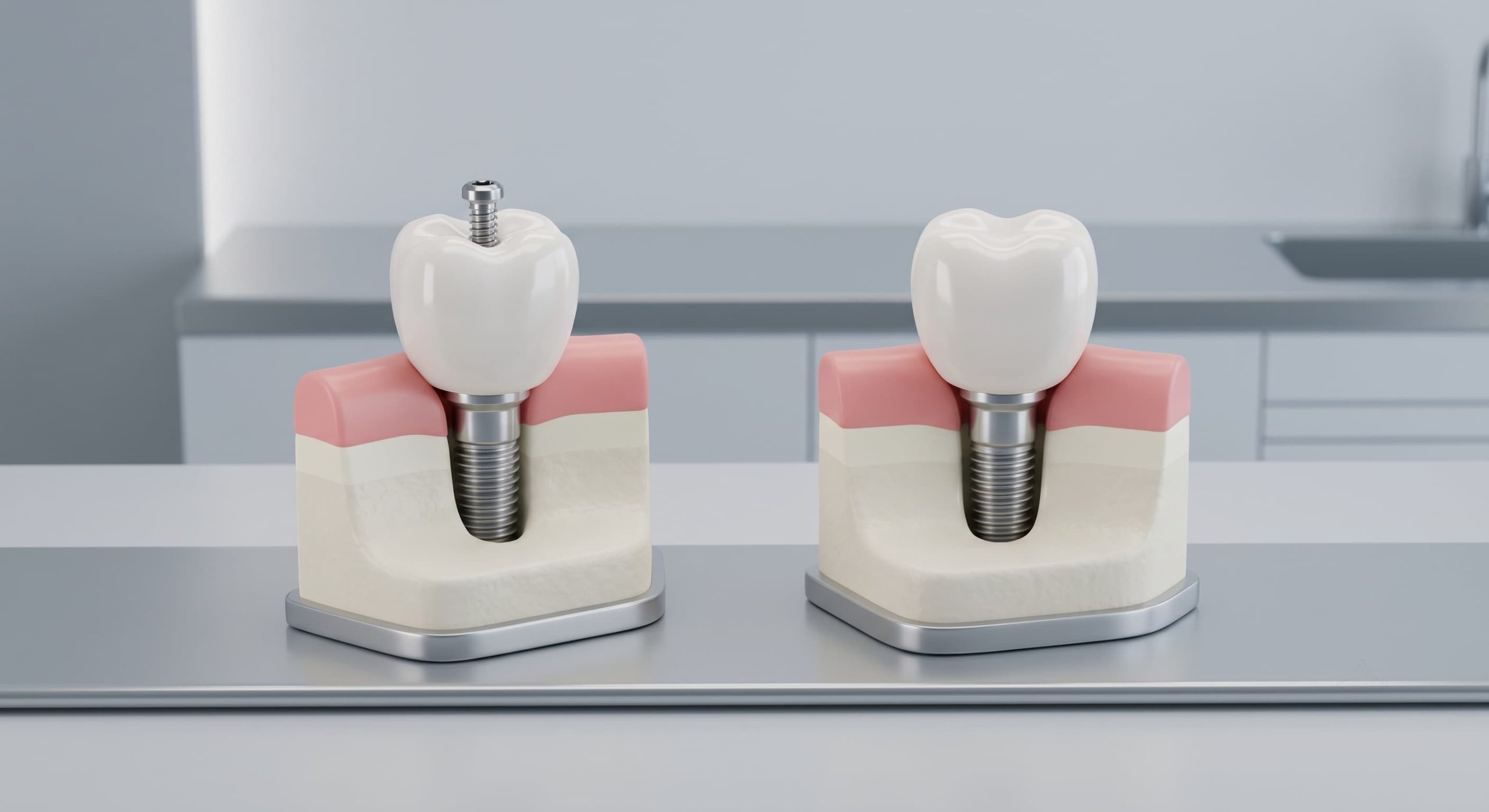
Your final implant crowns will be attached in one of two ways, either held in place by a small screw that passes through an access hole in the crown itself, or bonded permanently onto the abutment with dental cement. Which one your case ends up with is not a matter of personal preference on either side of the chair. It comes down to a handful of physical realities in your mouth, including the angle the implant sits at, how much space exists between your upper and lower jaw at that spot, and whether the tooth being replaced is visible when you smile or hidden further back.
The difference sounds technical, but it has a very practical consequence that most patients never hear about until something goes wrong. A screw-retained crown can usually be removed intact if it ever needs adjustment or repair. A cement-retained crown generally cannot, which means a problem years later often means replacing the whole crown rather than simply taking it off and putting it back.
This article walks through how each type actually attaches, what determines which one gets used in a given case, and why this decision carries more weight for a patient being treated abroad than for someone who can walk back into the same clinic whenever needed.
Quick Answer
A screw-retained implant crowns attaches with a screw through an access hole and can typically be removed without damaging it. A cement-retained crown is bonded to the abutment and usually cannot be removed without cutting it off. The choice depends on implant angle, available space between the jaws, and tooth position, not on preference, and it directly affects how easily the crown can be repaired later.
The real difference: how each crown attaches, and why that matters later
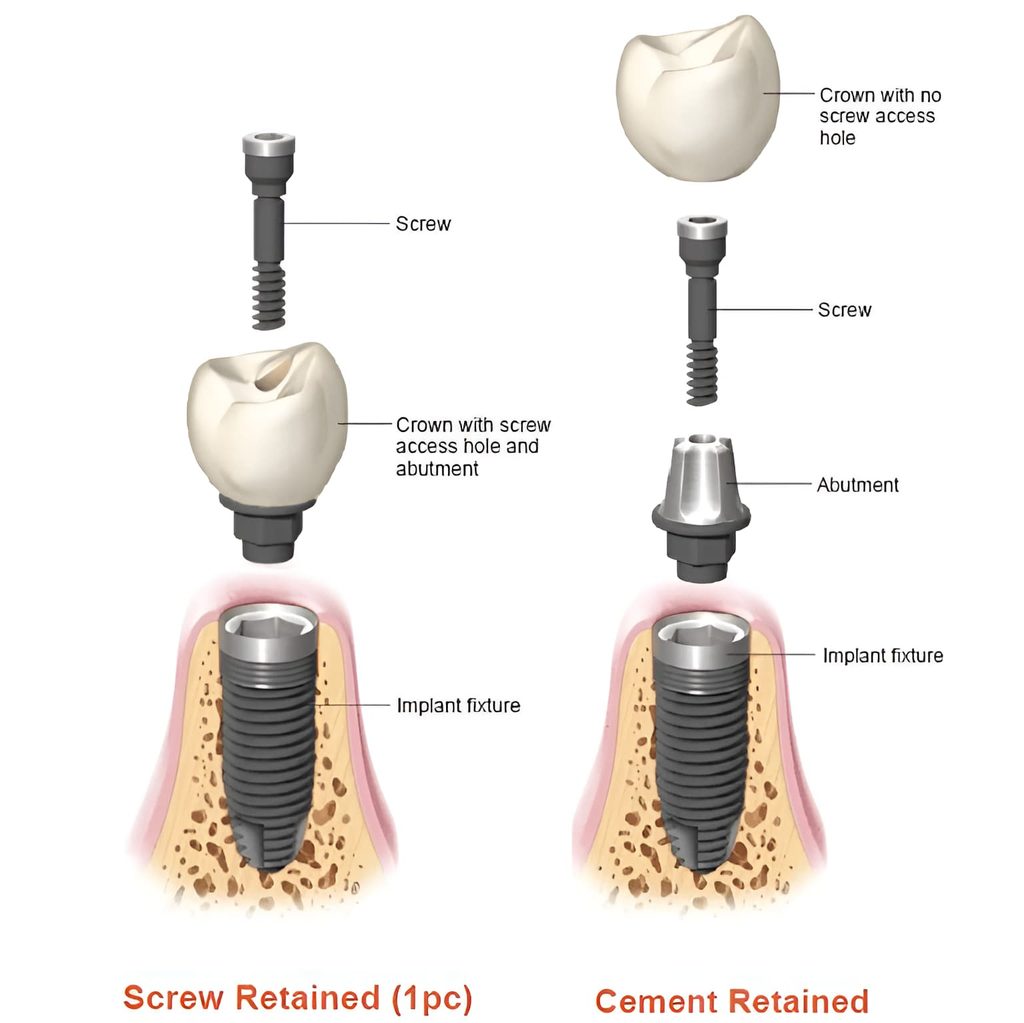
A screw-retained crown is built with a channel running through its biting surface down to the abutment underneath. A titanium or gold alloy screw passes through that channel and threads directly into the implant, holding the crown firmly in place. After the screw is tightened to the correct torque, the access hole is filled with a soft material and then sealed over with a tooth colored filling, so from the outside the crown looks complete. When a dentist needs to check the implant, adjust the bite, or replace the crown for any reason, that filling material can be removed and the screw backed out, taking the crown off in one piece without cutting or damaging it.
A cement-retained crown works differently. The abutment is shaped and the crown is cemented onto it in much the same way a crown is cemented onto a natural tooth, using a permanent or semi permanent dental cement. There is no access hole, no visible seam, and the crown sits as one continuous surface from the gum line to the biting edge. This gives a very clean, natural look, which is part of why it remains a common choice. The tradeoff is that removing a cemented crown intact is difficult or often impossible. In most cases, retrieving it means sectioning or cutting the crown off the abutment, which destroys the crown and requires a new one to be made.
This is the core distinction that everything else in this article builds on. One type is designed to come off cleanly if it ever needs to. The other is designed to stay exactly where it was put, with removal treated as a last resort rather than routine maintenance.
What actually decides which type your case gets
The choice between the two is driven by the specific anatomy of your case, and a dentist working through a treatment plan is generally weighing several factors at once rather than defaulting to one option out of habit.
Implant angle is often the deciding factor. An implant that sits at a noticeable angle, which can happen when the surrounding bone dictated a particular placement direction during surgery, would put the screw access hole somewhere visible on the front or biting surface of the crown if a screw-retained design were forced onto it. On a back molar, a visible access hole on the chewing surface is a non issue. On a front tooth, that same hole showing through the visible part of the crown is a cosmetic problem most patients would notice immediately, which pushes the decision toward a cement-retained crown or toward an angled abutment designed to redirect the screw channel to a less visible spot.
The vertical space between the upper and lower jaw at that specific site also matters. A screw-retained design needs enough room for the screw channel, the screw itself, and the sealing material on top of it, all before the crown even reaches its final biting surface. In cases with limited interocclusal space, often seen when a tooth has been missing for a long time and the opposing tooth has drifted or over erupted into the gap, there may simply not be enough vertical room to accommodate a screw-retained design without making the crown too short to function properly. Cement-retained crowns have more flexibility here because they do not need to reserve internal space for a screw channel.
Tooth position plays a similar role to implant angle but from an aesthetic rather than a mechanical angle. Front teeth, where the smile line is a genuine consideration, more often lean toward cement-retained crowns specifically because there is no access hole to disguise. Back teeth, where chewing function and the ability to retrieve the crown later matter more than an invisible seam, more often lean toward screw-retained designs.
Finally, in cases involving multiple adjacent implants, such as a bridge spanning several missing teeth or a full arch restoration, screw-retained designs are frequently preferred specifically because they allow the entire prosthesis to be removed as one unit for cleaning, adjustment, or repair, which becomes considerably more practical to maintain over years of use than trying to manage several cemented units independently.
Why retrievability matters more when you are treating abroad
For a patient being treated at home, near the same clinic that placed their implant, the difference between screw-retained and cement-retained crowns is mostly a clinical decision that plays out in the background. If something goes wrong, the original dentist is a short drive away either way.
For a patient who has traveled internationally for implant treatment and then flown home, this decision has a much more direct effect on what happens if a problem comes up later. A screw-retained crown that comes loose, needs re-tightening, or requires access to the implant for any reason can typically be removed by a dentist at home without destroying the crown, examined, and reattached, often as a straightforward same day fix. A cement-retained crown that develops the same kind of problem usually cannot be removed without cutting it off, which means a dentist back home is not simply reattaching an existing crown but remaking one from scratch, adding cost and time that a screw-retained design would have avoided.
This does not mean screw-retained is automatically the right choice for every implant a traveling patient receives. The anatomical factors described above still apply regardless of where the patient lives, and forcing a screw-retained design onto a case where it does not fit well, purely for the sake of future retrievability, can create its own problems, particularly around aesthetics on visible teeth. What it does mean is that retrievability is worth raising directly as a question before treatment, especially for any implant where the case could reasonably go either way.
What each type means day to day
Living with a screw-retained crown means there is a small filled access hole somewhere on its surface, most often invisible on a back tooth but occasionally a minor cosmetic tradeoff on a more visible one. In exchange, any future issue involving the implant itself, a loose screw, a bite that needs fine tuning, or simply wanting a second opinion from a different dentist, can usually be addressed by removing the crown cleanly rather than starting over.
Living with a cement-retained crown means a smoother, seamless appearance with no visible access point anywhere on the tooth, which is genuinely valuable on a front tooth where every visible detail is noticed. The tradeoff sits mostly in the future rather than the present. If cement residue is not fully cleaned away from around the implant during placement, it can contribute to inflammation of the surrounding gum tissue over time, a complication that is specific to cemented restorations and does not apply to screw-retained ones. And if the crown itself ever needs to come off, that step is inherently more involved than simply unscrewing it.
Delia Dental Clinic‘s approach to choosing between the two
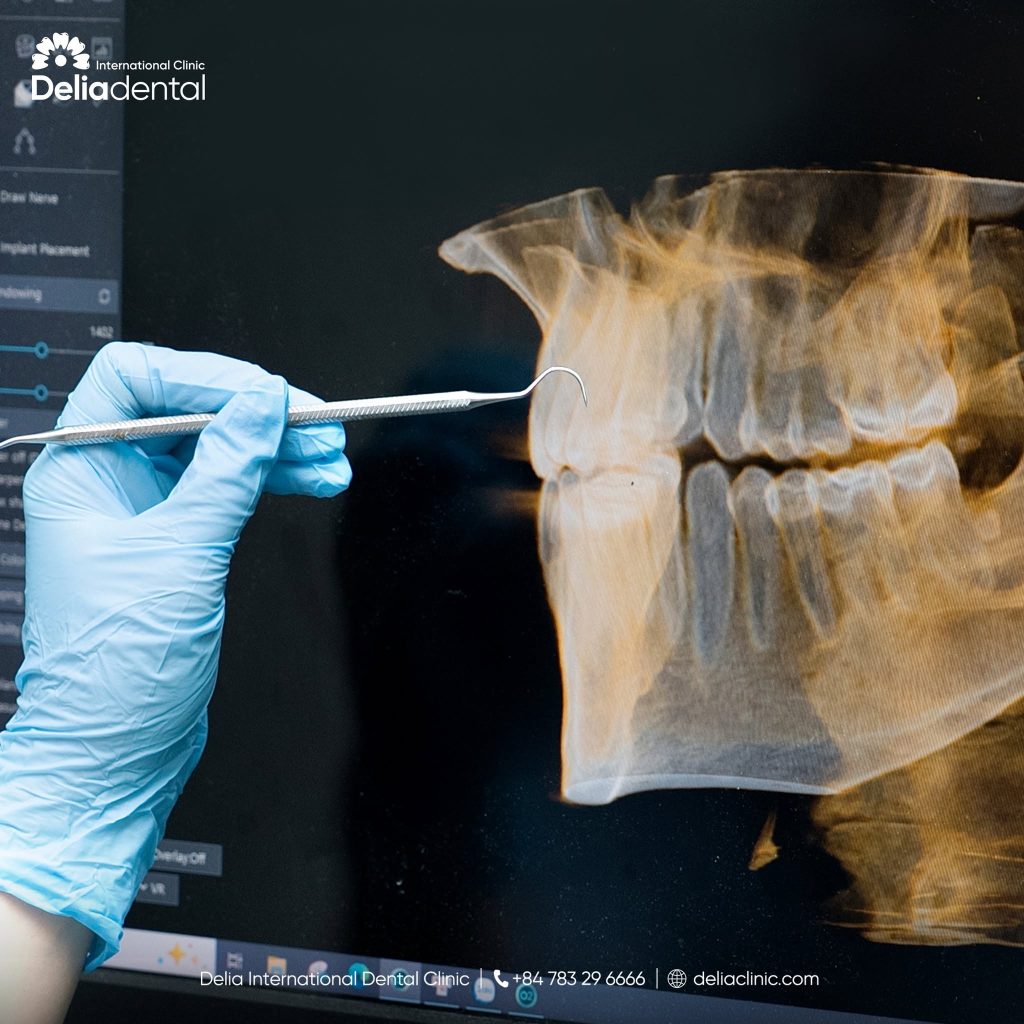
At Delia Dental Clinic in Hanoi and Ho Chi Minh City, the decision between a screw-retained and cement-retained crown is made after CBCT imaging and a clinical assessment of the specific implant site, taking into account the angle of placement, available interocclusal space, and the position of the tooth in the smile. This assessment happens as part of finalizing the treatment plan rather than being decided after the crown is already made.
Every implant case at Delia Dental Clinic is documented with an implant passport and written warranty information, which records the details of that specific implant and restoration, including the type of retention used. This gives patients something concrete to bring home, so a dentist in their own country has a clear starting point rather than having to guess how a crown was attached before deciding how to approach it.
Frequently asked questions
Can a cement-retained crown be changed to screw-retained later if I want more flexibility?
Generally not without significant rework, since the abutment and the crown for a cement-retained restoration are shaped and fitted together as a matched pair without a screw channel built in. Converting to a screw-retained design later typically means replacing both the abutment and the crown, effectively starting the restoration over rather than modifying the existing one.
Does the screw access hole weaken the crown or make it more likely to break?
Modern implant crowns are engineered with the access hole accounted for in the design and material thickness, so a properly made screw-retained crown is not meaningfully weaker than a cement-retained one for normal use. The filling material sealing the access hole is chosen to hold up under regular biting forces, and a dentist checks this fit as part of finishing the restoration.
Is leftover cement around an implant actually dangerous?
It can be a genuine concern if not managed carefully during placement, since residual cement trapped below the gum line has been associated with inflammation of the tissue around an implant, sometimes progressing to more serious complications if it goes unnoticed. This is one of the reasons careful cement removal technique during cementation matters, and it is a risk that simply does not exist with screw-retained restorations, since there is no cement involved in attaching them.
Which type is more common for All-on-4 or All-on-6 full arch cases?
Screw-retained designs are more commonly used for full arch restorations, largely because the ability to remove the entire prosthesis as one piece makes long term maintenance, cleaning, and any necessary adjustments considerably more practical across a restoration spanning many implants at once, compared to managing multiple individually cemented units.
If my dentist chose one type without asking which I preferred, does that mean something is wrong?
Not necessarily. In many cases, the anatomy of the implant site narrows the practical options down to one clearly better choice, leaving little genuine preference to weigh in on. It is still reasonable to ask directly which type was used and why, both for your own understanding and so you have that information on hand if you ever need to explain your case to a different dentist.
Final Thoughts
Neither screw-retained nor cement-retained is a universally better option. Each fits certain cases well and creates real tradeoffs in others, and the right choice depends on the specific angle, space, and position of your implant rather than a general rule that applies to every tooth in your mouth. What matters most is knowing which type your case actually uses, since that single detail shapes how straightforward any future adjustment or repair will be, particularly if you are not near the clinic that placed it.
Send your X-rays, CBCT files, or existing treatment plan to Delia Dental Clinic via WhatsApp or Messenger to ask which retention type is recommended for your case and why. The international patient team can walk through the reasoning for your specific implant site before your treatment plan is finalized.


