
There is no age at which dental implants stop being an option. What changes for older patients is not eligibility itself but the amount of medical information the dental team needs before travel, because bone quality, medication use and overall health are more likely to interact with each other rather than appear as a single isolated factor.
A 35 year old candidate for implants usually has one clear picture to review: healthy bone, no chronic medication, straightforward healing. A 68 year old candidate more often has several things happening at once, an osteoporosis medication alongside a blood pressure tablet, a bone density scan from several years ago, a joint replacement in the recent past. None of these rule out treatment on their own. Reviewed together, they change what the dental team asks for and how the treatment plan is built.
This article sets out what actually changes for older implant patients compared with the general pre travel checklist, and which records let Delia Dental Clinic review that combined picture before a flight is booked.
Quick Answer
Age alone does not prevent someone from having dental implants, and there is no fixed age cutoff. What matters is bone quality, current medication and general health, and older patients are more likely to have several of these interacting at once rather than one in isolation. A combined medication list, any bone density history, and confirmation of fitness for long haul travel should be reviewed before booking flights.
Does Age Alone Affect Whether Someone Is a Candidate for Implants?
No. Age itself is not listed as a contraindication to dental implants in clinical guidance, and long term survival rates for implants placed in older adults remain high. What changes with age is the biological environment the implant is placed into, not a fixed cutoff number.
Bone naturally remodels more slowly with age. Research comparing bone density around implants across age groups has found that while density improves after placement in every age group, the rate and extent of that improvement is smaller in older adults, which points to a reduced regenerative capacity rather than a failure to heal at all. This does not mean an older patient’s implant is less likely to succeed. It means healing may take longer to stabilise, and the dental team may allow more time before loading the implant with a permanent restoration.
A frail or medically complex patient may need additional caution around anaesthesia, fasting instructions and recovery planning that a generally healthy patient of the same age would not. This is a separate consideration from candidacy itself, and it is assessed case by case rather than assumed from age on a form.
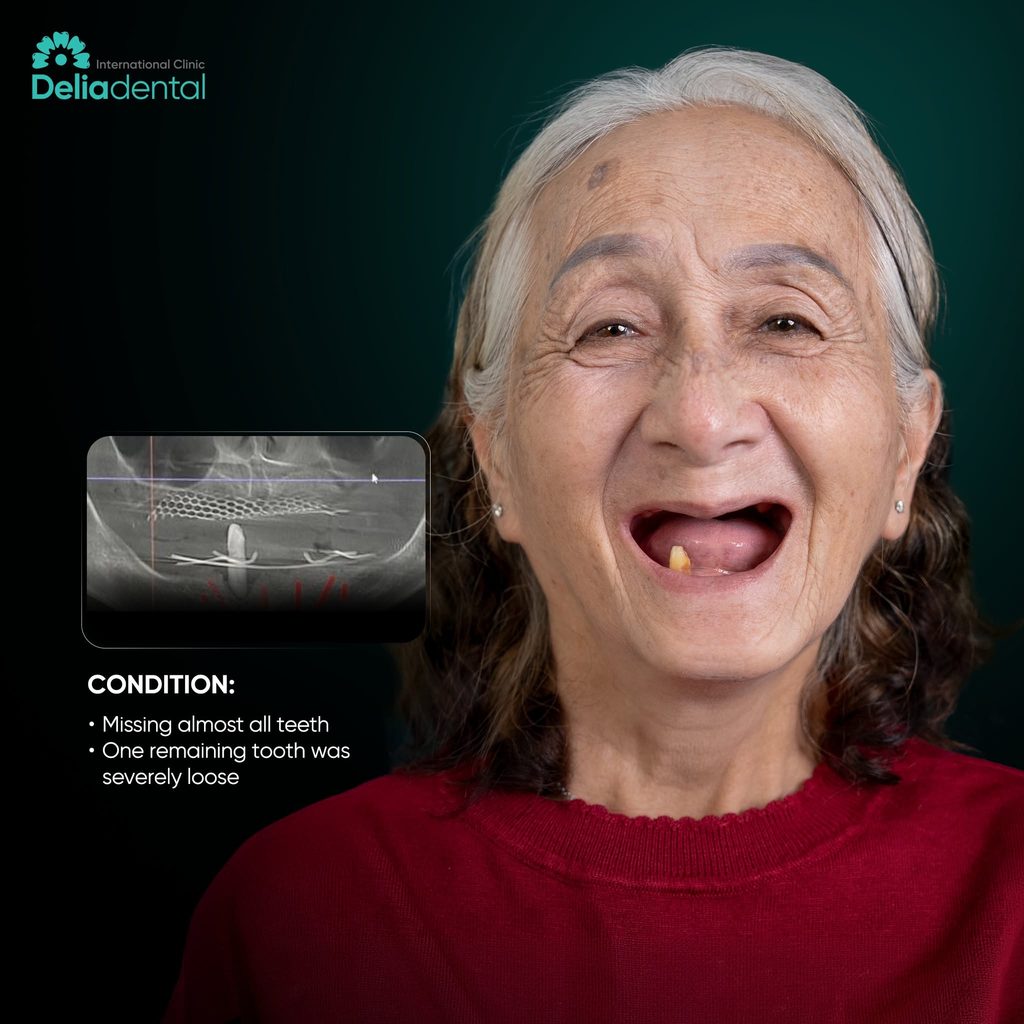
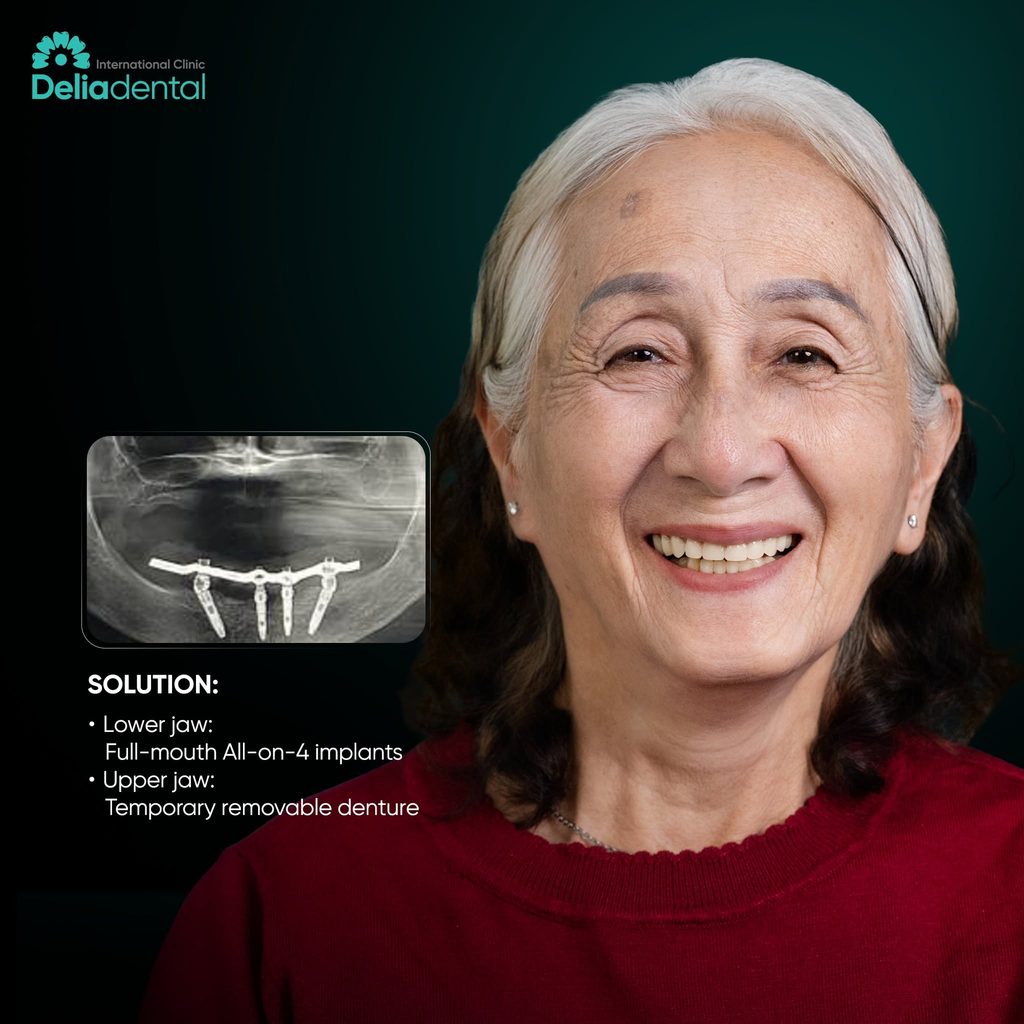
Ms. My Vo, an American patient, had lost almost all her teeth by the time she was treated at Delia Dental Clinic, with the one remaining tooth severely loose enough to make eating and speaking difficult. Her lower jaw was treated with full-mouth All-on-4 implants, while a temporary removable denture was used for the upper jaw during the same course of treatment. The case illustrates that even extensive tooth loss late in life does not automatically mean implants are off the table, though it does mean the treatment plan has to account for the condition of the whole mouth, not one tooth at a time.
Why Older Patients Often Need a Broader Medical Review
The single biggest practical difference for older implant patients is not any one medical condition. It is polypharmacy, the term used when a patient takes multiple medications at once, often for more than one condition. Clinical literature on implant planning increasingly flags this as a distinct area of attention, separate from reviewing each medication individually, because drugs prescribed for different conditions can interact with each other and with the surgical site in ways that a single medication review would miss.
A patient on a blood thinner for atrial fibrillation, a bisphosphonate for osteoporosis, and a blood pressure medication is not the same clinical picture as a patient taking any one of those three alone. The dental team needs to see the complete list together, not review each medication in a separate conversation, because the combination is what actually shapes the surgical plan, not any single drug.
Two of the most common intersections worth naming directly:
Anticoagulants and antiplatelets, prescribed for conditions such as atrial fibrillation, a previous stroke or a cardiac stent, affect bleeding risk during implant surgery. Current dental guidance generally favours continuing these medications rather than stopping them, since interrupting anticoagulation can carry a greater risk than the bleeding it is meant to prevent, and local measures are used instead to manage bleeding during the procedure. The decision to continue or adjust any anticoagulant is made between the prescribing physician and the treating dental team, never by the patient alone.
Bisphosphonates and other bone-modifying medications, commonly prescribed for osteoporosis, are relevant because they affect how bone remodels around a surgical site. Oral bisphosphonates taken for osteoporosis carry a low but recognised risk of a healing complication in the jaw known as medication-related osteonecrosis of the jaw, and this risk is a specific reason implant planning needs to know the exact medication, dose and duration of use rather than just the diagnosis of osteoporosis.
Neither of these findings means treatment cannot proceed. They mean the dental team needs the complete list, with dosage and duration, reviewed as one picture rather than several unconnected facts.
What Records Should Older Patients Prepare Before Travelling?
| Record | What it should show | Why it matters more when several conditions overlap |
|---|---|---|
| Complete medication list | Every medication, dose, schedule and prescribing reason, not only the ones felt relevant to dentistry | Interactions between medications, not any single drug, usually drive the treatment plan |
| Bone density history | Most recent DEXA scan result if one exists, and the date it was taken | Helps the dental team anticipate healing time and whether grafting is more likely to be discussed |
| Osteoporosis or bone-modifying medication details | Drug name, dose, and how long it has been taken | Directly relevant to jaw healing risk, and the answer changes the surgical approach |
| Cardiovascular and anticoagulant history | Diagnosis, current medication, and any recent cardiac event or procedure | Determines whether the prescribing physician needs to be consulted before invasive treatment |
| Recent falls, fractures or hospital admissions | Dates and outcomes of any recent event | Signals whether general health has changed since the last dental review |
| Mobility and general fitness notes | Any known limitation relevant to travel, sitting for extended procedures, or recovery | Relevant to travel logistics and appointment planning, separate from surgical suitability |
This list builds on, rather than replaces, the general pre travel checklist. The difference is that for a patient with one condition, each item can usually be reviewed on its own. For an older patient with several conditions and medications at once, the dental team needs to see them together to understand how they interact, which is the reasoning a single-condition checklist is not designed to capture.
How Does Bone Quality Affect Implant Planning for Older Patients?
Bone quality, not age itself, is the variable that changes an implant plan. Reduced bone density and altered bone architecture are associated with age and with conditions such as osteoporosis, and this can affect how firmly an implant sits immediately after placement and how long it takes to stabilise.
Research on implant stability across bone density categories has found that implants placed in lower density bone start with a lower stability measurement, but many still go on to integrate successfully. What this generally changes is the timeline, not the outcome, with a longer healing interval sometimes recommended before the implant is loaded with a permanent crown, and closer monitoring during that period.
This is also why a current CBCT scan matters more, not less, for older patients. A panoramic X-ray sent in advance can support preliminary planning, but decisions about bone volume, density and whether grafting should be considered are made from an in-clinic CBCT scan, as explained in the guide to why an implant plan may change after a CBCT scan. Grafting is not automatically required for older patients, and it should not be assumed before imaging confirms whether it is needed for the specific case.
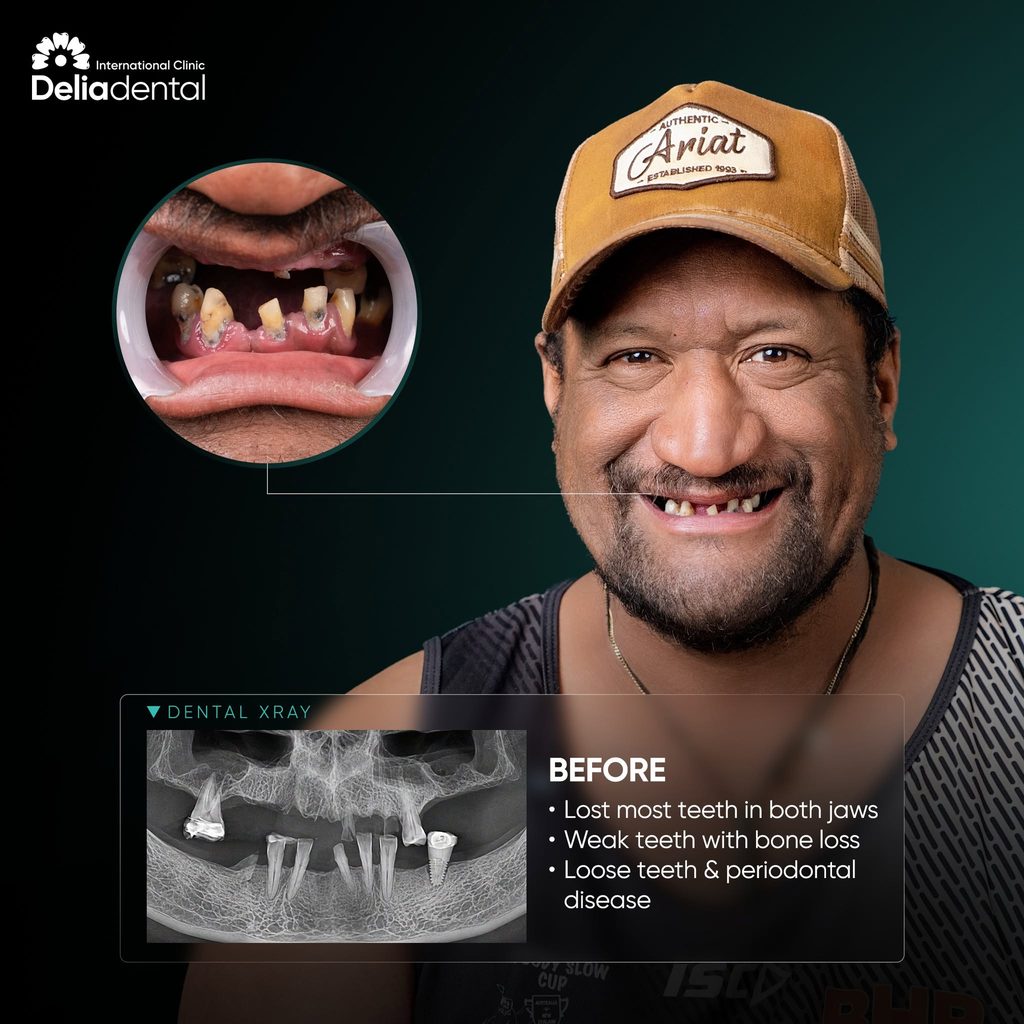
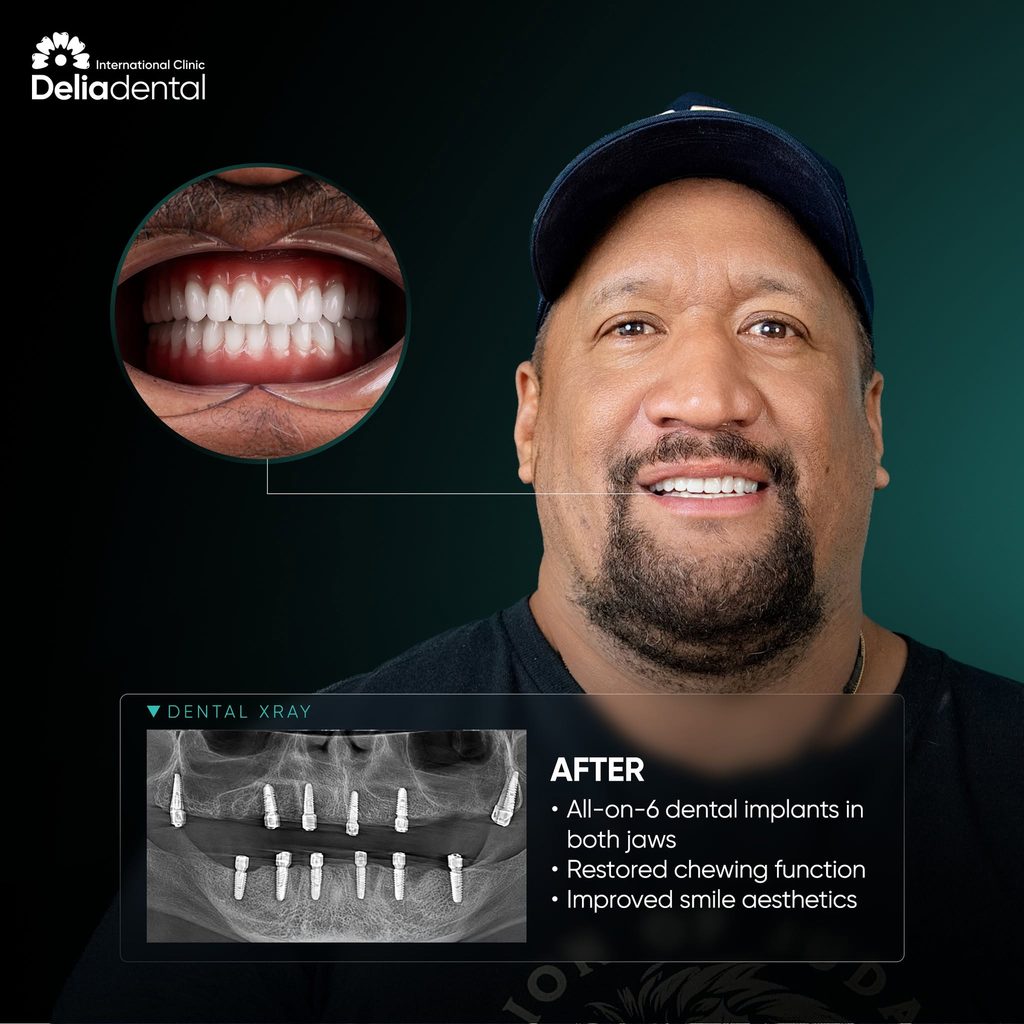
Michael John Molloy had lived with multiple missing teeth in both jaws for close to 20 years before being treated at Delia Dental Clinic, and by that point had developed severe bone loss that made everyday chewing increasingly difficult. His treatment used All-on-6 implants in both jaws combined with crowns to restore chewing function. Long-standing tooth loss of that duration is exactly the kind of case where bone condition, not age, ends up shaping how the implants are planned and staged.
What Should Be Confirmed Before Booking Long-Haul Travel?
Long-haul travel carries a higher deep vein thrombosis risk for any passenger, and that risk rises further with reduced mobility, dehydration and age, particularly on flights over eight hours. This is a travel consideration, separate from surgical fitness, and it should be discussed with a GP before departure rather than assumed to be covered by dental clearance.
Patients already taking an anticoagulant for another reason may have some protection already in place, but this should be confirmed rather than assumed, since the medication was prescribed for a different purpose. Simple in-flight measures, moving periodically, staying hydrated, and wearing compression stockings if advised, are commonly recommended for older travellers regardless of dental treatment.
Recovery logistics are worth planning honestly rather than optimistically. An older patient recovering from implant surgery, particularly a full arch case, may want a companion for the trip, more time between the surgical appointment and the flight home, and a realistic sense of how many separate visits the treatment will involve. The guide to travelling alone for dental work in Vietnam covers what to weigh when deciding whether a companion makes sense for a given case, and the guide to how long to stay in Vietnam for dental implants explains how surgical and final restoration visits are typically staged.
How Delia Dental Clinic Reviews Records for Older Patients
Delia Dental Clinic reviews an older patient’s case as one combined picture rather than as a series of separate medical items checked off individually. When a patient sends a complete medication list alongside dental records, the international patient team can identify where several factors, a bone medication, an anticoagulant, a cardiovascular history, might interact and flag this for clarification before a flight is booked, rather than after the patient has already arrived.
Patients preparing to send records can include a current medication list with every drug, dose and prescribing reason, any bone density scan result and its date, cardiovascular or anticoagulant history, recent hospital admissions or falls, and existing dental X-rays or CBCT files if available. The same principle from the general dental tourism medical checklist applies, records should be current, readable and relevant, rather than an exhaustive medical archive.
What a remote review cannot do is confirm the final surgical plan. After arriving at Delia’s Hanoi or Ho Chi Minh City branch, the dental team completes an updated health history, an in-person examination and a CBCT scan where indicated. For a patient on several medications or with a bone density history, this in-person stage is where the interacting factors identified earlier are confirmed against the actual clinical picture, bone quality, gum condition, extraction sites, before the treatment plan and staging are finalised. Medical clearance from a physician may be requested at this stage when the combined picture warrants it, coordinated between the dental team and the patient’s own prescribing clinicians rather than decided independently.
Frequently Asked Questions
Is there a maximum age for dental implants?
No fixed maximum age exists in current dental guidance. Suitability is based on bone quality, general health and how well the individual’s medical factors are managed, rather than the number of years lived. Very elderly or medically frail patients may need additional caution around anaesthesia and recovery planning, but this is assessed on the individual case rather than applied as an age rule.
Can I travel for implants if I take several medications at once?
In many cases yes, but the dental team needs to see the complete list together rather than reviewing medications one at a time. Some combinations, particularly an anticoagulant alongside a bone-modifying medication, change how the surgical plan is approached. This is coordinated between the treating dentist and the patient’s prescribing physicians rather than decided from the medication list alone.
Does osteoporosis medication affect implant planning?
It can, depending on the specific medication, dose and how long it has been taken. Oral bisphosphonates in particular carry a recognised, though low, risk of a jaw healing complication, which is why the dental team needs the exact drug name and duration rather than only the diagnosis of osteoporosis. This does not mean implants are automatically ruled out.
Do I need a companion to travel for implant treatment at an older age?
There is no rule requiring one, but many older patients find a companion useful for a full arch case or a longer recovery window, particularly around the day of surgery and the flight home. The decision depends on the extent of the treatment, general mobility and personal preference rather than age on its own.
Can bone grafting be confirmed before I travel?
Not with certainty from records alone. A panoramic X-ray or bone density history can suggest whether grafting may be discussed, but the actual decision depends on a current CBCT scan taken in clinic. Assuming grafting is or is not needed before that scan is not reliable.
Records to Prepare Before You Book
Preparing for this trip pairs well with reading how the wider pre-travel process works for any international patient, and with the specific implant planning steps that apply once records are reviewed.
- The Dental Tourism Medical Checklist: What Health Records to Prepare Before Your Trip to Vietnam
- Dental Implants with Diabetes: What Must Be Checked Before You Travel?
- Dental Trip to Vietnam: What Delia Dental Clinic Includes
- Wellness and Spa Spots in HCMC and Hanoi for Dental Tourism
Final Thoughts
Age is not the factor that determines whether dental implants are realistic. Bone quality, the combined effect of any medications being taken, and overall fitness for a long trip are what actually shape the plan, and for older patients those factors are more likely to appear together than in isolation.
Send a complete medication list with doses and prescribing reasons, any bone density scan result, cardiovascular or anticoagulant history, and existing dental X-rays or CBCT files to Delia Dental Clinic via WhatsApp or Messenger before booking flights. The international patient team can review the combined picture and identify what needs clarification ahead of the in-person examination at Delia’s Hanoi or Ho Chi Minh City clinic.


