Delia Global is the partnership arm built from running Delia Dental Clinic’s own operations, not a separate agency product designed to be sold to clinics that were never part of building it.
Delia Dental Clinic opened in Hanoi in 2018, expanded to Ho Chi Minh City in 2020 and Thanh Hoa in 2022, and has treated more than 1,000,000 patients over 8 years. Building that track record required solving the same operational problems most independent clinics face: inconsistent lead flow, lab delays, training that doesn’t hold up in daily practice, and patient records scattered across staff and channels. The sales team, laboratory, training curriculum and CRM system behind Delia Global’s core services all exist because Delia Dental Clinic’s own operations needed them first.
Delia Global is now extending that infrastructure, already tested across three clinics and over 1,000,000 patients, to more than 250 dental clinics internationally. Each core service is offered separately rather than bundled, so a partner clinic can take one at a time.
This is the practical difference between Delia Global and a typical agency or software vendor. An agency sells leads or software licenses upfront, regardless of outcome. Delia Global runs this same infrastructure for its own clinics and shares it with partners under revenue-sharing or service terms, rather than an upfront licensing fee.
What partner clinics actually get
Delia Global brings together four core services: patient acquisition, clinical training, lab outsourcing and CRM. A partner clinic doesn’t need to take all four. Most start with whichever core service addresses their current bottleneck and add others once that constraint is resolved.
The clinic keeps its own facility, its own dentists and full control of patient care. Delia Global doesn’t make clinical decisions or step into diagnosis. Its role is limited to the systems around the clinical work, the part that’s often hardest for an independent clinic to build without outside resources.
Business Partnership: patient acquisition without upfront cost
Most independent clinics rely on advertising agencies that charge before the quality of the resulting leads is known. The clinic carries the acquisition cost and still owns follow-up, conversion and delivery.
Under Business Partnership, Delia Global’s sales and marketing team, over 100 people processing more than 10,000 qualified leads a month, generates and qualifies patients before handing them to a partner clinic. Instead of an upfront fee, the arrangement runs on revenue sharing tied to patients who actually proceed through the agreed process, with the specific split set during onboarding.
The clinic still owns consultation, diagnosis, treatment acceptance and care. Delia Global’s role ends at acquisition and qualification. What changes is the incentive: the commercial side is tied to real patient activity instead of ad spend.
Training Transfer: Workflow, not a certificate
Delia Global’s training program runs at Delia Dental Clinic’s Vietnam facility using a 70-20-10 framework, roughly 70% hands-on practice, with one-to-one feedback rather than lecture-based teaching. It covers margin isolation, impression technique, occlusion control and veneer preparation, along with treatment judgment: when a case shouldn’t proceed, and how to spot factors that could compromise the result.
The distinction that matters here: a technique on its own might improve one procedure, but consistent outcomes come from how diagnosis, prep, impressions, lab communication and occlusion work together as a single process. That’s what the program is built around, reproducing that process at the partner clinic, not handing out a certificate for a technique demonstrated once.
Delia Dental Clinic’s core medical team, more than 20 specialists in restorative dentistry, trained and hold certifications from institutions in the US, South Korea and Europe, which is where much of the training curriculum draws from.
Lab Supply: Outsourced production on a shared standard
Lab delays cost more than a missed delivery date. They extend temporary-restoration periods and make treatment scheduling harder to plan with confidence.
Lab Supply lets a partner clinic outsource production to Delia Global’s facility in Vietnam, which runs a German-standard CAD/CAM workflow with materials including 3M Lava Esthetic zirconia, margins produced to 0.2mm, and a standard turnaround of 48 to 72 hours.
Turnaround alone isn’t the point. A fast lab still needs consistent case information from the clinic: accurate impressions, complete digital records, clear communication, or the speed doesn’t translate into a usable restoration. This is where Lab Supply and Training Transfer connect: training gets the clinical team documenting cases the lab can actually work from. Clinics can use Lab Supply on its own; combining it with training closes more of the gap between chairside work and what comes back from the lab.
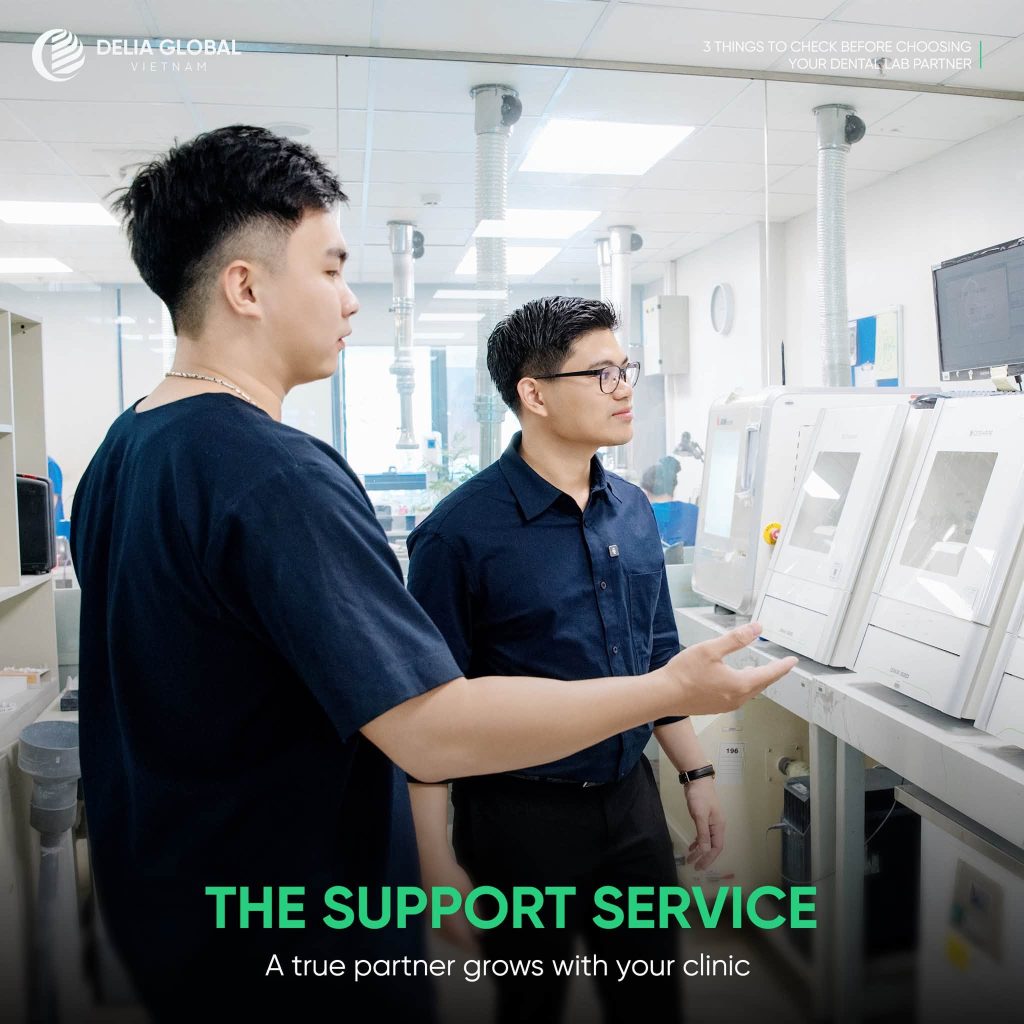
CRM and Management Systems: One record instead of several
When patient information lives across paper charts, personal messaging apps and individual staff memory, a clinic can keep generating enquiries while losing follow-up, because no single system shows what happens next for any given patient.
The CRM core service puts enquiry, treatment history and recall activity into one system, owned and controlled by the partner clinic. It gives management visibility across the whole patient journey instead of a series of disconnected touchpoints, and keeps that visibility intact when staff roles change or turn over. The risk it’s built to remove is operational, not clinical: a follow-up that depends on one employee’s memory is a follow-up that can be lost the day that employee is out sick, busy, or gone.
Why a Vietnam-based group is doing this
Vietnam sees more than 100,000 international dental patients a year. Delia’s own patient data shows patients from the Philippines and Indonesia together account for more than 45% of that volume. For a clinic owner in either market, that number represents cases and revenue leaving the country every year, going to a competitor a flight away rather than to the clinic down the street.
Lab Supply and Training Transfer exist to redirect that outflow. Instead of losing the patient to a clinic in Vietnam, the local clinic gets the same manufacturing capability and clinical training that made the trip worth it for that patient in the first place, so the case, and the revenue, stays with them. Delia Global has already run this directly with clinic owners in the Philippines, working through hands-on training and lab supply set up specifically to reduce how many of their patients felt they had to travel for treatment.
Is Delia Global a fit for your clinic?
A partner doesn’t need to be a large group. The more relevant question is whether the clinic has a clear operational constraint and the capacity to act on the support it gets.
Business Partnership works for a clinic that can receive enquiries, run consultations and deliver the treatments being promoted. Lab Supply needs a reliable process for collecting and transferring case files. Training Transfer is most useful when dentists are prepared to apply the workflow once they’re back at their own clinic. CRM implementation needs both clinical and admin teams willing to follow one shared process.
The first conversation should cover the clinic’s current situation: location, clinical team, treatment focus, current patient volume, lab turnaround, and the constraint that’s actually limiting growth right now. That’s what determines which core service to start with, instead of a fixed package.
Send Delia Global a short overview of your clinic and its current operational challenge. The team will review whether Business Partnership, Training Transfer, Lab Supply or CRM support fits best as a starting point.

FAQ
Do we need to sign up for all four core services, or can we start with one?
One. Most partner clinics start with whichever core service addresses their current bottleneck, lead flow, lab turnaround, training or systems, and add others later if needed.
We already work with a marketing agency or use our own practice software. Does that conflict with a Delia Global partnership?
No. Each core service runs independently. A clinic using its own CRM can still use Lab Supply or Training Transfer without switching systems elsewhere.
How is the revenue-sharing percentage for Business Partnership decided?
It’s set during partnership setup based on the clinic’s treatment mix and market, rather than a fixed rate applied to every partner.
What information does Delia Global need to evaluate whether a partnership makes sense for our clinic?
Location, clinical team size, treatment focus, current patient volume, current lab turnaround, and the specific constraint limiting growth. That’s enough to recommend a starting core service.
Is there a minimum commitment period, and what happens if a core service isn’t working for our clinic?
Terms are set per partner during onboarding and reviewed at agreed intervals rather than fixed into a single standard contract for every clinic. Ask the team directly for the current terms on the core service you’re considering before signing anything.
Final Thoughts
The four core services exist because Delia Dental Clinic’s own operations needed them, in this order, at different points in their growth. A partner clinic doesn’t need to adopt the whole system on day one. The practical starting point is whichever piece is currently costing you patients, whether that’s lead flow, lab turnaround, training consistency, or follow-up falling through the cracks.


